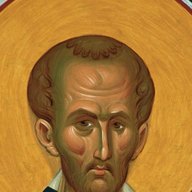
Be ye followers of me, even as I also am of Christ.
Μιμηταί μου γίνεσθε, καθὼς κἀγὼ Χριστοῦ.
St. John ChrysostomHomily 25 on 1 Corinthians · on 1 Corinthians 11:1
"Be ye imitators of me, even as I also am of Christ." This is a rule of the most perfect Christianity, this is a landmark exactly laid down, this is the point that stands highest of all; viz. the seeking those things which are for the common profit: which also Paul himself declared, by adding, "even as I also am of…
St. John ChrysostomHomily 26 on 1 Corinthians · on 1 Corinthians 11:2
Having finished therefore all the discourses concerning all these things, he next proceeds also to another accusation. And what was this? Their women used both to pray and prophesy unveiled and with their head bare, (for then women also used to prophesy;) but the men went so far as to wear long hair as having spent…
St. John ChrysostomHomily 26 on 1 Corinthians · on 1 Corinthians 11:3
"But I would have ye know, that the head of every man is Christ; and the head of every woman is the man; and the head of Christ is God." This is his account of the reason of the thing, and he states it to make the weaker more attentive. He indeed that is faithful, as he ought to be, and steadfast, doth not require any…
St. John ChrysostomHomily 26 on 1 Corinthians · on 1 Corinthians 11:4–5
Thus much in answer to the heretics: but we must also orderly go over the whole passage. For perhaps some one might here have doubt also, questioning with himself, what sort of a crime it was for the woman to be uncovered, or the man covered? What sort of crime it is, learn now from hence. Symbols many and diverse…
St. John ChrysostomHomily 26 on 1 Corinthians · on 1 Corinthians 11:6
"But if a woman is not veiled, let her also be shorn: but if it be a shame for a woman to be shorn or shaven, let her be veiled." Thus, in the beginning he simply requires that the head be not bare: but as he proceeds he intimates both the continuance of the rule, saying, "for it is one and the same thing as if she…
St. John ChrysostomHomily 26 on 1 Corinthians · on 1 Corinthians 11:7
Then he states also a cause, as one discoursing with those who are free: a thing which in many places I have remarked. What then is the cause? "For a man indeed ought not to have his head veiled, forasmuch as he is the image and glory of God." This is again another cause. "Not only," so he speaks, "because he hath…
St. John ChrysostomHomily 26 on 1 Corinthians · on 1 Corinthians 11:8–9
Then, having affirmed his point, he states again other reasons and causes also, leading thee to the first creation, and saying thus: "For the man is not of the woman, but the woman of the man." But if to be of any one, is a glory to him of whom one is, much more the being an image of him. "For neither was the man…
St. John ChrysostomHomily 26 on 1 Corinthians · on 1 Corinthians 11:10
"For this cause ought the woman to have a sign of authority on her head" "For this cause:" what cause, tell me? "For all these which have been mentioned," saith he; or rather not for these only, but also "because of the angels." "For although thou despise thine husband," saith he, "yet reverence the angels." It…
St. John ChrysostomHomily 26 on 1 Corinthians · on 1 Corinthians 11:11–12
"Nevertheless, neither is the man without the woman, nor the woman without the man, in the Lord." Thus, because he had given great superiority to the man, having said that the woman is of him and for him and under him; that he might neither lift up the men more than was due nor depress the women, see how he brings in…
St. John ChrysostomHomily 26 on 1 Corinthians · on 1 Corinthians 11:13
"Judge ye in yourselves: is it seemly that a woman pray unto God veiled?" Again he places them as judges of the things said, which also he did respecting the idol-sacrifices. For as there he saith, "judge ye what I say:" so here, "judge in yourselves:" and he hints something more awful here. For he says that the…
St. John ChrysostomHomily 26 on 1 Corinthians · on 1 Corinthians 11:14–15
"Doth not even nature itself teach you, that if a man have long hair, it is a dishonor unto him?" "But if a woman have long hair, it is a glory to her; for her hair is given her for a covering." His constant practice of stating commonly received reasons he adopts also in this place, betaking himself to the common…
St. John ChrysostomHomily 26 on 1 Corinthians · on 1 Corinthians 11:16
"But if any man seems to be contentious, we have no such custom, neither the Churches of God." It is then contentiousness to oppose these things, and not any exercise of reason. Notwithstanding, even thus it is a measured sort of rebuke which he adopts, to fill them the more with self-reproach; which in truth rendered…
St. John ChrysostomHomily 27 on 1 Corinthians · on 1 Corinthians 11:17
IT is necessary in considering the present charge to state also first the occasion of it. For thus again will our discourse be more intelligible. What then is this occasion? As in the case of the three thousand who believed in the beginning, all had eaten their meals in common and had all things common; such also was…
St. John ChrysostomHomily 27 on 1 Corinthians · on 1 Corinthians 11:18
"For first of all, when ye come together in the Church, I hear that divisions exist among you." And he saith not, "For fear that you do not sup together in common;" "for I hear that you feast in private, and not with the poor:" but what was most calculated thoroughly to shake their minds, that he set down, the name of…
St. John ChrysostomHomily 27 on 1 Corinthians · on 1 Corinthians 11:19
"For there must be also factions among you, that they which are approved may be made manifest among you." By "factions," here he means those which concern not the doctrines, but these present divisions. But even if he had spoken of the doctrinal heresies, not even thus did he give them any handle. For Christ Himself…
St. John ChrysostomHomily 27 on 1 Corinthians · on 1 Corinthians 11:20
"When ye assemble yourselves together," saith he, "it is not possible to eat the Lord's Supper." Seest thou how effectually appealing to their shame, even already by way of narrative he contrives to give them his counsel? "For the appearance of your assembly," saith he, "is different. It is one of love and brotherly…
St. John ChrysostomHomily 27 on 1 Corinthians · on 1 Corinthians 11:21
"For in your eating, each one taketh before other his own supper," saith he, "and one is hungry, and another is drunken." Perceivest thou how he intimates that they were disgracing themselves rather? For that which is the Lord's, they make a private matter: so that themselves are the first to suffer indignity,…
What? have ye not houses to eat and to drink in? or despise ye the church of God, and shame them that have not? What shall I say to you? shall I praise you in this? I praise you not.
St. John ChrysostomHomily 27 on 1 Corinthians · on 1 Corinthians 11:22
"What? have ye not houses to eat and to drink in? Or despise ye the Church of God, and put them to shame that have not?" Seest thou how he transferred the charge from the indignity offered to the poor to the Church, that his words might make a deeper impression of disgust? Here now you see is yet a fourth accusation,…
St. John ChrysostomHomily 27 on 1 Corinthians · on 1 Corinthians 11:23–24
"For I received of the Lord," saith he, "that which also I delivered unto you: how that the Lord Jesus in the night in which He was betrayed, took bread: And when He had given thanks, He brake it, and said, Take, eat: this is My Body, which is broken for you: this do in remembrance of me." Wherefore doth he here make…
After the same manner also he took the cup, when he had supped, saying, This cup is the new testament in my blood: this do ye, as oft as ye drink it, in remembrance of me.
St. John ChrysostomHomily 27 on 1 Corinthians · on 1 Corinthians 11:25
"In like manner also the cup after supper, saying, This cup is the New Covenant in My Blood: this do, as oft as ye drink of it, in remembrance of Me." What sayest thou? Art thou making a remembrance of Christ, and despisest thou the poor and tremblest not? Why, if a son or brother had died and thou wert making a…
St. John ChrysostomHomily 27 on 1 Corinthians · on 1 Corinthians 11:26
Next, having spoken concerning that Supper, he connects the things present with the things of that time, that even as on that very evening and reclining on that very couch and receiving from Christ Himself this sacrifice, so also now might men be affected; and he saith, "For as often as ye eat this bread, and drink…
St. John ChrysostomHomily 27 on 1 Corinthians · on 1 Corinthians 11:27
"Wherefore whosoever shall eat this bread and drink the cup of the Lord unworthily, shall be guilty of the Body and the Blood of the Lord." Why so? Because he poured it out, and makes the thing appear a slaughter and no longer a sacrifice. Much therefore as they who then pierced Him, pierced Him not that they might…
St. John ChrysostomHomily 28 on 1 Corinthians · on 1 Corinthians 11:28
"But let a man prove himself:" which also he saith in the second Epistle: "try your own selves, prove your own selves:" not as we do now, approaching because of the season rather than from any earnestness of mind. For we do not consider how we may approach prepared, with the ills that were within us purged out, and…
St. John ChrysostomHomily 28 on 1 Corinthians · on 1 Corinthians 11:29
"For he that eateth and drinketh unworthily, eateth and drinketh judgment to himself." What sayest thou, tell me? Is this Table which is the cause of so many blessings and teeming with life, become judgment? Not from its own nature, saith he, but from the will of him that approaches. For as His presence, which…
St. John ChrysostomHomily 28 on 1 Corinthians · on 1 Corinthians 11:30
"For this cause many among you are weak and sickly, and not a few sleep." Here he no longer brings his examples from others as he did in the case of the idol-sacrifices, relating the ancient histories and the chastisements in the wilderness, but from the Corinthians themselves; which also made the discourse apt to…
For if we would judge ourselves, we should not be judged.
εἰ γὰρ ἑαυτοὺς διεκρίνομεν, οὐκ ἂν ἐκρινόμεθα·
St. John ChrysostomHomily 28 on 1 Corinthians · on 1 Corinthians 11:31
"For if we discerned ourselves," saith he, "we should not be judged." And he said not, "if we punished ourselves, if we were revenged on ourselves," but if we were only willing to acknowledge our offence, to pass sentence on ourselves, to condemn the things done amiss, we should be rid of the punishment both in this…
St. John ChrysostomHomily 16 on 1 Corinthians · on 1 Corinthians 11:32
"Do not ye judge them that are within, whereas them that are without, God judgeth?" For since he had said, "What have I to do with judging those without;" lest any one should think that these were left unpunished, there is another tribunal which he sets over them, and that a fearful one. And this he said, both to…
St. John ChrysostomHomily 28 on 1 Corinthians · on 1 Corinthians 11:32
"But when we are judged, we are chastened of the Lord." He said not, we are punished, he said not, we have vengeance taken on us, but, "we are chastened." For what is done belongs rather to admonition than condemnation, to healing than vengeance, to correction than punishment. And not so only but by the threat of a…
St. John ChrysostomHomily 28 on 1 Corinthians · on 1 Corinthians 11:33
"Wherefore when ye come together to eat, wait one for another." Thus, while their fear was yet at its height and the terror of hell remained, he chooses again to bring in also the exhortation in behalf of the poor, on account of which he said all these things; implying that if they do not this they must partake…
St. John ChrysostomHomily 28 on 1 Corinthians · on 1 Corinthians 11:34
"And if any man is hungry, let him eat at home." By permitting, he hinders it, and more strongly than by an absolute prohibition. For he brings him out of the church and sends him to his house, hereby severely reprimanding and ridiculing them, as slaves to the belly and unable to contain themselves. For he said not,…
Every note is a real passage, quoted word for word from a published English translation, with its source. Nothing here is summarised or written by us. Some verses have many notes and some have none, because the Fathers wrote more on some passages than others.
St. John Chrysostom, Homilies on 1 Corinthians, Nicene and Post-Nicene Fathers, series 1, vol. 12 (1888–1889).
Scripture: the King James Version (1611); the Greek (tap Ελ) is the 1904 Patriarchal text of the Ecumenical Patriarchate.
All of these translations are in the public domain. The passages were matched to their verses by the Historical Christian Commentaries project, which also hosts the full texts we link to. The Fathers are a treasury of the Church's mind, and they are best read alongside the life of the Church: if a passage raises a question, bring it to your priest.