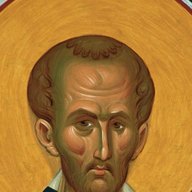
St. John ChrysostomHomily 6 on 1 Corinthians · on 1 Corinthians 2:1–2
Nothing was ever more prepared for combat than the spirit of Paul; or rather, I should say, not his spirit, (for he was not himself the inventor of these things,) but, nothing was ever equal to the grace working within him, which overcometh all things. For sufficient indeed is what had been said before to cast down…
St. John ChrysostomHomily 6 on 1 Corinthians · on 1 Corinthians 2:3
"And I was with you in weakness, and in fear, and in much trembling." This again is another topic: for not only are the believers unlearned persons; not only is he that speaketh unlearned; not only is the manner of the teaching of an unlearned cast throughout; not only was the thing preached of itself enough to…
St. John ChrysostomHomily 6 on 1 Corinthians · on 1 Corinthians 2:4
"And my speech and my preaching was not in persuasive words of wisdom:" that is, had not the wisdom from without. Now if the doctrine preached had nothing subtle, and they that were called were unlearned, and he that preached was of the same description, and thereto was added persecution, and trembling and fear; tell…
St. John ChrysostomHomily 6 on 1 Corinthians · on 1 Corinthians 2:5
"That your faith should not stand in the wisdom of men, but in the power of God." Seest thou how clearly in every way he hath set forth the vast gain of this "ignorance," and the great loss of this "wisdom?" For the latter made void the Cross, but the former proclaimed the power of God: the latter, besides their…
St. John ChrysostomHomily 7 on 1 Corinthians · on 1 Corinthians 2:6
"Howbeit we speak wisdom among the perfect:" for when I, accounted foolish and a preacher of follies, get the better of the wise, I overcome wisdom, not by foolishness but by a more perfect wisdom; a wisdom, too, so ample and so much greater, that the other appears foolishness. Wherefore having before called it by a…
St. John ChrysostomHomily 7 on 1 Corinthians · on 1 Corinthians 2:7
"But we speak God's wisdom in a mystery." What mystery? For surely Christ saith, "What ye have heard in the ear, proclaim upon the housetops." How then does he call it "a mystery?" Because that neither angel nor archangel, nor any other created power knew of it before it actually took place. Wherefore he saith, "That…
St. John ChrysostomHomily 7 on 1 Corinthians · on 1 Corinthians 2:8
"Which none of the rulers of this world knew; for had they known, they would not have crucified the Lord of Glory." Now if they knew not, how said He unto them, "Ye both know Me, and ye know whence I am?" Indeed, concerning Pilate the Scripture saith, he knew not. It is likely also that neither did Herod know. These,…
But as it is written, Eye hath not seen, nor ear heard, neither have entered into the heart of man, the things which God hath prepared for them that love him.
St. John ChrysostomHomily 7 on 1 Corinthians · on 1 Corinthians 2:9
"But as it is written, Things which eye saw not and ear heard not, and which entered not into the heart of man, whatsoever things God prepared for them that love Him." Where are these words written? Why, it is said to have been "written," then also, when it is set down, not in words, but in actual events, as in the…
St. John ChrysostomHomily 7 on 1 Corinthians · on 1 Corinthians 2:10–11
What kind of things then are these? That by what is esteemed to be the foolishness of preaching He shall overcome the world, and the nations shall be brought in, and there shall be reconciliation of God with men, and so great blessings shall come upon us! How then have we known? "Unto us," he saith, "God hath revealed…
Which things also we speak, not in the words which man’s wisdom teacheth, but which the Holy Ghost teacheth; comparing spiritual things with spiritual.
St. John ChrysostomHomily 7 on 1 Corinthians · on 1 Corinthians 2:13
But what is this, "comparing spiritual things with spiritual?" When a thing is spiritual and of dubious meaning, we adduce testimonies from the things which are spiritual. For instance, I say, Christ rose again-was born of a Virgin; I adduce testimonies and types and demonstrations; the abode of Jonah in the whale and…
But the natural man receiveth not the things of the Spirit of God: for they are foolishness unto him: neither can he know them, because they are spiritually discerned.
St. John ChrysostomHomily 7 on 1 Corinthians · on 1 Corinthians 2:14
"The natural man receiveth not the things of the Spirit." For as with these eyes no man could learn the things in the heavens; so neither the soul unaided the things of the Spirit. And why speak I of the things in heaven? It receives not even those in earth, all of them. For beholding afar off a square tower, we think…
St. John ChrysostomHomily 7 on 1 Corinthians · on 1 Corinthians 2:15–16
Next, pursuing his contrast, he states the cause of this, saying, "he knoweth not because they are spiritually discerned:" i.e. the things asserted require faith, and to apprehend them by reasonings is not possible, for their magnitude exceeds by a great deal the meanness of our understanding. Wherefore he saith, "but…
Every note is a real passage, quoted word for word from a published English translation, with its source. Nothing here is summarised or written by us. Some verses have many notes and some have none, because the Fathers wrote more on some passages than others.
St. John Chrysostom, Homilies on 1 Corinthians, Nicene and Post-Nicene Fathers, series 1, vol. 12 (1888–1889).
Scripture: the King James Version (1611); the Greek (tap Ελ) is the 1904 Patriarchal text of the Ecumenical Patriarchate.
All of these translations are in the public domain. The passages were matched to their verses by the Historical Christian Commentaries project, which also hosts the full texts we link to. The Fathers are a treasury of the Church's mind, and they are best read alongside the life of the Church: if a passage raises a question, bring it to your priest.