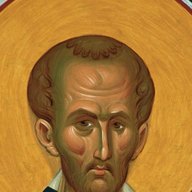
St. John ChrysostomHomily 10 on 1 Corinthians · on 1 Corinthians 4:1
"Let a man so account of us, as of ministers of Christ, and stewards of the mysteries of God." After he had cast down their spirit, mark how again he refreshes it, saying, "as ministers of Christ." Do not thou then, letting go the Master, receive a name from the servants and ministers. "Stewards;" saith he, indicating…
St. John ChrysostomHomily 10 on 1 Corinthians · on 1 Corinthians 4:2
"Moreover it is required in stewards, that a man be found faithful:" that is, that he do not appropriate to himself his master's goods, that he do not as a master lay claim for himself but administer as a steward. For a steward's part is to administer well the things committed to his charge: not to say that his…
St. John ChrysostomHomily 11 on 1 Corinthians · on 1 Corinthians 4:3
"With me it is a very small thing that I should be judged of you or of man's day." "I judge myself unworthy," saith he, "of being judged by you." And why say I, "by you?" I will add, "by any one else." Howbeit, let no one condemn Paul of arrogance; though he saith that no man is worthy to pass sentence concerning him.…
St. John ChrysostomHomily 11 on 1 Corinthians · on 1 Corinthians 4:4
Then because this saying also seemed to be that of one extolling himself greatly, this too he corrects, saying, "Yet am I not hereby justified." What then? Ought we not to judge ourselves and our own misdeeds? Yes surely: there is great need to do this when we sin. But Paul said not this, "For I know nothing," saith…
Therefore judge nothing before the time, until the Lord come, who both will bring to light the hidden things of darkness, and will make manifest the counsels of the hearts: and then shall every man have praise of God.
St. John ChrysostomHomily 11 on 1 Corinthians · on 1 Corinthians 4:5
"Therefore judge nothing before the time, until the Lord come; who will both bring to light the hidden things of darkness, and make manifest the counsels of the hearts, and then shall each man have his praise from God." What then? Is it not right that our teachers should do this? It is right in the case of open and…
And these things, brethren, I have in a figure transferred to myself and to Apollos for your sakes; that ye might learn in us not to think of men above that which is written, that no one of you be puffed up for one against another.
St. John ChrysostomHomily 12 on 1 Corinthians · on 1 Corinthians 4:6
"Now these things, brethren, I have in a figure transferred to myself and Apollos for your sakes; that in us ye might learn not to think of men above that which is written." So long as there was need of expressions as harsh as these, he refrained from drawing up the curtain, and went on arguing as if he were himself…
For who maketh thee to differ from another? and what hast thou that thou didst not receive? now if thou didst receive it, why dost thou glory, as if thou hadst not received it?
St. John ChrysostomHomily 12 on 1 Corinthians · on 1 Corinthians 4:7
"For who maketh thee to differ? For what hast thou which thou didst not receive?" From this point, dismissing the governed, he turns to the governors. What he saith comes to this: From whence is evident that thou art worthy of being praised? Why, hath any judgment taken place? any inquiry proceeded? any essay? any…
St. John ChrysostomHomily 12 on 1 Corinthians · on 1 Corinthians 4:8
"Already ye are filled, already ye are rich:" that is, ye want nothing henceforth; ye are become perfect; ye have attained the very summit; ye stand, as ye think, in need of no one, either among Apostles or teachers. "Already ye are filled." And well saith he "already;" pointing out, from the time, the incredibility…
For I think that God hath set forth us the apostles last, as it were appointed to death: for we are made a spectacle unto the world, and to angels, and to men.
St. John ChrysostomHomily 12 on 1 Corinthians · on 1 Corinthians 4:9
"For I think that God hath set forth us the Apostles last of all, as men doomed to death." There is great depth of meaning and severity implied again in his saying, "us:" and not even with this was he satisfied, but added also his dignity, hitting them vehemently: "us the Apostles;" who are enduring such innumerable…
St. John ChrysostomHomily 13 on 1 Corinthians · on 1 Corinthians 4:10
Having filled his speech with much severity which conveys a sharper blow than any direct charge and having said, "Ye have reigned without us;" and "God hath set forth us last, as men doomed to death" he shows by what comes next how they are "doomed to death;" saying, We are fools, and weak, and despised, and hunger,…
St. John ChrysostomHomily 12 on 1 Corinthians · on 1 Corinthians 4:10
"We are fools for Christ's sake, but ye are wise in Christ." Again, this also he spake in a way to abash them; implying that it is impossible for these contraries to agree, neither can things so distant from one another concur. "For how can it be," saith he, "that you should be wise, but we fools in the things…
St. John ChrysostomHomily 13 on 1 Corinthians · on 1 Corinthians 4:11
And "let no one," saith he, "think that I speak only of the past:" "Even unto this present hour we both hunger and thirst and are naked." Seest thou that all the life of Christians must be such as this; and not merely a day or two? For though the wrestler who is victorious in a single contest only, be crowned, he is…
St. John ChrysostomHomily 13 on 1 Corinthians · on 1 Corinthians 4:12
"And labor;" now against the false apostles who endure neither toil nor peril, while they themselves receive the fruits. "But not so are we," saith he: "but together with our perils from without, we also strain ourselves to the utmost with perpetual labor. And what is still more, no one can say that we fret at these…
St. John ChrysostomHomily 13 on 1 Corinthians · on 1 Corinthians 4:13
"Being reviled, we bless; being persecuted, we endure; being defamed, we entreat; we are made as the filth of the world." This is the meaning of "fools for Christ's sake." For whoso suffers wrong and avenges not himself nor is vexed, is reckoned a fool by the heathen; and dishonored and weak. And in order that he…
St. John ChrysostomHomily 13 on 1 Corinthians · on 1 Corinthians 4:14
Then since he saw that the blow could not well be borne, he speedily heals it; saying, "I write not these things to shame you, but to admonish you as my beloved children." "For not as abashing you," saith he, "do I speak these things." The very thing which by his words he had done, this he says he had not done: rather…
St. John ChrysostomHomily 13 on 1 Corinthians · on 1 Corinthians 4:15
"For though," saith he, "ye have ten thousand tutors in Christ, yet have ye not many fathers." He is not here setting forth his dignity, but the exceeding greatness of his love. Thus neither did he wound the other teachers: since he adds the clause, "in Christ:" but rather soothed them, designating not as parasites…
St. John ChrysostomHomily 13 on 1 Corinthians · on 1 Corinthians 4:16
"I beseech you, be ye imitators of me, as I also am of Christ." Astonishing! How great is our teacher's boldness of speech! How highly finished the image, when he can even exhort others hereunto! Not that in self-exaltation he doth so, but implying that virtue is an easy thing. As if he had said, "Tell me not, 'I am…
For this cause have I sent unto you Timotheus, who is my beloved son, and faithful in the Lord, who shall bring you into remembrance of my ways which be in Christ, as I teach every where in every church.
St. John ChrysostomHomily 14 on 1 Corinthians · on 1 Corinthians 4:17
Consider here also, I entreat, the noble soul, the soul more glowing and keener than fire: how he was indeed especially desirous to be present himself with the Corinthians, thus distempered and broken into parties. For he knew well what a help to the disciples his presence was and what a mischief his absence. And the…
St. John ChrysostomHomily 14 on 1 Corinthians · on 1 Corinthians 4:18
"Now some are puffed up, as though I were not coming unto you." For there he glances both at them and at certain others, casting down their highmindedness: since the love of preeminence is in fault, when men abuse the absence of their teacher for their own self-will. For when he addresses himself unto the people,…
St. John ChrysostomHomily 14 on 1 Corinthians · on 1 Corinthians 4:19
And therefore he goes on, "But I will come to you shortly, if the Lord will." Now to say this only would seem to be mere threatening. But to promise himself and demand from them the requisite proof by actions also; this was a course for a truly high spirit. Accordingly he added this too, saying, "And I will know, not…
St. John ChrysostomHomily 14 on 1 Corinthians · on 1 Corinthians 4:20
"For the kingdom of God is not in word, but in power." By signs, saith he, not by fine speaking, we have prevailed: and that our teaching is divine and really announces the Kingdom of Heaven we give the greater proof, namely, our signs which we work by the power of the Spirit. If those who are now puffed up desire to…
St. John ChrysostomHomily 14 on 1 Corinthians · on 1 Corinthians 4:21
"What will ye? Shall I come unto you with a rod, or in love and a spirit of meekness?" There is much both of terror and of gentleness in this saying. For to say, "I will know," was the language of one as yet withholding himself: but to say, "What will ye? Must I come unto you with a rod?" are the words of one…
Every note is a real passage, quoted word for word from a published English translation, with its source. Nothing here is summarised or written by us. Some verses have many notes and some have none, because the Fathers wrote more on some passages than others.
St. John Chrysostom, Homilies on 1 Corinthians, Nicene and Post-Nicene Fathers, series 1, vol. 12 (1888–1889).
Scripture: the King James Version (1611); the Greek (tap Ελ) is the 1904 Patriarchal text of the Ecumenical Patriarchate.
All of these translations are in the public domain. The passages were matched to their verses by the Historical Christian Commentaries project, which also hosts the full texts we link to. The Fathers are a treasury of the Church's mind, and they are best read alongside the life of the Church: if a passage raises a question, bring it to your priest.