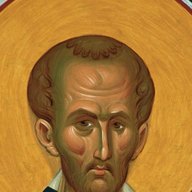
St. John ChrysostomHomily 21 on 1 Corinthians · on 1 Corinthians 9:1
"Am I not an Apostle? am I not free? have I not seen Jesus Christ our Lord? are not ye my work in the Lord?" Inasmuch as he had said, "If meat make my brother to stumble I will eat no flesh forever;" a thing which he had not yet done, but professed he would do if need require: lest any man should say, "Thou vauntest…
St. John ChrysostomHomily 21 on 1 Corinthians · on 1 Corinthians 9:2
"If to others I am not an Apostle, yet at least I am to you." Do you see how far he is from enlarging here without necessity? And yet he had the whole world to speak of, and barbarous nations, and sea and land. However, he mentions none of these things, but carries his point by concession, and even granting more than…
St. John ChrysostomHomily 21 on 1 Corinthians · on 1 Corinthians 9:3
"My defence to them that examine me is this." What is, "My defence to them that examine me is this?" "To those who seek to know whereby I am proved to be an Apostle, or who accuse me as receiving money, or inquire the cause of my not receiving, or would fain shew that I am not an Apostle: to all such, my instruction…
St. John ChrysostomHomily 21 on 1 Corinthians · on 1 Corinthians 9:4–5
"Have we no right to eat and to drink? Have we no right to lead about a wife that is a believer?" Why, how are these sayings a defence? "Because, when it appears that I abstain even from things which are allowed, it cannot be just to look suspiciously on me as a deceiver or one acting for gain." Wherefore, from what…
St. John ChrysostomHomily 21 on 1 Corinthians · on 1 Corinthians 9:6
"Or I only and Barnabas, have we not a right to forbear working?" See his humility of mind and his soul pure from envy, how he takes care not to conceal him whom he knew to be a partaker with himself in this perfection. For if the other things be common, how is not this common? Both they and we are apostles and are…
Who goeth a warfare any time at his own charges? who planteth a vineyard, and eateth not of the fruit thereof? or who feedeth a flock, and eateth not of the milk of the flock?
St. John ChrysostomHomily 21 on 1 Corinthians · on 1 Corinthians 9:7
"What soldier ever serveth at his own charges?" For since, which was the strongest point, he had proved from the Apostles that it is lawful to do so, he next comes to examples and to the common practice; as he uses to do: "What soldier serveth at his own charges?" saith he. But do thou consider, I pray, how very…
St. John ChrysostomHomily 21 on 1 Corinthians · on 1 Corinthians 9:8
Having shewn, as you see, both from the Apostles, that it is not forbidden the teacher to receive, and from illustrations found in common life, he proceeds also to a third head, thus saying, "Do I speak these things after the manner of men? or saith not the law also the same?" For since he had hitherto alleged nothing…
St. John ChrysostomHomily 21 on 1 Corinthians · on 1 Corinthians 9:9–10
"For it is written in the law of Moses, Thou shalt not muzzle the ox when he treadeth out the corn." And on what account hath he mentioned this, having the example of the priests? Wishing to establish it far beyond what the case required. Further, lest any should say, "And what have we to do with the saying about the…
Or saith he it altogether for our sakes? For our sakes, no doubt, this is written: that he that ploweth should plow in hope; and that he that thresheth in hope should be partaker of his hope.
St. John ChrysostomHomily 21 on 1 Corinthians · on 1 Corinthians 9:11
"If we sowed unto you spiritual things, is it a great matter if we shall reap your carnal things?" Lo, he adds also a fourth argument for the duty of yielding support. For since he had said, "What soldier ever serveth at his own charges?" and, "who planteth a vineyard?" and, "who feedeth a flock?" and introduced the…
If others be partakers of this power over you, are not we rather? Nevertheless we have not used this power; but suffer all things, lest we should hinder the gospel of Christ.
St. John ChrysostomHomily 21 on 1 Corinthians · on 1 Corinthians 9:12
"If others partake of this right over you, do not we yet more?" See also again another argument, and this too from examples though not of the same kind. For it is not Peter whom he mentions here nor the Apostles, but certain other spurious ones, with whom he afterwards enters into combat, and concerning whom he says,…
Do ye not know that they which minister about holy things live of the things of the temple? and they which wait at the altar are partakers with the altar?
St. John ChrysostomHomily 22 on 1 Corinthians · on 1 Corinthians 9:13–14
He takes great care to show that the receiving was not forbidden. Whereupon having said so much before, he was not content but proceeds also to the Law, furnishing an example closer to the point than the former. For it was not the same thing to bring forward the oxen and to adduce the law expressly given concerning…
St. John ChrysostomHomily 22 on 1 Corinthians · on 1 Corinthians 9:14
"Even so did the Lord ordain that they who proclaim the Gospel should live of the Gospel." Nor doth he even here say that they are supported by men, but as in the case of the priests, of "the temple" and "of the altar," so likewise here, "of the Gospel;" and as there he saith, "eat," so here, "live," not make…
But I have used none of these things: neither have I written these things, that it should be so done unto me: for it were better for me to die, than that any man should make my glorying void.
St. John ChrysostomHomily 22 on 1 Corinthians · on 1 Corinthians 9:15
"But I have used none of these things:" What then if thou hast not used them now, saith one, but intendest to use them at a future time, and on this account sayest these things. Far from it; for he speedily corrected the notion, thus saying; "And I write not these things that it may be so done in my case." And see…
St. John ChrysostomHomily 22 on 1 Corinthians · on 1 Corinthians 9:16–18
"For if I preach the Gospel, I have nothing to glory of; for necessity is laid upon me; for woe is unto me, if I preach not the Gospel! For if I do this of mine own will, I have a reward: but if not of mine own will, I have a stewardship entrusted to me. What then is my reward? That when I preach the Gospel, I may…
What is my reward then? Verily that, when I preach the gospel, I may make the gospel of Christ without charge, that I abuse not my power in the gospel.
St. John ChrysostomHomily 22 on 1 Corinthians · on 1 Corinthians 9:19
"For though I was free from all men, I brought myself under bondage to all, that I might gain the more." Here again he introduces another high step in advance. For a great thing it is even not to receive, but this which he is about to mention is much more than that. What then is it that he says? "Not only have I not…
And unto the Jews I became as a Jew, that I might gain the Jews; to them that are under the law, as under the law, that I might gain them that are under the law;
St. John ChrysostomHomily 22 on 1 Corinthians · on 1 Corinthians 9:20
"And I became," says he, "to the Jews as a Jew, that I might gain Jews." And how did this take place? When he circumcised that he might abolish circumcision. Wherefore he said not, "a Jew," but, "as a Jew," which was a wise arrangement. What sayest thou? The herald of the world and he who touched the very heavens and…
To them that are without law, as without law, (being not without law to God, but under the law to Christ,) that I might gain them that are without law.
St. John ChrysostomHomily 22 on 1 Corinthians · on 1 Corinthians 9:21
"To them that are without law, as without law." These were neither Jews, nor Christians, nor Greeks; but "outside of the Law," as was Cornelius, and if there were any others like him. For among these also making his appearance, he used to assume many of their ways. But some say that he hints at his discourse with the…
St. John ChrysostomHomily 22 on 1 Corinthians · on 1 Corinthians 9:22
"To the weak became I weak, that I might gain the weak:" in this part coming to their case, with a view to which also all these things have been spoken. However, those were much greater things, but this more to the purpose; whence also he hath placed it after them. Indeed he did the same thing likewise in his Epistle…
St. John ChrysostomHomily 22 on 1 Corinthians · on 1 Corinthians 9:23
"And I do all things for the Gospel's sake, that I may be a joint partaker thereof." "That is, that I may seem also myself to have added some contribution of mine own, and may partake of the crowns laid up for the faithful. For as he spake of "living of the Gospel," i.e, of the believers; so also here, "that I may be…
St. John ChrysostomHomily 23 on 1 Corinthians · on 1 Corinthians 9:24
Having pointed out the manifold usefulness of condescension and that this is the highest perfectness, and that he himself having risen higher than all towards perfection, or rather having gone beyond it by declining to receive, descended lower than all again; and having made known to us the times for each of these,…
St. John ChrysostomHomily 23 on 1 Corinthians · on 1 Corinthians 9:25
"And every man that striveth in the games is temperate in all things." What is, "all things?" He doth not abstain from one and err in another, but he masters entirely gluttony and lasciviousness and drunkenness and all his passions. "For this," saith he, "takes place even in the heathen games. For neither is excess of…
St. John ChrysostomHomily 23 on 1 Corinthians · on 1 Corinthians 9:26
"I therefore so run, as not uncertainly." Thus having shamed them from those that are without, he next brings forward himself also, which kind of thing is a most excellent method of teaching: and accordingly we find him every where doing so. But what is, "not uncertainly?" "Looking to some mark," saith he, "not at…
St. John ChrysostomHomily 23 on 1 Corinthians · on 1 Corinthians 9:27
"But I buffet my body, and bring it into bondage lest by any means, after that I have preached to others, I myself should be rejected." Here he implies that they are subject to the lust of the belly and give up the reins to it, and under a pretence of perfection fulfil their own greediness; a thought which before also…
Every note is a real passage, quoted word for word from a published English translation, with its source. Nothing here is summarised or written by us. Some verses have many notes and some have none, because the Fathers wrote more on some passages than others.
St. John Chrysostom, Homilies on 1 Corinthians, Nicene and Post-Nicene Fathers, series 1, vol. 12 (1888–1889).
Scripture: the King James Version (1611); the Greek (tap Ελ) is the 1904 Patriarchal text of the Ecumenical Patriarchate.
All of these translations are in the public domain. The passages were matched to their verses by the Historical Christian Commentaries project, which also hosts the full texts we link to. The Fathers are a treasury of the Church's mind, and they are best read alongside the life of the Church: if a passage raises a question, bring it to your priest.