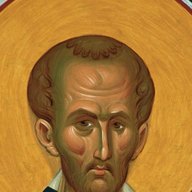
St. John ChrysostomHomily 6 on 1 Timothy · on 1 Timothy 2:1
The Priest is the common father, as it were, of all the world; it is proper therefore that he should care for all, even as God, Whom he serves. For this reason he says, "I exhort therefore that, first of all, supplications, prayers, intercessions, and giving of thanks be made for all men." From this, two advantages…
St. John ChrysostomHomily 6 on 1 Timothy · on 1 Timothy 2:2
But some one perhaps will say, he meant not for all men, but for all the faithful. How then does he speak of kings? for kings were not then worshipers of God, for there was a long succession of ungodly princes. And that he might not seem to flatter them, he says first, "for all men," then "for kings"; for if he had…
St. John ChrysostomHomily 7 on 1 Timothy · on 1 Timothy 2:2
If in order to put an end to public wars, and tumults, and battles, the Priest is exhorted to offer prayers for kings and governors, much more ought private individuals to do it. For there are three very grievous kinds of war. The one is public, when our soldiers are attacked by foreign armies: The second is, when…
St. John ChrysostomHomily 6 on 1 Timothy · on 1 Timothy 2:3
He says, "supplications, prayers, intercessions, and giving of thanks." For we must give thanks to God for the good that befalls others, as that He maketh the sun to shine upon the evil and the good, and sendeth His rain both upon the just and the unjust. Observe how he would unite and bind us together, not only by…
St. John ChrysostomHomily 6 on 1 Timothy · on 1 Timothy 2:4
And if we are commanded to pray for our neighbors, not only for the faithful, but for the unbelieving also, consider how wrong it is to pray against your brethren.
St. John ChrysostomHomily 7 on 1 Timothy · on 1 Timothy 2:4
Imitate God! if He willeth that all men should be saved, there is reason why one should pray for all, if He hath willed that all should be saved, be thou willing also; and if thou wishest it, pray for it, for wishes lead to prayers. Observe how from every quarter He urges this upon the soul, to pray for the Heathen,…
St. John ChrysostomHomily 7 on 1 Timothy · on 1 Timothy 2:5
He had before said, "to come to the knowledge of the truth," implying that the world is not in the truth. Now he says, "that there is one God," that is, not as some say, many, and that He has sent His Son as Mediator, thus giving proof that He will have all men to be saved. But is not the Son God? Most truly He is;…
St. John ChrysostomHomily 7 on 1 Timothy · on 1 Timothy 2:6
Was Christ then a ransom for the Heathen? Undoubtedly Christ died even for Heathen; and you cannot bear to pray for them. Why then, you ask, did they not believe? Because they would not: but His part was done. His suffering was a "Testimony," he says; for He came, it is meant, "to bear witness to the truth" of the…
St. John ChrysostomHomily 7 on 1 Timothy · on 1 Timothy 2:7
Since therefore Christ suffered for the Gentiles, and I was separated to be a "teacher of the Gentiles," why dost thou refuse to pray for them? He fully shows his own credibility, by saying that he was "ordained" (Acts xiii. 2), that is, separated, for this purpose, the other Apostles being backward in teaching the…
St. John ChrysostomHomily 8 on 1 Timothy · on 1 Timothy 2:8
"When thou prayest," saith Christ, "thou shalt not be as the hypocrites are; for they love to pray standing in the synagogues and in the corners of the streets, that they may be seen of men. Verily I say unto you, they have their reward. But thou, when thou prayest, enter into thy closet, and when thou hast shut thy…
St. John ChrysostomHomily 8 on 1 Timothy · on 1 Timothy 2:8
The object of Paul is to distinguish the Christian from the Jewish prayers, therefore observe what he says: "In every place lifting up holy hands," which was not permitted the Jews, for they were not allowed to approach God, to sacrifice and perform their services, elsewhere, but assembling from all parts of the world…
St. John ChrysostomHomily 8 on 1 Timothy · on 1 Timothy 2:8
What means this? Who is angry when he prays? It means, without bearing malice. Let the mind of him that prays be pure, freed from all passion. Let no one approach God in enmity, or in an unamiable temper, or with "doubting." What is "without doubting"? Let us hear. It implies that we should have no misgiving but that…
In like manner also, that women adorn themselves in modest apparel, with shamefacedness and sobriety; not with broided hair, or gold, or pearls, or costly array;
St. John ChrysostomHomily 8 on 1 Timothy · on 1 Timothy 2:9
In like manner he says, I will that women approach God without wrath and doubting, lifting up holy hands: that they should not follow their own desires, nor be covetous or rapacious. For what if a woman does not rob or steal herself, but does it through means of her husband? Paul however requires something more of…
St. John ChrysostomHomily 8 on 1 Timothy · on 1 Timothy 2:9
What? Dost thou approach God to pray, with broidered hair and ornaments of gold? Art thou come to a dance? to a marriage? to a gay procession? There such a broidery, such costly garments, had been seasonable, here not one of them is wanted. Thou art come to pray, to supplicate for pardon of thy sins, to plead for…
St. John ChrysostomHomily 8 on 1 Timothy · on 1 Timothy 2:9
Imitate not therefore the courtesans. For by such a dress they allure their many lovers; and hence many have incurred a disgraceful suspicion, and, instead of gaining any advantage from their ornaments, have injured many by bearing this character. For as the adulteress, though she may have a character for modesty,…
St. John ChrysostomHomily 8 on 1 Timothy · on 1 Timothy 2:9
But if these prohibitions are addressed to those who have husbands, who are rich, and live luxuriously; much more to those who have professed virginity. But what virgin, you say, wears gold, or broidered hair? Yet there may be such a studied nicety in a simple dress, as that these are nothing to it. You may study…
But (which becometh women professing godliness) with good works.
ἀλλ᾽ ὃ πρέπει γυναιξὶν ἐπαγγελλομέναις θεοσέβειαν, δι᾽ ἔργων ἀγαθῶν.
St. John ChrysostomHomily 8 on 1 Timothy · on 1 Timothy 2:10
Paul however requires something more of women, that they adorn themselves "in modest apparel, with shamefacedness and sobriety; not with broidered hair or gold or pearls or costly array; But (which becometh women professing godliness) with good works." But what is this "modest apparel"? Such attire as covers them…
St. John ChrysostomHomily 8 on 1 Timothy · on 1 Timothy 2:10
Thou hast Christ for thy Bridegroom, O virgin, why dost thou seek to attract human lovers? He will judge thee as an adulteress. Why dost thou not wear the ornament that is pleasing to Him; modesty, chastity, orderliness, and sober apparel? This is meretricious, and disgraceful. We can no longer distinguish harlots and…
Let the woman learn in silence with all subjection.
Γυνὴ ἐν ἡσυχίᾳ μανθανέτω ἐν πάσῃ ὑποταγῇ·
St. John ChrysostomHomily 9 on 1 Timothy · on 1 Timothy 2:11
Great modesty and great propriety does the blessed Paul require of women, and that not only with respect to their dress and appearance: he proceeds even to regulate their speech. And what says he? "Let the woman learn in silence"; that is, let her not speak at all in the church; which rule he has also given in his…
St. John ChrysostomHomily 9 on 1 Timothy · on 1 Timothy 2:12
"But I suffer not a woman to teach." "I do not suffer," he says. What place has this command here? The fittest. He was speaking of quietness, of propriety, of modesty, so having said that he wished them not to speak in the church, to cut off all occasion of conversation, he says, let them not teach, but occupy the…
St. John ChrysostomHomily 9 on 1 Timothy · on 1 Timothy 2:13
If it be asked, what has this to do with women of the present day? it shows that the male sex enjoyed the higher honor. Man was first formed; and elsewhere he shows their superiority. "Neither was the man created for the woman, but the woman for the man." Why then does he say this? He wishes the man to have the…
St. John ChrysostomHomily 9 on 1 Timothy · on 1 Timothy 2:14
But how was Adam not deceived? If he was not deceived, he did not then transgress? Attend carefully. The woman said, "The serpent beguiled me." But the man did not say, The woman deceived me, but, "she gave me of the tree, and I did eat." Now it is not the same thing to be deceived by a fellow-creature, one of the…
St. John ChrysostomHomily 9 on 1 Timothy · on 1 Timothy 2:15
Shall not women then be saved? Yes, by means of children. For it is not of Eve that he says, "If they continue in faith and charity and holiness with sobriety." What faith? what charity? what holiness with sobriety? It is as if he had said, "Ye women, be not cast down, because your sex has incurred blame. God has…
Every note is a real passage, quoted word for word from a published English translation, with its source. Nothing here is summarised or written by us. Some verses have many notes and some have none, because the Fathers wrote more on some passages than others.
St. John Chrysostom, Homilies on 1 Timothy, Nicene and Post-Nicene Fathers, series 1, vol. 13 (1888–1889).
Scripture: the King James Version (1611); the Greek (tap Ελ) is the 1904 Patriarchal text of the Ecumenical Patriarchate.
All of these translations are in the public domain. The passages were matched to their verses by the Historical Christian Commentaries project, which also hosts the full texts we link to. The Fathers are a treasury of the Church's mind, and they are best read alongside the life of the Church: if a passage raises a question, bring it to your priest.