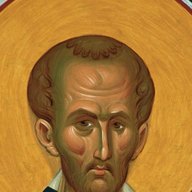
St. John ChrysostomHomily 21 on 2 Corinthians · on 2 Corinthians 10:1–2
"Now I Paul myself." Great emphasis, great weight is here. So he says elsewhere, "Behold I Paul say unto you;" and again, "As Paul the aged;" and again in another place, "Who lath been a succorer of many, and of me." So also here, "Now I Paul myself." This even is a great thing, that himself beseecheth; but that other…
St. John ChrysostomHomily 21 on 2 Corinthians · on 2 Corinthians 10:1–2
"Who in your presence am lowly among you, but being absent am of good courage toward you." What, pray, is this? Surely he speaks in irony, using their speeches. For they said this, that 'when he is present indeed, he is worthy of no account, but poor and contemptible; but when absent, swells, and brags, and sets…
St. John ChrysostomHomily 21 on 2 Corinthians · on 2 Corinthians 10:1–2
"But I beseech you, that I may hot when present show courage with the confidence, wherewith I count to be bold against some which count of us as if we walked according to the flesh." Seest thou how great his indignation, and how complete his refutation of those sayings of theirs? For he saith, 'I beseech you, do not…
But I beseech you, that I may not be bold when I am present with that confidence, wherewith I think to be bold against some, which think of us as if we walked according to the flesh.
St. John ChrysostomHomily 21 on 2 Corinthians · on 2 Corinthians 10:3
"For though we walk in the flesh, we do not war according to the flesh." Here he goes on to alarm them also by the figure he uses, 'for,' says he, 'we are indeed encompassed with flesh; I own it, but we do not live by the flesh;' or rather, he said not even this, but for the present reserves it, for it belongs to the…
St. John ChrysostomHomily 21 on 2 Corinthians · on 2 Corinthians 10:4
"For our weapons are not of the flesh." For what sort of weapons are of the flesh? Wealth, glory, power, fluency, cleverness, circumventions, flatteries, hypocrisies, whatsoever else is similar to these. But ours are not of this sort: but of what kind are they? "Mighty before God." And he said not, 'we are not…
Casting down imaginations, and every high thing that exalteth itself against the knowledge of God, and bringing into captivity every thought to the obedience of Christ;
St. John ChrysostomHomily 21 on 2 Corinthians · on 2 Corinthians 10:5
"Casting down imaginations." First giving emphasis by the figure, and then by this additional expression declaring the spiritual character of the warfare. For these strongholds besiege souls, not bodies. Whence they are stronger than the others, and therefore also the weapons they require are mightier. But by…
St. John ChrysostomHomily 21 on 2 Corinthians · on 2 Corinthians 10:5
"And bringing every thought into captivity to the obedience of Christ." And yet the name, "captivity," hath an ill sound with it; for it is the destruction of liberty. Wherefore then has he used it? With a meaning of its own, in regard to another point. For the word "captivity" conveys two ideas, the loss of liberty,…
St. John ChrysostomHomily 21 on 2 Corinthians · on 2 Corinthians 10:6
"And being in readiness to avenge all disobedience, when your obedience shall be fulfilled." Here he alarmed these also, not those alone: 'for,' says he, 'we were waiting for you, that when by our exhortations and threatenings we have reformed you, and purged and separated you from their fellowship; then, when those…
Do ye look on things after the outward appearance? If any man trust to himself that he is Christ’s, let him of himself think this again, that, as he is Christ’s, even so are we Christ’s.
St. John ChrysostomHomily 22 on 2 Corinthians · on 2 Corinthians 10:7
"Ye look at the things that are before your face." Behold here also prudence. For having rebuked those that deceived them, he confined not his remarks to them, but he leaps away from them to these too; and he does so constantly. For, in truth, he scourgeth not those only that lead astray, but the deceived also. For…
For though I should boast somewhat more of our authority, which the Lord hath given us for edification, and not for your destruction, I should not be ashamed:
St. John ChrysostomHomily 22 on 2 Corinthians · on 2 Corinthians 10:8
"For though I should glory somewhat abundantly concerning our authority which the Lord gave for building you up, and not for casting you down, I shall not be put to shame." For since he was going to say somewhat great, observe how he softens it. For nothing doth so offend the majority of hearers as for any one to…
St. John ChrysostomHomily 22 on 2 Corinthians · on 2 Corinthians 10:9–11
"But that I may not seem as if I would terrify you: for his letters, say they, are weighty and strong: but his bodily presence is weak, and his speech of no account. Let such a one reckon this, that what we are in word by letters when we are absent, such are we also in deed when we are present." What he says is this:…
For we dare not make ourselves of the number, or compare ourselves with some that commend themselves: but they measuring themselves by themselves, and comparing themselves among themselves, are not wise.
St. John ChrysostomHomily 22 on 2 Corinthians · on 2 Corinthians 10:12
"For we are not bold to number, or compare ourselves with some that commend themselves." Here he both shows that those false Apostles are boasters and say great things of themselves: and ridicules them as commending themselves. 'But we do no such thing: but even if we shall do any thing great, we refer all unto God,…
But we will not boast of things without our measure, but according to the measure of the rule which God hath distributed to us, a measure to reach even unto you.
St. John ChrysostomHomily 22 on 2 Corinthians · on 2 Corinthians 10:13
"But we will not glory beyond our measure:" as they do. For it is probable that in their boasting they said, 'we have converted the world, we have reached unto the ends of the earth,' and vented many other such like big words. 'But not so we,' he says, "But according to the measure of the province which God…
For we stretch not ourselves beyond our measure, as though we reached not unto you: for we are come as far as to you also in preaching the gospel of Christ:
St. John ChrysostomHomily 22 on 2 Corinthians · on 2 Corinthians 10:14
"For we stretch not ourselves overmuch, as though we reached not unto you: for we came even as far as unto you in preaching the Gospel of Christ." Not simply 'we came,' but, 'we announced, we preached, we persuaded, we succeeded.' For it is probable that they having merely come to the disciples of the Apostles,…
Not boasting of things without our measure, that is, of other men’s labours; but having hope, when your faith is increased, that we shall be enlarged by you according to our rule abundantly,
St. John ChrysostomHomily 22 on 2 Corinthians · on 2 Corinthians 10:15–16
"Not glorying beyond" our "measure," that is, "in other men's labors, but having hope that as your faith groweth, we shall be magnified in you according to our province unto further abundance, so as to preach the Gospel even unto the parts beyond you, and not to glory in another's province in regard of things ready to…
St. John ChrysostomHomily 22 on 2 Corinthians · on 2 Corinthians 10:18
"For not he that commendeth himself is approved, but whom the Lord commendeth." He did not say, we are so, "but whom the Lord commendeth." Seest thou how modestly he speaks? But if as he proceeds he stirreth up loftier words, wonder not, for this also cometh of Paul's prudence. For if he had gone on in every part to…
Every note is a real passage, quoted word for word from a published English translation, with its source. Nothing here is summarised or written by us. Some verses have many notes and some have none, because the Fathers wrote more on some passages than others.
St. John Chrysostom, Homilies on 2 Corinthians, Nicene and Post-Nicene Fathers, series 1, vol. 12 (1888–1889).
Scripture: the King James Version (1611); the Greek (tap Ελ) is the 1904 Patriarchal text of the Ecumenical Patriarchate.
All of these translations are in the public domain. The passages were matched to their verses by the Historical Christian Commentaries project, which also hosts the full texts we link to. The Fathers are a treasury of the Church's mind, and they are best read alongside the life of the Church: if a passage raises a question, bring it to your priest.