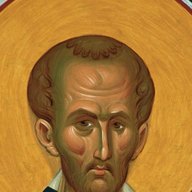
St. John ChrysostomHomily 4 on 2 Corinthians · on 2 Corinthians 2:1
"But I determined for myself that I would not come again to you with sorrow." The expression "again" proves that he had already been made sorry from thence, and whilst he seems to be speaking in his own defence he covertly rebukes them. Now if they had both already made him sorry and were about again to make him…
St. John ChrysostomHomily 4 on 2 Corinthians · on 2 Corinthians 2:2
"For if I make you sorry, who then is he that maketh me glad, but he that is made sorry by me?" What is this consequence? A very just one indeed. For observe, I would not, he saith, come unto you, lest I should increase your sorrow, rebuking, showing anger and disgust. Then seeing that even this was strong and implied…
And I wrote this same unto you, lest, when I came, I should have sorrow from them of whom I ought to rejoice; having confidence in you all, that my joy is the joy of you all.
St. John ChrysostomHomily 4 on 2 Corinthians · on 2 Corinthians 2:3
"And I wrote this very thing unto you." What? That for this cause I came not, to spare you. When wrote he? In the former Epistle when he said, "I do not wish to see you now by the way?" I think not; but in this Epistle when he said, "Lest when I come again, my God should humble me before you." I have written then…
For out of much affliction and anguish of heart I wrote unto you with many tears; not that ye should be grieved, but that ye might know the love which I have more abundantly unto you.
St. John ChrysostomHomily 4 on 2 Corinthians · on 2 Corinthians 2:4
"For out of much affliction and anguish of heart I wrote unto you with many tears, not that ye should be made sorry, but that ye might know the love which I have more abundantly unto you." What more tenderly affectioned than this man's spirit is? for he showeth himself to have been not less pained than they who had…
St. John ChrysostomHomily 4 on 2 Corinthians · on 2 Corinthians 2:5–6
"But if any hath caused sorrow, he hath caused sorrow not to me, but in part (that I press not too heavily) to you all." Having first praised them as feeling joy and sorrow for the same things as himself, he then strikes into the subject of this person, having said first, "my joy is the joy of you all." But if my joy…
St. John ChrysostomHomily 4 on 2 Corinthians · on 2 Corinthians 2:7
"So that contrariwise ye should rather forgive him and comfort him, lest by any means such a one should be swallowed up with his overmuch sorrow." He bids them not only take off the censure: but, besides, restores him to his former estate; for if one let go him that hath been scourged and heal him not, he hath done…
Wherefore I beseech you that ye would confirm your love toward him.
διὸ παρακαλῶ ὑμᾶς κυρῶσαι εἰς αὐτὸν ἀγάπην.
St. John ChrysostomHomily 4 on 2 Corinthians · on 2 Corinthians 2:8
"Wherefore I beseech you to confirm your love toward him." He no longer commands but beseeches, not as a teacher but as an equal; and having seated them on the judgment seat he placed himself in the rank of an advocate; for having succeeded in his object, for joy he adopts without restraint the tone of supplication.…
St. John ChrysostomHomily 4 on 2 Corinthians · on 2 Corinthians 2:9–10
"For to this end also did I write to you, that I might know the proof of you, whether ye are obedient in all things." I not only in cutting off but also in reuniting. Seest thou how here again he brings the danger to their doors. For as when he sinned, he alarmed their minds, except they should cut him off, saying, "A…
St. John ChrysostomHomily 4 on 2 Corinthians · on 2 Corinthians 2:11
"That no advantage may be gained over us by Satan: for we are not ignorant of his devices." Seest thou how he both committeth the power to them and again taketh away that by that he may soften them, by this eradicate their self will. But this is not all that he provides for by this, but shows also that should they be…
St. John ChrysostomHomily 5 on 2 Corinthians · on 2 Corinthians 2:12–13
These words seem on the one hand to be unworthy of Paul, if because of a brother's absence he threw away so great an opportunity of saving; and on the other, to hang apart from the context. What then? Will ye that we should first prove that they hang upon the context, or, that he hath said nothing unworthy of himself?…
St. John ChrysostomHomily 5 on 2 Corinthians · on 2 Corinthians 2:12–13
He doth not say that the absence of Titus impeded the salvation of those who were about to come over, nor yet that he neglected those that believed on this account, but that he had no relief, that is, 'I was afflicted, I was distressed for the absence of my brother;' showing how great a matter a brother's absence is;…
St. John ChrysostomHomily 5 on 2 Corinthians · on 2 Corinthians 2:13
"Taking my leave of them, I went from thence." That is, 'I spent no longer time, being straitened and distressed.' And perhaps the work was even impeded by his absence. And this was no light consolation to them too. For if when a door was opened there, and for this purpose he had come; yet because he found not the…
St. John ChrysostomHomily 5 on 2 Corinthians · on 2 Corinthians 2:14
"But thanks be to God, which always causeth us to triumph in Christ, and maketh manifest through us the savor of His knowledge in every place." For that he may not seem as though in sorrow to be lamenting these things, he sendeth up thanks to God. Now what he saith is this: 'Every where is trouble, every where…
St. John ChrysostomHomily 5 on 2 Corinthians · on 2 Corinthians 2:14
For which cause also he said, "Now thanks be unto God, Which always causeth us to triumph," that is, 'Who maketh us renowned unto all. For what seemeth to be matter of disgrace, being persecuted from every quarter, this appeareth to us to be matter of very great honor.' Wherefore he said not, "Which maketh us seen of…
St. John ChrysostomHomily 5 on 2 Corinthians · on 2 Corinthians 2:14
"And which maketh manifest through us the savor of His knowledge in every place." He said above, "Which always causeth us to triumph." Here he saith "in every place," showing that every place and every time is full of the Apostles' labors. And he uses yet another metaphor, that of the sweet savor. For 'like as those…
St. John ChrysostomHomily 5 on 2 Corinthians · on 2 Corinthians 2:14
Now he said this, at once both to set forth the power of the Preaching, in that by the very designs formed against them, they shine more than those who prosecute them and who cause the whole world to know both their trophies and their sweet savor: and to exhort them in regard to their afflictions and trials to bear…
St. John ChrysostomHomily 5 on 2 Corinthians · on 2 Corinthians 2:15
"For we are a sweet savor of Christ unto God, in them that are saved and in them that perish." Whether, saith he, one be saved or be lost, the Gospel continues to have its proper virtue: and as the light, although it blindeth the weakly, is still light, though causing blindness; and as honey, though it be bitter to…
St. John ChrysostomHomily 5 on 2 Corinthians · on 2 Corinthians 2:15
Since both the sun, for this reason most especially that he is exceeding bright, doth wound the eyes of the weak: and the Saviour is "for the fall and rising again of many," but still He continueth to be a Saviour, though ten thousand fall; and His coming brought a sorer punishment upon them that believe not, but…
St. John ChrysostomHomily 5 on 2 Corinthians · on 2 Corinthians 2:15
The expression also, "sweet savor of Christ," appears to me to admit of a double interpretation: for he means either that in dying they offered themselves a sacrifice: or that they were a sweet savor of the death of Christ, as if one should say, this incense is a sweet savor of this victim. The expression then, sweet…
St. John ChrysostomHomily 5 on 2 Corinthians · on 2 Corinthians 2:16
Seest thou to what a height he hath advanced the trials, terming them a triumph and a sweet savor and a sacrifice offered unto God. Then, whereas he said, "we are a sweet savor, even in them that perish," lest thou shouldest think that these too are acceptable, he added, "To the one a savor from death unto death, to…
St. John ChrysostomHomily 5 on 2 Corinthians · on 2 Corinthians 2:16
"And who is sufficient for these things?" Seeing he had uttered great things, that 'we are a sacrifice of Christ and a sweet savor, and are every where made to triumph,' he again useth moderation, referring all to God. Whence also he saith, "and who is sufficient for these things?" 'for all,' saith he, 'is Christ's,…
St. John ChrysostomHomily 5 on 2 Corinthians · on 2 Corinthians 2:17
"For we are not as the rest, which corrupt the word of God." 'For even if we use great sounding words, yet we declared nothing to be our own that we achieved, but all Christ's. For we will not imitate the false apostles; the men who say that most is of themselves.' For this is "to corrupt," when one adulterates the…
St. John ChrysostomHomily 5 on 2 Corinthians · on 2 Corinthians 2:17
Whence he added, "But as of sincerity, but as of God, in the sight of God speak we in Christ." 'We do not,' saith he 'beguile you and so preach, as conferring a gift on you, or as bringing in and mingling somewhat from ourselves, "but as of God;" that is, we do not say that we confer any thing of our own, but that God…
St. John ChrysostomHomily 5 on 2 Corinthians · on 2 Corinthians 2:17
Whence he elsewhere also turns them into ridicule, saying, "For what hast thou that thou didst not receive? but if thou didst receive it, why dost thou glory as if thou hadst not received it." This is the highest virtue, to refer every thing to God, to consider nothing to be our own, to do nothing out of regard to…
Every note is a real passage, quoted word for word from a published English translation, with its source. Nothing here is summarised or written by us. Some verses have many notes and some have none, because the Fathers wrote more on some passages than others.
St. John Chrysostom, Homilies on 2 Corinthians, Nicene and Post-Nicene Fathers, series 1, vol. 12 (1888–1889).
Scripture: the King James Version (1611); the Greek (tap Ελ) is the 1904 Patriarchal text of the Ecumenical Patriarchate.
All of these translations are in the public domain. The passages were matched to their verses by the Historical Christian Commentaries project, which also hosts the full texts we link to. The Fathers are a treasury of the Church's mind, and they are best read alongside the life of the Church: if a passage raises a question, bring it to your priest.