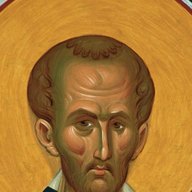
Having therefore these promises, dearly beloved, let us cleanse ourselves from all filthiness of the flesh and spirit, perfecting holiness in the fear of God.
St. John ChrysostomHomily 13 on 2 Corinthians · on 2 Corinthians 7:1
"Having therefore these promises, beloved." What promises? That we should be temples of God, sons and daughters, have Him indwelling, and walking in us, be His people, have Him for our God and Father. "Let us cleanse ourselves from all defilement of flesh and spirit." Let us neither touch unclean things, for this is…
St. John ChrysostomHomily 14 on 2 Corinthians · on 2 Corinthians 7:2
Again he raiseth the discourse about love, mitigating the harshness of his rebuke. For since he had convicted and reproached them as being beloved indeed, yet not loving in an equal degree, but breaking away from his love and mixing up with other pestilent fellows; again he softens the vehemence of his rebuke, saying,…
St. John ChrysostomHomily 14 on 2 Corinthians · on 2 Corinthians 7:3
"I say it not to condemn you." How is this evident? "For I have said before," he adds, "that ye are in our hearts to die and live with you." This is the greatest affection, when even though treated with contempt, he chooseth both to die and live with them. 'For neither are ye merely in our hearts,' he says, 'but in…
St. John ChrysostomHomily 14 on 2 Corinthians · on 2 Corinthians 7:4
"Great is my boldness of speech towards you." 'Therefore I venture upon such things,' he says, 'not to condemn you by what I say, but out of my great boldness of speech,' which also farther signifying, he said, "Great is my glorying on your behalf." 'For think not indeed,' he saith, 'that because I thus speak, I speak…
St. John ChrysostomHomily 14 on 2 Corinthians · on 2 Corinthians 7:5
"For even when we were come into Macedonia, our flesh had no relief." For since he said, "our tribulation;" he both explains of what sort it was, and magnifies it by his words, in order to show that the consolation and joys received from them was great, seeing it had repelled so great a sorrow. "But we were afflicted…
St. John ChrysostomHomily 14 on 2 Corinthians · on 2 Corinthians 7:6
"Nevertheless He that comforteth the lowly comforted us by the coming of Titus." For since he had testified great things of them in what he said, that he may not seem to be flattering them he cites as witness Titus the brother, who had come from them to Paul after the first Epistle to declare unto him the particulars…
And not by his coming only, but by the consolation wherewith he was comforted in you, when he told us your earnest desire, your mourning, your fervent mind toward me; so that I rejoiced the more.
St. John ChrysostomHomily 14 on 2 Corinthians · on 2 Corinthians 7:7
"While he told us your longing, your mourning, your zeal for me." 'These things made him glad,' he says, 'these things comforted him.' Seest thou how he shows that he also is an earnest lover of theirs, seeing he considers their good report as a consolation to himself; and when he was come, gloried, as though on…
For though I made you sorry with a letter, I do not repent, though I did repent: for I perceive that the same epistle hath made you sorry, though it were but for a season.
St. John ChrysostomHomily 15 on 2 Corinthians · on 2 Corinthians 7:8
He goes on to apologize for his Epistle, when, (the sin having been corrected,) to treat them tenderly was unattended with danger; and he shows the advantage of the thing. For he did this indeed even before, when he said, "For out of much affliction and anguish of heart, I wrote unto you: not that ye should be made…
St. John ChrysostomHomily 15 on 2 Corinthians · on 2 Corinthians 7:8–9
Having said, "I do not regret," he tells the reason also; alleging the good that resulted from his letter; and skillfully excusing himself by saying, "though but for a season." For truly that which was painful was brief, but that which was profitable was perpetual. And what indeed followed naturally was to say, 'even…
Now I rejoice, not that ye were made sorry, but that ye sorrowed to repentance: for ye were made sorry after a godly manner, that ye might receive damage by us in nothing.
St. John ChrysostomHomily 15 on 2 Corinthians · on 2 Corinthians 7:9
Seest thou wisdom unspeakable? 'For had we not done this,' he says, 'we had done you damage.' And he affirms that indeed which was well achieved to be theirs, but the damage his own, if indeed he had been silent. For if they are likely to be corrected by a sharp rebuke, then, if we did not sharply rebuke, we should…
St. John ChrysostomHomily 15 on 2 Corinthians · on 2 Corinthians 7:10
'Therefore.' he says, 'though I did regret before I saw the fruit and the gain, how great they were I do not regret now.' For such a thing is godly sorrow. And then he philosophizeth about it, showing that sorrow is not in all cases a grievous thing, but when it is worldly. And what is worldly? If thou be in sorrow…
For behold this selfsame thing, that ye sorrowed after a godly sort, what carefulness it wrought in you, yea, what clearing of yourselves, yea, what indignation, yea, what fear, yea, what vehement desire, yea, what zeal, yea, what revenge! In all things ye have approved yourselves to be clear in this matter.
St. John ChrysostomHomily 15 on 2 Corinthians · on 2 Corinthians 7:11
"For behold," he saith, "this self-same thing, that ye were made sorry after a godly sort, what earnest care it wrought in you." 'For not only,' he saith, 'did your sorrow not cast you into that condemning of yourselves, as having acted idly in so doing; but it made you even more careful.' Then he speaks of the…
Wherefore, though I wrote unto you, I did it not for his cause that had done the wrong, nor for his cause that suffered wrong, but that our care for you in the sight of God might appear unto you.
St. John ChrysostomHomily 15 on 2 Corinthians · on 2 Corinthians 7:12
For that they might not say, Why then dost thou rebuke us if we were "clear in the matter?" setting himself to meet this even further above, and disposing of it beforehand, he said what he said, namely, "I do not regret, though I did regret." 'For so far,' says he, 'am I from repenting now of what I wrote then, that I…
St. John ChrysostomHomily 15 on 2 Corinthians · on 2 Corinthians 7:13
"Therefore we have been comforted." Since we both showed our care for you and have been wholly successful. As he said also in another place, "Now we live, if ye stand fast in the Lord;" and again, "For what is our hope, or joy, or crown of rejoicing? are not even ye?" For this is life, this comfort, this consolation…
St. John ChrysostomHomily 16 on 2 Corinthians · on 2 Corinthians 7:13
See again how he exalts their praises, and showeth their love. For having said, 'I was pleased that my Epistle wrought so much and that ye gained so much,' for "I rejoice," he saith, "not that ye were made sorry, but that ye were made sorry unto repentance;" and having shown his own love, for he saith, "Though I wrote…
For if I have boasted any thing to him of you, I am not ashamed; but as we spake all things to you in truth, even so our boasting, which I made before Titus, is found a truth.
St. John ChrysostomHomily 16 on 2 Corinthians · on 2 Corinthians 7:14
"For if in anything I have gloried to him on your behalf." It is high praise when the teacher boasted, for he saith, "I was not put to shame." I therefore rejoiced, because ye showed yourselves to be amended and proved my words by your deeds. So that the honor accruing to me was twofold; first, in that ye had made…
St. John ChrysostomHomily 16 on 2 Corinthians · on 2 Corinthians 7:15
"And his inward affection is more abundant toward you." What follows is in commendation of him, as exceedingly consumed with love and attached to them. And he said not 'his love.' Then that he may not appear to be flattering, he everywhere mentions the causes of his affection; in order that he may, as I said, both…
I rejoice therefore that I have confidence in you in all things.
χαίρω ὅτι ἐν παντὶ θαρρῶ ἐν ὑμῖν.
St. John ChrysostomHomily 16 on 2 Corinthians · on 2 Corinthians 7:16
"I rejoice therefore, that in every thing I am of good courage concerning you." Seest thou that he rejoiceth more on their account; 'because,' he saith, 'ye have in no particular shamed your teacher, nor show yourselves unworthy of my testimony.' So that he joyed not so much for Titus' sake, that he enjoyed so great…
Every note is a real passage, quoted word for word from a published English translation, with its source. Nothing here is summarised or written by us. Some verses have many notes and some have none, because the Fathers wrote more on some passages than others.
St. John Chrysostom, Homilies on 2 Corinthians, Nicene and Post-Nicene Fathers, series 1, vol. 12 (1888–1889).
Scripture: the King James Version (1611); the Greek (tap Ελ) is the 1904 Patriarchal text of the Ecumenical Patriarchate.
All of these translations are in the public domain. The passages were matched to their verses by the Historical Christian Commentaries project, which also hosts the full texts we link to. The Fathers are a treasury of the Church's mind, and they are best read alongside the life of the Church: if a passage raises a question, bring it to your priest.