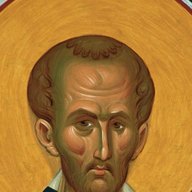
St. John ChrysostomHomily 4 on 2 Thessalonians · on 2 Thessalonians 3:1
"Finally, brethren, pray for us, that the word of the Lord may run and be glorified, even as also it is with you." He indeed had prayed for them, that they might be stablished; and now he asks of them, entreating them to pray for him, not that he may not incur danger, for to this he was appointed, but that "the word…
St. John ChrysostomHomily 4 on 2 Thessalonians · on 2 Thessalonians 3:2
"And that we may be delivered from unreasonable and evil men; for all have not faith." This is the manner of one showing also his dangers as to which especially he besought them. "From unreasonable and evil men," he says, "for all have not faith." Thus he is speaking of those who contradict the Preaching, who oppose…
St. John ChrysostomHomily 5 on 2 Thessalonians · on 2 Thessalonians 3:3–4
"But the Lord is faithful, who shall stablish you, and guard you from the evil one. And we have confidence in the Lord touching you that ye both do and will do the things which we command you." Neither ought we, having committed everything to the prayers of the Saints, to be idle ourselves, and run into wickedness,…
St. John ChrysostomHomily 5 on 2 Thessalonians · on 2 Thessalonians 3:5
"But the Lord," he says, "direct your hearts into the love of God, and the patience of Christ." Again he commends them, and prays, showing his concern for them. For when he is about to enter upon reproof, he previously smooths down their minds, by saying, "I am confident that ye will hear," and by requesting prayers…
Now we command you, brethren, in the name of our Lord Jesus Christ, that ye withdraw yourselves from every brother that walketh disorderly, and not after the tradition which he received of us.
St. John ChrysostomHomily 5 on 2 Thessalonians · on 2 Thessalonians 3:6
"Now we command you, brethren, in the name of our Lord Jesus Christ, that ye withdraw yourselves from every brother that walketh disorderly and not after the tradition which they received of us." That is, it is not we that say these things, but Christ, for that is the meaning of "in the name of our Lord Jesus Christ";…
St. John ChrysostomHomily 5 on 2 Thessalonians · on 2 Thessalonians 3:7
Great is the confidence of the Teacher, when from his own good actions he is entitled to reprove his disciples. Wherefore also Paul said, "For yourselves know how ye ought to imitate us." And he ought to be a Teacher more of life than of the word. And let no one think that this is said from a spirit of boasting. For…
St. John ChrysostomHomily 5 on 2 Thessalonians · on 2 Thessalonians 3:7–8
"For yourselves know how ye ought to imitate us: for we behaved not ourselves disorderly among you; neither did we eat bread for nought at any man's hand." And yet even if they had eaten, it would not have been for nought. "For the laborer," he says, "is worthy of his hire." (Luke x. 7.) "But in labor and travail,…
St. John ChrysostomHomily 5 on 2 Thessalonians · on 2 Thessalonians 3:10
"For even when we were with you, this we commanded you, If any will not work, neither let him eat." See how in the former Epistle indeed he discourses somewhat more mildly concerning these things; as when he says, "We beseech you, brethren,-that ye would abound more and more-and that ye study"-and nowhere does he say,…
St. John ChrysostomHomily 5 on 2 Thessalonians · on 2 Thessalonians 3:11–12
"For we hear of some that walk among you disorderly, that work not at all, but are busybodies." This indeed he says here; but there, in the first Epistle, he says, "that ye may walk honestly towards them that are without." On what account? Perhaps there was as yet no such thing. For upon another occasion also…
St. John ChrysostomHomily 5 on 2 Thessalonians · on 2 Thessalonians 3:13
"But ye, brethren, be not weary in well doing." See how immediately the fatherly heart was overcome. He was not able to carry out his reproof farther, but again pitied them. And see with what discretion! He has not said, But pardon them, until they are amended; but what? "But ye, be not weary in well doing." Withdraw…
St. John ChrysostomHomily 5 on 2 Thessalonians · on 2 Thessalonians 3:14
"And if any man obeyeth not our word by this Epistle." He has not said, He that disobeys, disobeys me, but "note that man." This is no slight chastisement. "Have no company with him." Then again he says, "that he may be ashamed." And he does not permit them to proceed farther. For as he had said, "if any does not work…
St. John ChrysostomHomily 5 on 2 Thessalonians · on 2 Thessalonians 3:15
"Yet count him not as an enemy, but admonish him as a brother." By this he shows that he has assigned a heavy punishment against him, in depriving him of freedom of conversation. For if to be a receiver even with many others is worthy of disgrace, when they even reprove whilst they offer it, and withdraw themselves,…
St. John ChrysostomHomily 5 on 2 Thessalonians · on 2 Thessalonians 3:16
"Now the Lord of peace Himself give you peace at all times in all ways." See how, when he mentions the things that are to be done, he sets his mark upon them by prayer, adding prayer and supplication, like certain marks set upon things that are laid up. "Give you peace," he says, "at all times, in all ways." For since…
St. John ChrysostomHomily 1 on 2 Thessalonians · on 2 Thessalonians 3:17–18
Whence then shall we know them, he says? For this very reason, he added, "The salutation of me Paul with mine own hand, which is the token in every Epistle: so I write. The grace of our Lord Jesus Christ be with you all." He does not here mean, that this is the token,-for it is probable that others also imitated…
St. John ChrysostomHomily 5 on 2 Thessalonians · on 2 Thessalonians 3:17–18
"The salutation of me Paul with mine own hand, which is the token in every Epistle: so I write. The grace of our Lord Jesus Christ be with you all." This he says that he writes in every Epistle, that no one may be able to counterfeit them, his subscription being subjoined as a great token. And he calls the prayer a…
Every note is a real passage, quoted word for word from a published English translation, with its source. Nothing here is summarised or written by us. Some verses have many notes and some have none, because the Fathers wrote more on some passages than others.
St. John Chrysostom, Homilies on 2 Thessalonians, Nicene and Post-Nicene Fathers, series 1, vol. 13 (1888–1889).
Scripture: the King James Version (1611); the Greek (tap Ελ) is the 1904 Patriarchal text of the Ecumenical Patriarchate.
All of these translations are in the public domain. The passages were matched to their verses by the Historical Christian Commentaries project, which also hosts the full texts we link to. The Fathers are a treasury of the Church's mind, and they are best read alongside the life of the Church: if a passage raises a question, bring it to your priest.