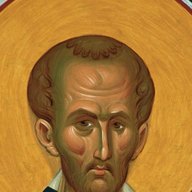
St. John ChrysostomHomily 1 on 2 Timothy · on 2 Timothy 1:1–2
What is the reason of his writing this second Epistle to Timothy? He had said, "I hope to come unto thee shortly" (1 Tim. iii. 14), and as this had not taken place, instead of coming to him, he consoles him by a letter, when he was grieving perhaps for his absence, and oppressed by the cares of the government, which…
St. John ChrysostomHomily 1 on 2 Timothy · on 2 Timothy 1:2
"To Timothy, my dearly beloved son." Not merely his "son," but, "dearly beloved"; since it is possible for sons not to be beloved. Not such, he means, art thou; I call thee not merely a son, but a "dearly beloved son." As he calls the Galatians his children, but at the same time complains of them; "My little…
St. John ChrysostomHomily 1 on 2 Timothy · on 2 Timothy 1:3–4
"I thank God, whom I serve from my forefathers with pure conscience, that without ceasing I have remembrance of thee in my prayers night and day; greatly desiring to see thee, being mindful of thy tears, that I might be filled with joy." "'I thank God,' he says, 'that I remember thee,' so much do I love thee." This is…
When I call to remembrance the unfeigned faith that is in thee, which dwelt first in thy grandmother Lois, and thy mother Eunice; and I am persuaded that in thee also.
St. John ChrysostomHomily 1 on 2 Timothy · on 2 Timothy 1:5
"When I call to remembrance the unfeigned faith that is in thee." This is another commendation, that Timothy came not of Gentiles, nor of unbelievers, but of a family that served Christ from the first. (Acts xvi. 1, Acts xvi. 3.) "Which dwelt first in thy grandmother Lois, and thy mother Eunice." For Timothy, it says,…
St. John ChrysostomHomily 1 on 2 Timothy · on 2 Timothy 1:6
"Wherefore I put thee in remembrance that thou stir up the gift of God, which is in thee by the putting on of my hands." You see how greatly dispirited and dejected he considers him to be. He almost says, "Think not that I despise thee, but be assured that I do not condemn thee, nor have I forgotten thee. Consider, at…
St. John ChrysostomHomily 1 on 2 Timothy · on 2 Timothy 1:7
"For God hath not given us the spirit of fear, but of power, and of love, and of a sound mind." That is, we did not receive the Spirit, that we should shrink from exertion, but that we may speak with boldness. For to many He gives a spirit of fear, as we read in the wars of the Kings. "A spirit of fear fell upon…
Be not thou therefore ashamed of the testimony of our Lord, nor of me his prisoner: but be thou partaker of the afflictions of the gospel according to the power of God;
St. John ChrysostomHomily 2 on 2 Timothy · on 2 Timothy 1:8
There is nothing worse than that man should measure and judge of divine things by human reasonings. For thus he will fall from that rock a vast distance, and be deprived of the light. For if he who wishes with human eyes to apprehend the rays of the sun will not only not apprehend them, but, besides this failure, will…
Who hath saved us, and called us with an holy calling, not according to our works, but according to his own purpose and grace, which was given us in Christ Jesus before the world began,
St. John ChrysostomHomily 2 on 2 Timothy · on 2 Timothy 1:9
"According to the power of God; Who hath saved us, and called us with a holy calling, not according to our works, but according to His own purpose and grace, which was given us in Christ Jesus before the world began." More especially because it was a hard thing to say, "Be partakers of afflictions," he again consoles…
But is now made manifest by the appearing of our Saviour Jesus Christ, who hath abolished death, and hath brought life and immortality to light through the gospel:
St. John ChrysostomHomily 2 on 2 Timothy · on 2 Timothy 1:10
"But is now made manifest by the appearing of our Saviour Jesus Christ, Who hath abolished death, and hath brought life and immortality to light by the Gospel." Thou seest the power, thou seest the gift bestowed not by works, but through the Gospel. These are objects of hope: for both were wrought in His Body. And how…
St. John ChrysostomHomily 2 on 2 Timothy · on 2 Timothy 1:11
"Whereunto I am appointed a preacher and an Apostle, and a teacher of the Gentiles." Why does he so constantly repeat this, and call himself a teacher of the Gentiles? Because he wishes to persuade them that they also ought to draw close to the Gentiles. Be not therefore dismayed at my sufferings. The sinews of death…
For the which cause I also suffer these things: nevertheless I am not ashamed: for I know whom I have believed, and am persuaded that he is able to keep that which I have committed unto him against that day.
St. John ChrysostomHomily 2 on 2 Timothy · on 2 Timothy 1:12
"For the which cause I also suffer these things, nevertheless I am not ashamed. For I know Whom I have believed, and am persuaded that He is able to keep that which I have committed unto Him against that day." "I am not ashamed," he says. For are chains, are sufferings, a matter for shame? Be not then ashamed! Thou…
St. John ChrysostomHomily 3 on 2 Timothy · on 2 Timothy 1:13
Not by letters alone did Paul instruct his disciple in his duty, but before by words also which he shows, both in many other passages, as where he says, "whether by word or our Epistle" (2 Thess. ii. 15.), and especially here. Let us not therefore suppose that anything relating to doctrine was spoken imperfectly. For…
St. John ChrysostomHomily 3 on 2 Timothy · on 2 Timothy 1:14
"That good thing which was committed unto thee keep,"-how?-"by the Holy Ghost which dwelleth in us." For it is not in the power of a human soul, when instructed with things so great, to be sufficient for the keeping of them. And why? Because there are many robbers, and thick darkness, and the devil still at hand to…
St. John ChrysostomHomily 3 on 2 Timothy · on 2 Timothy 1:15
Then he describes his trials and temptations, not to depress his disciple, but to elevate him, that if he should ever fall into the same, he may not think it strange, when he looks back and remembers what things happened to his Teacher. What then says he? Since it was probable that Timothy might be apprehended, and be…
St. John ChrysostomHomily 3 on 2 Timothy · on 2 Timothy 1:16–18
"The Lord give mercy to the house of Onesiphorus, for he oft refreshed me, and was not ashamed of my chain. But, when he was in Rome, he sought me out diligently and found me." Observe how he everywhere speaks of the shame, and not of the danger, lest Timothy should be alarmed. And yet it was a thing that was full of…
The Lord grant unto him that he may find mercy of the Lord in that day: and in how many things he ministered unto me at Ephesus, thou knowest very well.
Every note is a real passage, quoted word for word from a published English translation, with its source. Nothing here is summarised or written by us. Some verses have many notes and some have none, because the Fathers wrote more on some passages than others.
St. John Chrysostom, Homilies on 2 Timothy, Nicene and Post-Nicene Fathers, series 1, vol. 13 (1888–1889).
Scripture: the King James Version (1611); the Greek (tap Ελ) is the 1904 Patriarchal text of the Ecumenical Patriarchate.
All of these translations are in the public domain. The passages were matched to their verses by the Historical Christian Commentaries project, which also hosts the full texts we link to. The Fathers are a treasury of the Church's mind, and they are best read alongside the life of the Church: if a passage raises a question, bring it to your priest.