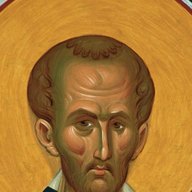
St. John ChrysostomHomily 48 on Acts · on Acts 23:1
"And Paul, earnestly beholding the council, said, Men and brethren, I have lived in all good conscience before God until this day." It shows his boldness, and how it awed them. What he means is this: I am not conscious to myself of having wronged you at all, or of having done anything worthy of these bonds.
St. John ChrysostomHomily 48 on Acts · on Acts 23:2–3
"And the high priest Ananias commanded them that stood by him to smite him on the mouth. Then said Paul unto him, God shall smite thee, thou whited wall: for sittest thou to judge me after the law, and commandest me to be smitten contrary to the law?" What hardihood, what shamelessness! Therefore Paul set him down…
St. John ChrysostomHomily 48 on Acts · on Acts 23:2–3
They are the words of boldness, rather than of anger; he did not choose to appear in a contemptible light to the tribune. For suppose the tribune himself had spared to scourge him, only as he was about to be delivered up to the Jews, his being beaten by their servants would have more emboldened him: this is why Paul…
Then said Paul unto him, God shall smite thee, thou whited wall: for sittest thou to judge me after the law, and commandest me to be smitten contrary to the law?
τότε ὁ Παῦλος πρὸς αὐτὸν εἶπε· τύπτειν σε μέλλει ὁ Θεός, τοῖχε κεκονιαμένε· καὶ σὺ κάθῃ κρίνων με κατὰ τὸν νόμον, καὶ παρανομῶν κελεύεις με τύπτεσθαι!
St. John ChrysostomHomily 48 on Acts · on Acts 23:4–5
"And they that stood by said, Revilest thou God's high priest? Then said Paul, I wist not, brethren, that he was the high priest: for it is written, Thou shalt not speak evil of the ruler of thy people." Because "I knew not that he was high priest." Some say, Why then does he defend himself as if it was matter of…
St. John ChrysostomHomily 48 on Acts · on Acts 23:4–5
"For it is written," etc. He wishes to show that he thus speaks, not from fear, nor because Ananias did not deserve to be called this, but from obedience to the law in this point also. And indeed I am fully persuaded that he did not know that it was the high priest, since he had returned now after a long interval, and…
St. John ChrysostomHomily 48 on Acts · on Acts 23:4–5
"I wist not," he says, "that he was God's high priest": and, to show that he was not dissembling he adds, "Thou shalt not speak evil of the ruler of thy people." He even confesses him to be still ruler. Let us also learn the gentleness also, that in both the one and the other we may be perfect. For one must look…
But when Paul perceived that the one part were Sadducees, and the other Pharisees, he cried out in the council, Men and brethren, I am a Pharisee, the son of a Pharisee: of the hope and resurrection of the dead I am called in question.
St. John ChrysostomHomily 49 on Acts · on Acts 23:6
Again he discourses simply as man, and he does not on all occasions alike enjoy the benefit of supernatural aid. "I am a Pharisee, the son of a Pharisee:" both in this, and in what comes after it, he wished to divide the multitude, which had an evil unanimity against him. And he does not speak a falsehood here either:…
St. John ChrysostomHomily 49 on Acts · on Acts 23:6
"I," he says, "am a Pharisee:" then, that he may not seem to pay court, he adds, "Of the hope and resurrection of the dead it is, that I am called in question." From this charge and calumny he commends himself.
St. John ChrysostomHomily 49 on Acts · on Acts 23:8
"But the Pharisees," it says, "confess both." And yet there are three things: how then does he say both? "Spirit and Angel" is put as one. When he is on their side, then they plead for him.
St. John ChrysostomHomily 49 on Acts · on Acts 23:8
"For the Sadducees indeed," etc. The Sadducees have no knowledge of anything incorporeal, perhaps not even God; so gross are they: whence neither do they choose to believe that there is a Resurrection.
And there arose a great cry: and the scribes that were of the Pharisees’ part arose, and strove, saying, We find no evil in this man: but if a spirit or an angel hath spoken to him, let us not fight against God.
St. John ChrysostomHomily 49 on Acts · on Acts 23:9
"And there arose a great cry: and the scribes that were of the Pharisees' part arose, and strove, saying, We find no evil in this man: but if a spirit has spoken to him, or an angel?" Why did they not plead for him before this? Do you observe, how, when the passions give way, the truth is discovered? Where is the…
St. John ChrysostomHomily 49 on Acts · on Acts 23:9
"And the scribes," etc. Look; the tribune also hears that the Pharisees have acquitted him of the charges, and have given sentence in his favor, and with greater confidence carries him off by force.
And when there arose a great dissension, the chief captain, fearing lest Paul should have been pulled in pieces of them, commanded the soldiers to go down, and to take him by force from among them, and to bring him into the castle.
St. John ChrysostomHomily 49 on Acts · on Acts 23:10
"And when there arose a great dissension, the tribune, fearing lest Paul should have been pulled in pieces of them, commanded the soldiers to go down, and to take him by force from among them, and to bring him into the castle." The tribune is afraid of his being pulled in pieces, now that he has said that he is a…
And the night following the Lord stood by him, and said, Be of good cheer, Paul: for as thou hast testified of me in Jerusalem, so must thou bear witness also at Rome.
St. John ChrysostomHomily 49 on Acts · on Acts 23:11
"And the night following the Lord stood by him, and said, Be of good cheer, Paul: for as thou hast testified of Me in Jerusalem, so must thou bear witness also at Rome." See what strong consolation! First he praises him, "As thou hast testified to My cause in Jerusalem;" then He does not leave him to be afraid for the…
St. John ChrysostomHomily 49 on Acts · on Acts 23:11
But why did He not appear to him before he fell into the danger? Because it is evermore in the afflictions that God comforts us; for He appears more wished-for, while even in the dangers He exercises and trains us. Besides, he was then at ease, when free from bonds; but now great perils were awaiting him. "And the…
St. John ChrysostomHomily 51 on Acts · on Acts 23:11
Some one might say, How is it, that having been told, "Thou must also bear witness of Me in Rome", he, as if unbelieving, did this? God forbid: nay, he did it, because he so strongly believed. For it would have been a tempting of God to be bold on account of that declaration, and to cast himself into numberless…
And when it was day, certain of the Jews banded together, and bound themselves under a curse, saying that they would neither eat nor drink till they had killed Paul.
St. John ChrysostomHomily 49 on Acts · on Acts 23:12–13
"And when it was day, certain of the Jews banded together, and bound themselves under a curse, saying that they would neither eat nor drink till they had killed Paul. And they were more than forty which had made this conspiracy." "They bound themselves under a curse," it says. See how vehement and revengeful they are…
St. John ChrysostomHomily 49 on Acts · on Acts 23:12–13
"We have bound ourselves," they say, "under a curse, that we will not eat nor drink." What is all this zeal? "Bound themselves by a curse:" it was a kind of necessity that those men fastened on themselves by the curse. "That they would neither eat nor drink." Behold fasting the mother of murder! Just as Herod imposed…
And they came to the chief priests and elders, and said, We have bound ourselves under a great curse, that we will eat nothing until we have slain Paul.
St. John ChrysostomHomily 49 on Acts · on Acts 23:14–15
For such is the nature of that nation: when there needs concerting together for a good object, not even two concur with each other: but when it is for an evil object, the entire people does it. And they admit the rulers also as accomplices. "And they came to the chief priests and elders, and said, We have bound…
St. John ChrysostomHomily 49 on Acts · on Acts 23:14–15
"We have bound ourselves," they say, "under a curse, that we will not eat nor drink." What is all this zeal? "That he may bring him down," it says, "unto you, as though ye would enquire into his case more perfectly." Has he not twice made a speech unto you? has he not said that he is a Pharisee? What would ye have…
St. John ChrysostomHomily 49 on Acts · on Acts 23:14–15
And yet they ought to have come to the tribune, ought to have laid a charge, and assembled a court of justice: for these are not the doings for priests, but for captains of banditti, these are not the doings for rulers, but for ruffians. They endeavor also to corrupt the ruler: but it was providentially ordered, to…
Now therefore ye with the council signify to the chief captain that he bring him down unto you to morrow, as though ye would enquire something more perfectly concerning him: and we, or ever he come near, are ready to kill him.
St. John ChrysostomHomily 49 on Acts · on Acts 23:16
"And when Paul's sister's son heard of their lying in wait, he went and entered into the castle, and told Paul." This was of God's providence, their not perceiving that it would be heard. What then did Paul? he was not alarmed, but perceived that this was God's doing: and casting all upon Him, so he acquits himself…
St. John ChrysostomHomily 49 on Acts · on Acts 23:16
"Paul's sister's son heard of it." This was of God's providence, their not perceiving that it would be heard. What then did Paul? he was not alarmed, but perceived that this was God's doing: and casting all upon Him, so he acquits himself from further concern about it: "having called one of the centurions," etc. He…
St. John ChrysostomHomily 49 on Acts · on Acts 23:17–19
"Then Paul called one of the centurions unto him, and said, Bring this young man unto the tribune: For he hath a certain thing to tell him. So he took him, and brought him to the tribune, and said, Paul the prisoner called me unto him, and prayed me to bring this young man unto thee, who hath something to say unto…
So he took him, and brought him to the chief captain, and said, Paul the prisoner called me unto him, and prayed me to bring this young man unto thee, who hath something to say unto thee.
And he said, The Jews have agreed to desire thee that thou wouldest bring down Paul to morrow into the council, as though they would enquire somewhat of him more perfectly.
But do not thou yield unto them: for there lie in wait for him of them more than forty men, which have bound themselves with an oath, that they will neither eat nor drink till they have killed him: and now are they ready, looking for a promise from thee.
St. John ChrysostomHomily 49 on Acts · on Acts 23:22
"So the tribune then let the young man depart, and charged him, See thou tell no man that thou hast showed these things to me." Moreover he gives his orders to the centurions only, at the time when the thing was to be done: and so Paul is sent into Caesarea, that there too he might discourse in a greater theatre and…
And he called unto him two centurions, saying, Make ready two hundred soldiers to go to Caesarea, and horsemen threescore and ten, and spearmen two hundred, at the third hour of the night;
St. John ChrysostomHomily 49 on Acts · on Acts 23:23–24
"And he called unto him two centurions, saying, Make ready two hundred soldiers to go to Caesarea, and horsemen threescore and ten, and spearmen two hundred, at the third hour of the night; and provide them beasts, that they may set Paul on, and bring him safe unto Felix the governor." See how he becomes a minister to…
St. John ChrysostomHomily 49 on Acts · on Acts 23:25–30
"And he wrote a letter after this manner: Claudius Lysias unto the most excellent governor Felix sendeth greeting. This man was taken of the Jews, and should have been killed of them: then came I with an army, and rescued him, having understood that he was a Roman. And when I would have known the cause wherefore they…
St. John ChrysostomHomily 49 on Acts · on Acts 23:27–30
"About to have been killed of them:" so set upon his death were they. First, "I came with the army, and rescued him:" then also "I brought him down unto them:" and not even so did they find anything to lay to his charge: and when they ought to have been stricken with fear and shame for the former act, they again…
And when it was told me how that the Jews laid wait for the man, I sent straightway to thee, and gave commandment to his accusers also to say before thee what they had against him. Farewell.
St. John ChrysostomHomily 49 on Acts · on Acts 23:30
If he was acquitted of the charge, why did the tribune send the accusers? That the enquiry might be more strict: that the man might be the more entirely cleared.
St. John ChrysostomHomily 50 on Acts · on Acts 23:31–33
Like some king whom his body-guards escort, so did these convey Paul; in such numbers too, and by night, for fear of the wrath of the people. Now then you will say that they have got him out of the city, they desist from their violence? No indeed. But the tribune would not have sent him off with such care for his…
St. John ChrysostomHomily 50 on Acts · on Acts 23:34–35
And when the governor had read the letter, he asked of what province he was. And when he understood that he was of Cilicia; I will hear thee, said he, when thine accusers are also come. Already Lysias has spoken for his exculpation; but the Jews seek to gain the hearer beforehand. And he ordered him to be kept in…
Every note is a real passage, quoted word for word from a published English translation, with its source. Nothing here is summarised or written by us. Some verses have many notes and some have none, because the Fathers wrote more on some passages than others.
St. John Chrysostom, Homilies on Acts, Nicene and Post-Nicene Fathers, series 1, vol. 11 (1888–1889).
Scripture: the King James Version (1611); the Greek (tap Ελ) is the 1904 Patriarchal text of the Ecumenical Patriarchate.
All of these translations are in the public domain. The passages were matched to their verses by the Historical Christian Commentaries project, which also hosts the full texts we link to. The Fathers are a treasury of the Church's mind, and they are best read alongside the life of the Church: if a passage raises a question, bring it to your priest.