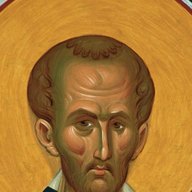
St. John ChrysostomHomily 1 on Colossians · on Colossians 1:1–2
"Paul an Apostle of Jesus Christ through the will of God." It were well also to say, what from considering this Epistle we have found to be its occasion and subject. What then is it? They used to approach God through angels; they held many Jewish and Grecian observances. These things then he is correcting. Wherefore…
St. John ChrysostomHomily 1 on Colossians · on Colossians 1:3
Ver. 3. "We give thanks to God, the Father of our Lord Jesus Christ." He seems to me to refer everything to the Father, that what he has to say may not at once offend them. "Praying always for you." He shows his love, not by giving thanks only, but also by continual prayer, in that those whom he did not see, he had…
St. John ChrysostomHomily 1 on Colossians · on Colossians 1:4
Ver. 4. "Having heard of your faith in Christ Jesus." A little above he said, "our Lord." "He," saith he, "is Lord, not the servants." "Of Jesus Christ." These names also are symbols of His benefit to us, for "He," it means, "shall save His people from their sins." (Matt. i. 21.) Ver. 4. "Having heard of your faith in…
St. John ChrysostomHomily 1 on Colossians · on Colossians 1:5
Ver. 5. "Because of the hope which is laid up for you in the heavens." He speaks of the good things to come. This is with a view to their temptations, that they should not seek their rest here. For lest any should say, "And where is the good of their love toward the saints, if they themselves are in affliction?" he…
Which is come unto you, as it is in all the world; and bringeth forth fruit, as it doth also in you, since the day ye heard of it, and knew the grace of God in truth:
St. John ChrysostomHomily 1 on Colossians · on Colossians 1:6
Ver. 6. "Which is come unto you, even as it is also in all the world." He now gives them credit. "Is come," he said metaphorically. He means, it did not come and go away, but that it remained, and was there. Then because to the many the strongest confirmation of doctrines is that they hold them in common with many, he…
St. John ChrysostomHomily 1 on Colossians · on Colossians 1:7–8
Ver. 7. "Even as ye learned of Epaphras our beloved fellow-servant." He, it is probable, had preached there. "Ye learned" the Gospel. Then to show the trust-worthiness of the man, he says, "our fellow servant." "Who is a faithful minister of Christ on your behalf; who also declared unto us your love in the Spirit."…
For this cause we also, since the day we heard it, do not cease to pray for you, and to desire that ye might be filled with the knowledge of his will in all wisdom and spiritual understanding;
St. John ChrysostomHomily 2 on Colossians · on Colossians 1:9
"For this cause." What cause? Because we heard of your faith and love, because we have good hopes, we are hopeful to ask for future blessings also. For as in the games we cheer on those most who are near upon gaining the victory, just so doth Paul also most exhort those who have achieved the greater part. "Since the…
St. John ChrysostomHomily 2 on Colossians · on Colossians 1:9
And Paul shows here, that since that time he has been praying, and has not yet prevailed, and yet has not desisted; for the words, "from the day we heard it," show this. But it implies condemnation to them, if, from that time, even assisted by prayers, they had not amended themselves. "And making request," he says,…
St. John ChrysostomHomily 2 on Colossians · on Colossians 1:9
And, "that ye may be filled," he saith; not, "that ye may receive," for they had received; but "that ye may be filled" with what as yet was lacking. Thus both the rebuke was given without offense, and the praise did not suffer them to sink down, and become supine, as if it had been complete. But what is, "that ye may…
St. John ChrysostomHomily 2 on Colossians · on Colossians 1:10
"To walk worthily," he says, "of the Lord." Here he speaks of life and its works, for so he doth also everywhere: with faith he always couples conduct. "Unto all pleasing." And how, "all pleasing"? "Bearing fruit in every good work, and increasing in the knowledge of God." Seeing, saith he, He hath fully revealed…
St. John ChrysostomHomily 2 on Colossians · on Colossians 1:10
"To walk," saith he, "worthily of the Lord," and "in every good work," so as to be always advancing, and nowhere standing still, and, with a metaphor, "bearing fruit and increasing in the knowledge of God," that ye might be in such measure "strengthened," according to the might of God, as is possible for man to be.…
St. John ChrysostomHomily 2 on Colossians · on Colossians 1:10
"Bearing fruit," he saith: this hath reference to works. "Strengthened": this to trials. "Unto all patience and longsuffering": long-suffering towards one another, patience towards those without. For longsuffering is toward those whom we can requite, but patience toward those whom we cannot. For this reason the term…
St. John ChrysostomHomily 2 on Colossians · on Colossians 1:10
"In the knowledge of God." And at the same time he touches in passing upon the methods of knowledge; for this is to be in error, not to know God as one ought; or he means, so as to increase in the knowledge of God. For if he that hath not known the Son, knoweth not the Father either; justly is there need of increased…
St. John ChrysostomHomily 2 on Colossians · on Colossians 1:11
"Strengthened with all power." He is here speaking of trials and persecutions. We pray that ye might be filled with strength, that ye faint not for sorrow, nor despair. "According to the might of His glory." But that ye may take up again such forwardness as it becometh the power of His glory to give. "Unto all…
St. John ChrysostomHomily 2 on Colossians · on Colossians 1:11
And again, "strengthened with all power," and again, "unto all patience and long-suffering"; for the constant addition of "all" bears witness to their doing well in part, though, it might be, not in all.
St. John ChrysostomHomily 2 on Colossians · on Colossians 1:12
"Unto all patience and longsuffering," he saith, "with joy, giving thanks" unto God. Then being about to exhort them, he makes no mention of what by and by shall be laid up for them; he did hint at this however in the beginning of the Epistle, saying, "Because of the hope which is laid up for you in the heavens": but…
St. John ChrysostomHomily 2 on Colossians · on Colossians 1:12
"To Him who made us meet to be partakers of the inheritance of the saints in light." He hath said a great thing. What has been given, he saith, is of this nature; He hath not only given, but also made us strong to receive. Now by saying, "Who made us meet," he showed that the thing was one of great weight. For…
St. John ChrysostomHomily 2 on Colossians · on Colossians 1:13
"Who delivered us," he saith, "from the power of darkness." The whole is of Him, the giving both of these things and those; for nowhere is any achievement of ours. "From the power of darkness," he saith, that is, of error, the dominion of the devil. He said not "darkness," but "power"; for it had great power over us,…
St. John ChrysostomHomily 2 on Colossians · on Colossians 1:13
"Into the kingdom of the Son of His love." He said not simply, "the kingdom of heaven," but gave a grandeur to his discourse by saying, "The kingdom of the Son," for no praise can be greater than this, as he saith elsewhere also: "If we endure, we shall also reign with Him." He hath counted us worthy of the same…
St. John ChrysostomHomily 2 on Colossians · on Colossians 1:14
For He indeed translated us, but the Son furnished the cause. For what saith he? "Who delivered us out of the power of darkness." But the same is, "In whom we have the full redemption, even the forgiveness of sins." For had we not been forgiven our sins, we should not have been "translated." So here again the words,…
St. John ChrysostomHomily 2 on Colossians · on Colossians 1:14
But if one ought to say anything more: the work of the Son is the greater. How? Because it were a thing impossible to give the kingdom to men whilst continuing in their sins; but thus it is an easier thing, so that He prepared the way for the gift. What sayest thou? He Himself loosed thee from thy sins: surely then He…
St. John ChrysostomHomily 2 on Colossians · on Colossians 1:15
"Who is the image of the invisible God, the First-born of all creation." We light here upon a question of heresy. So it were well we should put it off to-day and proceed with it to-morrow, addressing it to your ears when they are fresh.
St. John ChrysostomHomily 3 on Colossians · on Colossians 1:15
Paul, discoursing as we showed of the dignity of the Son, says these words: "Who is the Image of the invisible God." Whose image then wilt thou have Him be? God's? Then he is exactly like the one to whom you assign Him. For if as a man's image, say so, and I will have done with you as a madman. But if as God and God's…
For by him were all things created, that are in heaven, and that are in earth, visible and invisible, whether they be thrones, or dominions, or principalities, or powers: all things were created by him, and for him:
St. John ChrysostomHomily 3 on Colossians · on Colossians 1:16
Next he proceeds to the doctrine itself. For that they may not think Him to be of more recent existence, because that in former times the approach was through Angels, but now through Him; he shows first, that they had no power (for else it had not been "out of darkness" that he brought), next, that He is also before…
St. John ChrysostomHomily 3 on Colossians · on Colossians 1:17
"And He is before all things," he saith. This is befitting God. Where is Paul of Samosata? "And in Him all things consist," that is, they are created into Him. He repeats these expressions in close sequence; with their close succession, as it were with rapid strokes, tearing up the deadly doctrine by the roots. For,…
St. John ChrysostomHomily 3 on Colossians · on Colossians 1:18
"And He is the head of the body, the Church." Then having spoken of His dignity, he afterwards speaks of His love to man also. "He is," saith he, "the Head of the body, the Church." And he said not "of the fullness," (although this too is signified,) out of a wish to show His great friendliness to us, in that He who…
For it pleased the Father that in him should all fulness dwell;
ὅτι ἐν αὐτῷ εὐδόκησε πᾶν τὸ πλήρωμα κατοικῆσαι
St. John ChrysostomHomily 3 on Colossians · on Colossians 1:19
"For it was the good pleasure of the Father, that in Him should all the fullness dwell." Whatsoever things are of the Father, these he saith are of the Son also, and that with more of intensity, because that He both became "dead" for, and united Himself to us. He said, "Firstfruits," as of fruits. He said not…
And, having made peace through the blood of his cross, by him to reconcile all things unto himself; by him, I say, whether they be things in earth, or things in heaven.
St. John ChrysostomHomily 3 on Colossians · on Colossians 1:20
"And...through Him to reconcile all things unto Himself." Lest thou shouldest think that He undertook the office of a minister only, he saith, "unto Himself." And yet he elsewhere says, that He reconciled us to God, as in the Epistle he wrote to the Corinthians. And he well said, "Through Him to make an end of…
St. John ChrysostomHomily 4 on Colossians · on Colossians 1:21–22
Here he goes to show that He reconciled those even who were unworthy of reconciliation. For by the saying that they were under the power of darkness, he shows the calamity in which they were. But lest, on hearing of "the power of darkness," thou shouldest consider it Necessity, he adds, "And you that were alienated,"…
St. John ChrysostomHomily 4 on Colossians · on Colossians 1:21–22
And throughout he is showing that the Angels had no power in the successive times, forasmuch as men continued enemies; they could neither persuade them, nor, if persuaded, could they deliver them from the devil. For neither would persuading them be any gain, except he that held them were bound; nor would binding him…
St. John ChrysostomHomily 4 on Colossians · on Colossians 1:21–22
"Yet now hath He reconciled in the body of His flesh through death to present you holy and without blemish and unreprovable before Him." Again he lays down also the manner of the reconciliation, that it was "in the Body," not by being merely beaten, nor scourged, nor sold, but even by dying a death the most shameful.…
If ye continue in the faith grounded and settled, and be not moved away from the hope of the gospel, which ye have heard, and which was preached to every creature which is under heaven; whereof I Paul am made a minister;
St. John ChrysostomHomily 4 on Colossians · on Colossians 1:23
"If so be that ye continue in the faith grounded and steadfast, and not moved away from the hope of the Gospel." Here he strikes a blow at their listlessness. And he said not simply "continue," for it is possible to continue wavering, and vacillating; it is possible to stand, and continue, though turned this way and…
Who now rejoice in my sufferings for you, and fill up that which is behind of the afflictions of Christ in my flesh for his body’s sake, which is the church:
St. John ChrysostomHomily 4 on Colossians · on Colossians 1:24
"Now I rejoice in my sufferings for your sake, and fill up on my part that which is lacking of the afflictions of Christ in my flesh for His Body's sake, which is the Church." And what is the connection of this? It seems indeed not to be connected, but it is even closely so. And "minister," he says, that is, bringing…
St. John ChrysostomHomily 4 on Colossians · on Colossians 1:24
Next, that for His sake also he doeth these things, hearken: "For His Body's sake," he saith, assuredly meaning to say this: "I pleasure not you, but Christ: for what things He should have suffered, I suffer instead of Him." See how many things he establishes. Great, he shows, is the claim upon their love. As in his…
St. John ChrysostomHomily 4 on Colossians · on Colossians 1:24
He does not then say this to exalt himself, but through a desire to show that Christ is even yet caring for them. And he shows what he says to be credible, by adding, "for His Body's sake." For that so it is, and that there is no unlikelihood in it, is plain from these things being done for His body's sake. Look how…
St. John ChrysostomHomily 4 on Colossians · on Colossians 1:25
"Of which I was made," saith he, "a minister, according to the dispensation of God which is given me to youward, to fulfill the word of God." "The dispensation." Either he means, He so willed that after His own departure we should succeed to the dispensation, in order that ye might not feel as deserted, (for it is…
St. John ChrysostomHomily 5 on Colossians · on Colossians 1:26
Having said what we have come to, and showed the lovingkindness of God and the honor, by the greatness of the things given, he introduces yet another consideration that heightens them, namely, that neither before us did any one know Him. As he doth also in the Epistle to the Ephesians, saying, neither Angels, nor…
St. John ChrysostomHomily 5 on Colossians · on Colossians 1:27
Let not others therefore deceive you, for they know not. Why to them alone? "To whom He was pleased," he saith. See how everywhere He stops the mouth of their questions. "To whom God was pleased to make known," he saith. Yet His will is not without reason. By way of making them accountable for grace, rather than…
Whom we preach, warning every man, and teaching every man in all wisdom; that we may present every man perfect in Christ Jesus:
ὃν ἡμεῖς καταγγέλλομεν νουθετοῦντες πάντα ἄνθρωπον καὶ διδάσκοντες πάντα ἄνθρωπον ἐν πάσῃ σοφίᾳ, ἵνα παραστήσωμεν πάντα ἄνθρωπον τέλειον ἐν Χριστῷ Ἰησοῦ·
St. John ChrysostomHomily 5 on Colossians · on Colossians 1:28
"Whom we," not Angels: "teaching" and "admonishing": not imperiously nor using constraint, for this too is of God's lovingkindness to men, not to bring them to Him after the manner of a tyrant. Seeing it was a great thing he had said, "teaching," he added, "admonishing," which is rather like a father than an…
St. John ChrysostomHomily 5 on Colossians · on Colossians 1:29
"Whereunto I labor also, striving." And he said not, "I am desirous" merely, nor in any indifferent way, but "I labor, striving," with great earnestness, with much watching. If I, for your good, thus watch, much more ought ye. Then again, showing that it is of God, he saith, "according to His working which worketh in…
Every note is a real passage, quoted word for word from a published English translation, with its source. Nothing here is summarised or written by us. Some verses have many notes and some have none, because the Fathers wrote more on some passages than others.
St. John Chrysostom, Homilies on Colossians, Nicene and Post-Nicene Fathers, series 1, vol. 13 (1888–1889).
Scripture: the King James Version (1611); the Greek (tap Ελ) is the 1904 Patriarchal text of the Ecumenical Patriarchate.
All of these translations are in the public domain. The passages were matched to their verses by the Historical Christian Commentaries project, which also hosts the full texts we link to. The Fathers are a treasury of the Church's mind, and they are best read alongside the life of the Church: if a passage raises a question, bring it to your priest.