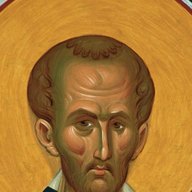
St. John ChrysostomHomily 7 on Colossians · on Colossians 3:1
"If then ye were raised together with Christ." He brings them together, having above established that He died. Therefore he saith, "If then ye were raised together with Christ, seek the things that are above." No observances are there. "Where Christ is seated on the right hand of God." Wonderful! Whither hath he led…
Set your affection on things above, not on things on the earth.
τὰ ἄνω φρονεῖτε, μὴ τὰ ἐπὶ τῆς γῆς.
St. John ChrysostomHomily 7 on Colossians · on Colossians 3:2–4
"Set your mind on the things that are above, not on the things that are upon the earth. For ye died, and your life is hid with Christ in God. When Christ who is your life shall be manifested, then shall ye also with Him be manifested in glory." This is not your life, he saith, it is some other one. He is now urgent to…
Mortify therefore your members which are upon the earth; fornication, uncleanness, inordinate affection, evil concupiscence, and covetousness, which is idolatry:
St. John ChrysostomHomily 8 on Colossians · on Colossians 3:5
"Mortify therefore your members," he saith, "which are upon the earth." What sayest thou? Was it not thou that saidst, "Ye are buried; ye are buried together with Him; ye are circumcised: we have put off the body of the sins of the flesh"; how then again sayest thou, "Mortify"? Art thou sporting? Dost thou thus…
St. John ChrysostomHomily 8 on Colossians · on Colossians 3:5
But why did he begin his list with fornication? For having said, "Mortify your members which are upon the earth," he immediately says, "fornication"; and so he does almost everywhere. Because this passion hath the greatest sway. For even when writing his Epistle to the Thessalonians he did the same. And what wonder?…
St. John ChrysostomHomily 8 on Colossians · on Colossians 3:5
So Christ also saith, "If thy right eye causeth thee to stumble," that is, if thou lookest unchastely, "cut it out," that is, thine evil thought. And he (Paul) seems to me to speak of "fornication, uncleanness, passion, desire" as the same, namely fornication: by means of all these expressions drawing us away from…
St. John ChrysostomHomily 8 on Colossians · on Colossians 3:6
"For which things' sake cometh the wrath of God upon the sons of disobedience." By many things he had been withdrawing them; by the benefits which are already given, by the evils to come from which we had been delivered, being who, and wherefore; and all those considerations, as, for instance, who we were, and in what…
St. John ChrysostomHomily 8 on Colossians · on Colossians 3:6
"For which things' sake cometh," he saith, "the wrath of God upon the sons of disobedience." Sons of disobedience, he calls them, to deprive them of excuse, and to show that it was because they would not be obedient, that they were in that condition.
St. John ChrysostomHomily 8 on Colossians · on Colossians 3:7
"In the which ye also walked aforetime, when ye lived in them." In order to shame them, he saith, "when ye lived in them," and implying praise, as now no more so living: at that time they might.
St. John ChrysostomHomily 8 on Colossians · on Colossians 3:7
"In the which ye also," he saith, "walked aforetime," and (afterward) became obedient. He points them out as still in them, and praises them, saying, "But now do ye also put away all these, anger, wrath, malice, railing, shameful speaking."
St. John ChrysostomHomily 8 on Colossians · on Colossians 3:8
"But now put ye also away all these." He speaks always both universally and particularly; but this is from earnestness. "Anger, wrath, malice, railing, shameful speaking out of your mouth. Lie not one to another." "Shameful speaking," he saith, "out of your mouth," clearly intimating that it pollutes it.
St. John ChrysostomHomily 8 on Colossians · on Colossians 3:8
But against others he advanceth his discourse. Under the head of "passion and railing" he means revilings, just as under "wrath" he means wickedness. And in another place, to shame them, he says, "for we are members one of another." He makes them out to be as it were manufacturers of men; casting away this one, and…
St. John ChrysostomHomily 8 on Colossians · on Colossians 3:9–10
"Seeing that ye have put off the old man with his doings, and have put on the new man, which is being renewed unto knowledge after the image of Him that created him." It is worth enquiring here, what can be the reason why he calls the corrupt life, "members," and "man," and "body," and again the virtuous life, the…
St. John ChrysostomHomily 8 on Colossians · on Colossians 3:9–10
One royal form it hath, that, namely, of Christ. They whom he has in view, appear to me rather to be of the Gentiles. For like as earth, being but sand, even though one part be greater, another less, losing its own previous form, doth afterwards become gold; and like as wool, of whatever kind it be, receiveth another…
St. John ChrysostomHomily 8 on Colossians · on Colossians 3:11
"Where there cannot be Greek and Jew, circumcision and uncircumcision, Barbarian, Scythian, bondman, freeman: but Christ is all, and in all." Lo! here is a third encomium of this "man." With him, there is no difference admitted either of nation, or of rank, or of ancestry, seeing he hath nothing of externals, nor…
St. John ChrysostomHomily 8 on Colossians · on Colossians 3:12
"Put on, therefore, as the elect of God, holy and beloved." He shows the easiness of virtue, so that they might both possess it continually, and use it as the greatest ornament. The exhortation is accompanied also with praise, for then its force is greatest. For they had been before holy, but not elect; but now both…
St. John ChrysostomHomily 8 on Colossians · on Colossians 3:13
"Forbearing one another, and forgiving each other, if any man have a complaint against any: even as Christ forgave you, so also do ye." Again, he speaks after the class, and he always does it; for from kindness comes humbleness of mind, and from this, longsuffering. "Forbearing," he saith, "one another," that is,…
St. John ChrysostomHomily 8 on Colossians · on Colossians 3:13
"Forbearing," he saith, "one another"; he showeth what is just. Thou forbearest him, and he thee; and so he says in the Epistle to the Galatians, "Bear ye one another's burdens."
St. John ChrysostomHomily 8 on Colossians · on Colossians 3:14
"And above all these things put on love, which is the bond of perfectness." Dost thou see that he saith this? For since it is possible for one who forgives, not to love; yea, he saith, thou must love him too, and he points out a way whereby it becomes possible to forgive. For it is possible for one to be kind, and…
St. John ChrysostomHomily 8 on Colossians · on Colossians 3:15
"And let the peace of God rule in your hearts, to the which also ye were called in one body; and be ye thankful." "The peace of God." This is that which is fixed and steadfast. If on man's account indeed thou hast peace, it quickly comes to dissolution, but if on God's account, never. Although he had spoken of love…
St. John ChrysostomHomily 8 on Colossians · on Colossians 3:15
"And be ye thankful." For this is to be thankful, and very effectively, to deal with his fellow-servants as God doth with himself, to submit himself to the Master, to obey; to express his gratitude for all things, even though one insult him, or beat him. For in truth he that confesses thanks due to God for what he…
Let the word of Christ dwell in you richly in all wisdom; teaching and admonishing one another in psalms and hymns and spiritual songs, singing with grace in your hearts to the Lord.
St. John ChrysostomHomily 9 on Colossians · on Colossians 3:16
Having exhorted them to be thankful, he shows also the way, that, of which I have lately discoursed to you. And what saith he? "Let the word of Christ dwell in you richly"; or rather not this way alone, but another also. For I indeed said that we ought to reckon up those who have suffered things more terrible, and…
St. John ChrysostomHomily 9 on Colossians · on Colossians 3:16
"In all wisdom, teaching and admonishing one another." "In all," says he. Virtue he calls wisdom, and lowliness of mind is wisdom, and almsgiving, and other such like things, are wisdom; just as the contraries are folly, for cruelty too cometh of folly. Whence in many places it calleth the whole of sin folly. "The…
St. John ChrysostomHomily 9 on Colossians · on Colossians 3:16
Tarry not, I entreat, for another to teach thee; thou hast the oracles of God. No man teacheth thee as they; for he indeed oft grudgeth much for vainglory's sake and envy. Hearken, I entreat you, all ye that are careful for this life, and procure books that will be medicines for the soul. If ye will not any other, yet…
St. John ChrysostomHomily 9 on Colossians · on Colossians 3:16
"Teaching," he saith, "and admonishing one another with psalms and hymns and spiritual songs." Mark also the considerateness of Paul. Seeing that reading is toilsome, and its irksomeness great, he led them not to histories, but to psalms, that thou mightest at once delight thy soul with singing, and gently beguile thy…
St. John ChrysostomHomily 9 on Colossians · on Colossians 3:16
When in these thou hast led him on from childhood, by little and little thou wilt lead him forward even to the higher things. The Psalms contain all things, but the Hymns again have nothing human. When he has been instructed out of the Psalms, he will then know hymns also, as a diviner thing. For the Powers above…
St. John ChrysostomHomily 9 on Colossians · on Colossians 3:16
What is the hymn of those above? The Faithful know. What say the cherubim above? What say the Angels? "Glory to God in the highest." Therefore after the psalmody come the hymns, as a thing of more perfection. "With psalms," he saith, "with hymns, with spiritual songs, with grace singing in your hearts to God." He…
St. John ChrysostomHomily 9 on Colossians · on Colossians 3:17
"And whatsoever ye do," he saith, "in word or in deed, do all in the name of the Lord Jesus, giving thanks to God the Father through Him." For if we thus do, there will be nothing polluted, nothing unclean, wherever Christ is called on. If thou eat, if thou drink, if thou marry, if thou travel, do all in the Name of…
St. John ChrysostomHomily 9 on Colossians · on Colossians 3:17
And what is to "do in word or in deed"? Either requesting or performing anything whatever. Hear how in the Name of God Abraham sent his servant; David in the Name of God slew Goliath. Marvelous is His Name and great. Again, Jacob sending his sons saith, "My God give you favor in the sight of the man." For he that…
St. John ChrysostomHomily 9 on Colossians · on Colossians 3:17
These things let us learn, not as far as words only, but to fulfill them also by works. Nothing is equal to this Name, marvelous is it everywhere. "Thy Name," he saith, "is ointment poured forth." He that hath uttered it is straightway filled with fragrance. "No man," it is said, "can call Jesus Lord, but by the Holy…
St. John ChrysostomHomily 10 on Colossians · on Colossians 3:18
That is, be subject for God's sake, because this adorneth you, he saith, not them. For I mean not that subjection which is due to a master, nor yet that alone which is of nature, but that for God's sake.
St. John ChrysostomHomily 10 on Colossians · on Colossians 3:19
See how again he has exhorted to reciprocity. As in the other case he enjoineth fear and love, so also doth he here. For it is possible for one who loves even, to be bitter. What he saith then is this. Fight not; for nothing is more bitter than this fighting, when it takes place on the part of the husband toward the…
St. John ChrysostomHomily 10 on Colossians · on Colossians 3:20
Again he has put that, "in the Lord," at once laying down the laws of obedience, and shaming them, and casting them down. For this, saith he, is well-pleasing to the Lord. See how he would have us do all not from nature only, but, prior to this, from what is pleasing to God, that we may also have reward.
St. John ChrysostomHomily 10 on Colossians · on Colossians 3:21
Lo! again here also is subjection and love. And he said not, "Love your children," for it had been superfluous, seeing that nature itself constraineth to this; but what needed correction he corrected; that the love should in this case also be the more vehement, because that the obedience is greater. For it nowhere…
St. John ChrysostomHomily 10 on Colossians · on Colossians 3:22
And see how always he sets down the names, "wives, children, servants," being at once a just claim upon their obedience. But that none might be pained, he added, "to your masters according to the flesh." Thy better part, the soul, is free, he saith; thy service is for a season. It therefore do thou subject, that thy…
St. John ChrysostomHomily 10 on Colossians · on Colossians 3:23
He desires to have them freed not only from hypocrisy, but also from slothfulness. He hath made them instead of slaves free, when they need not the superintendence of their master for the expression "heartily" means this, "with good will," not with a slavish necessity, but with freedom, and of choice. And what is the…
St. John ChrysostomHomily 10 on Colossians · on Colossians 3:25
Here he confirmeth his former statements. For that his words may not appear to be those of flattery, "he shall receive," he saith, "the wrong he hath done," that is, he shall suffer punishment also, "for there is no respect of persons." For what if thou art a servant? it is no shame to thee. And truly he might have…
Every note is a real passage, quoted word for word from a published English translation, with its source. Nothing here is summarised or written by us. Some verses have many notes and some have none, because the Fathers wrote more on some passages than others.
St. John Chrysostom, Homilies on Colossians, Nicene and Post-Nicene Fathers, series 1, vol. 13 (1888–1889).
Scripture: the King James Version (1611); the Greek (tap Ελ) is the 1904 Patriarchal text of the Ecumenical Patriarchate.
All of these translations are in the public domain. The passages were matched to their verses by the Historical Christian Commentaries project, which also hosts the full texts we link to. The Fathers are a treasury of the Church's mind, and they are best read alongside the life of the Church: if a passage raises a question, bring it to your priest.