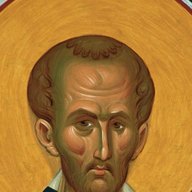
St. John ChrysostomHomily 4 on Galatians · on Galatians 4:1–3
The word "child" in this place denotes not age but understanding; meaning that God had from the beginning designed for us these gifts, but, as we yet continued childish, He let us be under the elements of the world, that is, new moons and sabbaths, for these days are regulated by the course of sun and moon. If then…
St. John ChrysostomHomily 4 on Galatians · on Galatians 4:4–5
Here he states two objects and effects of the Incarnation, deliverance from evil and supply of good, things which none could compass but Christ. They are these; deliverance from the curse of the Law, and promotion to sonship. Fitly does he say, that we might "receive," "[be paid,]" implying that it was due; for the…
St. John ChrysostomHomily 4 on Galatians · on Galatians 4:6–7
Had not we been first made sons, we could not have called Him Father. If then grace hath made us freemen instead of slaves, men instead of children, heirs and sons instead of aliens, is it not utter absurdity and stupidity to desert this grace, and to turn away backwards?
St. John ChrysostomHomily 4 on Galatians · on Galatians 4:8–9
Here turning to the Gentile believers he says that it is an idolatry, this rigid observance of days, and now incurs a severe punishment. To enforce this, and inspire them with a deeper anxiety, he calls the elements "not by nature Gods." And his meaning is,-Then indeed, as being benighted and bewildered, ye lay…
But now, after that ye have known God, or rather are known of God, how turn ye again to the weak and beggarly elements, whereunto ye desire again to be in bondage?
I am afraid of you, lest I have bestowed upon you labour in vain.
φοβοῦμαι ὑμᾶς μήπως εἰκῆ κεκοπίακα εἰς ὑμᾶς.
St. John ChrysostomHomily 4 on Galatians · on Galatians 4:11
Observe the tender compassion of the Apostle; they were shaken and he trembles and fears. And hence he has put it so as thoroughly to shame them, "I have bestowed labor upon you," saying, as it were, make not vain the labors which have cost me sweat and pain. By saying "I fear," and subjoining the word "lest," he both…
St. John ChrysostomHomily 4 on Galatians · on Galatians 4:12
This is addressed to his Jewish disciples, and he brings his own example forward, to induce them thereby to abandon their old customs. Though you had none other for a pattern, he says, to look at me only would have sufficed for such a change, and for your taking courage. Therefore gaze on me; I too was once in your…
St. John ChrysostomHomily 4 on Galatians · on Galatians 4:13–14
Not to have injured one is indeed no great thing, for no man whatever would choose to hurt wantonly and without object to annoy another who had never injured him. But for you, not only have ye not injured me, but ye have shown me great and inexpressible kindness, and it is impossible that one who has been treated with…
Where is then the blessedness ye spake of? for I bear you record, that, if it had been possible, ye would have plucked out your own eyes, and have given them to me.
St. John ChrysostomHomily 4 on Galatians · on Galatians 4:15–16
Here he shows perplexity and amazement, and desires to learn of themselves the reason of their change. Who, says he, hath deceived you, and caused a difference in your disposition towards me? Are ye not the same who attended and ministered to me, counting me more precious than your own eyes? what then has happened?…
St. John ChrysostomHomily 4 on Galatians · on Galatians 4:17
It is a wholesome emulation which leads to an imitation of virtue, but an evil one, which seduces from virtue him who is in the right path. And this is the object of those persons, who would deprive you of perfect knowledge, and impart to you that which is mutilated and spurious, and this for no other purpose than…
St. John ChrysostomHomily 4 on Galatians · on Galatians 4:18
Here he hints that his absence had been the cause of this, and that the true blessing was for disciples to hold right opinions not only in the presence but also in the absence of their master. But as they had not arrived at this point of perfection, he makes every effort to place them there.
St. John ChrysostomHomily 4 on Galatians · on Galatians 4:19
Observe his perplexity and perturbation, "Brethren, I beseech you:" "My little children, of whom I am again in travail:" He resembles a mother trembling for her children. "Until Christ be formed in you." Behold his paternal tenderness, behold this despondency worthy of an Apostle. Observe what a wail he utters, far…
St. John ChrysostomHomily 4 on Galatians · on Galatians 4:20
Observe his warmth, his inability to refrain himself, and to conceal these his feelings; such is the nature of love; nor is he satisfied with words, but desires to be present with them, and so, as he says, to change his voice, that is, to change to lamentation, to shed tears, to turn every thing into mourning. For he…
St. John ChrysostomHomily 4 on Galatians · on Galatians 4:21
He says rightly, "ye that desire," for the matter was not one of a proper and orderly succession of things but of their own unseasonable contentiousness. It is the Book of Creation which he here calls the Law, which name he often gives to the whole Old Testament.
St. John ChrysostomHomily 4 on Galatians · on Galatians 4:22
He returns again to Abraham, not in the way of repetition, but, inasmuch as the Patriarch's fame was great among the Jews, to show that the types had their origin from thence, and that present events were pictured aforetime in him. Having previously shown that the Galatians were sons of Abraham, now, in that the…
St. John ChrysostomHomily 4 on Galatians · on Galatians 4:23
What is the meaning of "after the flesh?" Having said that Faith united us to Abraham, and it having seemed incredible to his hearers, that those who were not begotten by Abraham should be called his sons, he proves that this paradox had actually happened long ago; for that Isaac, born not according to the order of…
Which things are an allegory: for these are the two covenants; the one from the mount Sinai, which gendereth to bondage, which is Agar.
ἅτινά ἐστιν ἀλληγορούμενα. αὗται γάρ εἰσι δύο διαθῆκαι, μία μὲν ἀπὸ ὄρους Σινᾶ, εἰς δουλείαν γεννῶσα, ἥτις ἐστὶν Ἄγαρ·
St. John ChrysostomHomily 4 on Galatians · on Galatians 4:24
Contrary to usage, he calls a type an allegory; his meaning is as follows; this history not only declares that which appears on the face of it, but announces somewhat farther, whence it is called an allegory. And what hath it announced? no less than all the things now present. For these women are two covenants; one…
St. John ChrysostomHomily 4 on Galatians · on Galatians 4:25
The bond-woman was called Hagar, and "Hagar" is the word for Mount Sinai in the language of that country. So that it is necessary that all who are born of the Old Covenant should be bondmen, for that mountain where the Old Covenant was delivered hath a name in common with the bondwoman. And it includes Jerusalem, for…
St. John ChrysostomHomily 4 on Galatians · on Galatians 4:26
Those therefore, who are born of her are not bondmen. Thus the type of the Jerusalem below was Hagar, as is plain from the mountain being so called; but of that which is above is the Church. Nevertheless he is not content with these types, but adds the testimony of Isaiah to what he has spoken...
For it is written, Rejoice, thou barren that bearest not; break forth and cry, thou that travailest not: for the desolate hath many more children than she which hath an husband.
St. John ChrysostomHomily 4 on Galatians · on Galatians 4:27
Who is this who before was "barren," and "desolate?" Clearly it is the Church of the Gentiles, that was before deprived of the knowledge of God? Who, "she which hath the husband?" plainly the Synagogue. Yet the barren woman surpassed her in the number of her children, for the other embraces one nation, but the…
St. John ChrysostomHomily 4 on Galatians · on Galatians 4:28
It is not merely that the Church was barren like Sarah, or became a mother of many children like her, but she bore them in the way Sarah did. As it was not nature but the promise of God which rendered Sarah a mother, [for the word of God which said, "At the time appointed I will return unto thee, and Sarah shall have…
St. John ChrysostomHomily 4 on Galatians · on Galatians 4:29–30
What! does all this consolation consist in showing that freemen are persecuted by bond-men? By no means, he says, I do not stop here, listen to what follows, and then, if you be not pusillanimous under persecution, you will be sufficiently comforted. And what is it that follows? "Cast out the son of the handmaid, for…
Nevertheless what saith the scripture? Cast out the bondwoman and her son: for the son of the bondwoman shall not be heir with the son of the freewoman.
St. John ChrysostomHomily 4 on Galatians · on Galatians 4:31
He turns and discusses this on all sides, desiring to prove that what had taken place was no novelty, but had been before typified many ages ago. How then can it be otherwise than absurd for those who had been set apart so long and who had obtained freedom, willingly to subject themselves to the yoke of bondage?
Every note is a real passage, quoted word for word from a published English translation, with its source. Nothing here is summarised or written by us. Some verses have many notes and some have none, because the Fathers wrote more on some passages than others.
St. John Chrysostom, Homilies on Galatians, Nicene and Post-Nicene Fathers, series 1, vol. 13 (1888–1889).
Scripture: the King James Version (1611); the Greek (tap Ελ) is the 1904 Patriarchal text of the Ecumenical Patriarchate.
All of these translations are in the public domain. The passages were matched to their verses by the Historical Christian Commentaries project, which also hosts the full texts we link to. The Fathers are a treasury of the Church's mind, and they are best read alongside the life of the Church: if a passage raises a question, bring it to your priest.