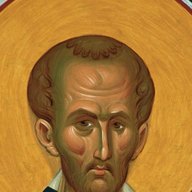
St. John ChrysostomHomily 33 on Hebrews · on Hebrews 13:1
See how he enjoins them to preserve what they had: he does not add other things. He did not say, "Be loving as brethren," but, "Let brotherly love continue." And again, he did not say, "Be hospitable," as if they were not, but, "Be not forgetful of hospitality," for this was likely to happen owing to their afflictions.
Be not forgetful to entertain strangers: for thereby some have entertained angels unawares.
διὰ ταύτης γὰρ ἔλαθόν τινες ξενίσαντες ἀγγέλους.
St. John ChrysostomHomily 33 on Hebrews · on Hebrews 13:2
He did not say, "Be hospitable," as if they were not, but, "Be not forgetful of hospitality," for this was likely to happen owing to their afflictions. Therefore (he says) "some have entertained angels unawares." Seest thou how great was the honor, how great the gain! What is "unawares"? They entertained them without…
St. John ChrysostomHomily 33 on Hebrews · on Hebrews 13:2
And he did not say, "Be not forgetful" of the entertaining of strangers, but "of hospitality": that is, do not merely entertain strangers, but do it with love for the strangers. Moreover he did not speak of the recompense that is future, and in store for us, lest he should make them more supine, but of that already…
St. John ChrysostomHomily 33 on Hebrews · on Hebrews 13:4
See how large is his discourse concerning chastity. "Follow peace," he said, "and holiness; Lest there be any fornicator or profane person" (c. xii. 14); and again, "Fornicators and adulterers God will judge." (c. xii. 16.) In every case, the prohibition is with a penalty. "Follow peace with all men," he says, "and…
St. John ChrysostomHomily 33 on Hebrews · on Hebrews 13:4
But let us see in what sense "Marriage is honorable in all and the bed undefiled." Because (he means) it preserves the believer in chastity. Here he also alludes to the Jews, because they accounted the woman after childbirth polluted: and "whosoever comes from the bed," it is said, "is not clean." Those things are not…
Let your conversation be without covetousness; and be content with such things as ye have: for he hath said, I will never leave thee, nor forsake thee.
Ἀφιλάργυρος ὁ τρόπος, ἀρκούμενοι τοῖς παροῦσιν· αὐτὸς γὰρ εἴρηκεν· οὐ μή σε ἀνῶ οὐδ᾽ οὐ μή σε ἐγκαταλίπω·
St. John ChrysostomHomily 33 on Hebrews · on Hebrews 13:5
"Let your conversation be without covetousness," he says. He did not say, Possess nothing, but, "Let your conversation be without covetousness": that is, let it show forth the philosophical character of your mind. For he says above also, "And ye took joyfully the spoiling of your goods." (c. x. 34.) He gives these…
St. John ChrysostomHomily 33 on Hebrews · on Hebrews 13:5
"Let your conversation" (he says) "be without covetousness": since many after having exhausted their property, afterwards wish to recover it again under the guise of alms, therefore he says, "Let your conversation be without covetousness"; that is, that we should be desirous only of what is necessary and…
St. John ChrysostomHomily 33 on Hebrews · on Hebrews 13:6
"So that we may boldly say, the Lord is my helper, and I will not fear what man shall do unto me." Again consolation in their trials. ... "For He hath said," and He doth not lie, "I will never leave thee, nor forsake thee. So that we boldly say, The Lord is my Helper, and I will not fear what man shall do unto me."…
St. John ChrysostomHomily 33 on Hebrews · on Hebrews 13:7
"Remember them which have the rule over you." This he was laboring to say above: therefore "Follow peace with all men." (c. xii. 14.) He gave this exhortation also to the Thessalonians, to "hold them in honor exceedingly." (1 Thess. v. 13.) "Remember" (he says) "them which have the rule over you, who have spoken unto…
St. John ChrysostomHomily 33 on Hebrews · on Hebrews 13:7
"Remember them which have the rule over you, who have spoken unto you the word of God." In this place I think that he is speaking about assistance also. For this is implied in the words "who have spoken unto you the word of God." "Whose faith follow considering the end of their conversation." What is "considering"?…
St. John ChrysostomHomily 33 on Hebrews · on Hebrews 13:8
In these words, "Jesus Christ the same yesterday and to-day and for ever," "yesterday" means all the time that is past: "to-day," the present: "for ever," the endless which is to come. That is to say: Ye have heard of an High Priest, but not an High Priest who fails. He is always the same. As though there were some…
St. John ChrysostomHomily 33 on Hebrews · on Hebrews 13:8
"Jesus Christ the same yesterday and to-day and for ever." Do not think that then indeed He wrought wonders, but now works no wonders. He is the same. This is, "remember them that have the rule over you."
Be not carried about with divers and strange doctrines. For it is a good thing that the heart be established with grace; not with meats, which have not profited them that have been occupied therein.
St. John ChrysostomHomily 33 on Hebrews · on Hebrews 13:9
"Be not carried about with divers and strange doctrines." Not "with strange doctrines" only, but neither with "divers ones." "For it is a good thing that the heart be established with grace, not with meats which have not profited them that have been occupied therein." Here he gently hints at those who introduce the…
St. John ChrysostomHomily 33 on Hebrews · on Hebrews 13:9
"Be not carried about with divers and strange doctrines." "Strange," that is, different from those ye heard from us; "Divers" that is, of all sorts: for they have no stability, but are different one from another. For especially manifold is the doctrine of meats. "For it is a good thing that the heart be established…
St. John ChrysostomHomily 33 on Hebrews · on Hebrews 13:10
For "we have an altar whereof they have no right to eat which serve the Tabernacle." Not as the Jewish ordinances, are those among us, as it is not lawful even for the High Priest to partake of them. So that since he had said, "Do not observe," and this seemed to be the language of one who is throwing down his own…
St. John ChrysostomHomily 33 on Hebrews · on Hebrews 13:11–12
"For the bodies of those beasts whose blood is brought into the sanctuary by the High Priest for sin, are burned without the camp. Wherefore Jesus also, that He might sanctify the people with His own blood, suffered" (he says) "without the gate." Seest thou the type shining forth? "For sin," he says, and "suffered…
St. John ChrysostomHomily 33 on Hebrews · on Hebrews 13:11–12
In the next place he takes away the sacrifice from the type, and directs his discourse to the prototype, saying, "The bodies of those beasts whose blood is brought into the sanctuary by the High Priest, are burned without the camp." Then those things were a type of these and thus Christ, suffering "without," fulfilled…
St. John ChrysostomHomily 33 on Hebrews · on Hebrews 13:13
"Let us go forth therefore to Him without the camp, bearing His reproach," that is, suffering the same things; having communion with Him in His sufferings. He was crucified without as a condemned person: neither let us then be ashamed to "go forth out" of the world.
St. John ChrysostomHomily 33 on Hebrews · on Hebrews 13:13
But what is, "Let us go forth to Him"? Let us have fellowship with Him in His sufferings; let us bear His reproach. For He did not simply bid us dwell "outside the gate," but as He was reproached as a condemned person, so also we.
St. John ChrysostomHomily 33 on Hebrews · on Hebrews 13:14
"Let us go forth therefore to Him without the camp, bearing His reproach," that is, suffering the same things; having communion with Him in His sufferings. He was crucified without as a condemned person: neither let us then be ashamed to "go forth out" of the world. "For we have here no continuing city" (he says) "but…
St. John ChrysostomHomily 33 on Hebrews · on Hebrews 13:15
"By Him therefore let us offer the sacrifice of praise to God continually, that is, the fruit of our lips giving thanks to His Name." "By Him," as by an High Priest, according to the flesh. "Giving thanks" (he says) "to His Name." Let us utter nothing blasphemous, nothing hasty, nothing bold, nothing presumptuous,…
St. John ChrysostomHomily 33 on Hebrews · on Hebrews 13:15
And "by Him let us offer a sacrifice to God." Of what kind of sacrifice does he speak? "The fruit of lips giving thanks to His Name." They, the Jews, brought sheep, and calves, and gave them to the Priest: let "us" bring none of these things, but thanksgiving. This "fruit" let "our lips" put forth. "For with such…
St. John ChrysostomHomily 33 on Hebrews · on Hebrews 13:16
"But to do good and to communicate forget not." I speak not merely with reference to the brethren present, but to those absent also. But if others have plundered your property, display your hospitality out of such things as ye have. What excuse then shall we have henceforward, when they, even after the spoiling of…
Obey them that have the rule over you, and submit yourselves: for they watch for your souls, as they that must give account, that they may do it with joy, and not with grief: for that is unprofitable for you.
St. John ChrysostomHomily 34 on Hebrews · on Hebrews 13:17
Anarchy is an evil, and the occasion of many calamities, and the source of disorder and confusion. For as, if thou take away the leader from a chorus, the chorus will not be in tune and in order; and if from a phalanx of an army thou remove the commander, the evolutions will no longer be made in time and order, and if…
St. John ChrysostomHomily 34 on Hebrews · on Hebrews 13:18
"Pray for us" (he says); "for we trust we have a good conscience among all, willing to live honestly." Thou seest that he used these apologies, as writing to persons grieved with him, as to those who turned away, who were disposed as towards a transgressor, not enduring even to hear his name? Inasmuch then as he asked…
St. John ChrysostomHomily 34 on Hebrews · on Hebrews 13:19
"But I beseech you the rather to do this, that I may be restored to you the sooner." His thus praying was the act of one who loved them greatly, and that not simply, but with all earnestness, that so, he says, I may come to you speedily. The earnest desire to come to them is the mark of one conscious to himself of…
Now the God of peace, that brought again from the dead our Lord Jesus, that great shepherd of the sheep, through the blood of the everlasting covenant,
St. John ChrysostomHomily 34 on Hebrews · on Hebrews 13:20–21
Therefore having first asked their prayers, he then himself also prays for all good things on them. "Now the God of peace," he says (be ye not therefore at variance one with another), "that brought again from the earth the Shepherd of the sheep" (this is said concerning the resurrection) "the Great Shepherd" (another…
Make you perfect in every good work to do his will, working in you that which is wellpleasing in his sight, through Jesus Christ; to whom be glory for ever and ever. Amen.
St. John ChrysostomHomily 34 on Hebrews · on Hebrews 13:22
"And I beseech you, brethren, suffer the word of exhortation, for indeed I have written a letter unto you in few words." Seest thou that what he wrote to no one else, he writes to them? For (he means) I do not even trouble you with long discourse. And having written thus much, he said this was little, in comparison…
St. John ChrysostomHomily 34 on Hebrews · on Hebrews 13:23
I suppose that they were not at all unfavorably disposed towards Timothy: wherefore he also put him forward. For "know ye," he says, "that our brother Timothy is set at liberty, with whom, if he come shortly, I will see you." "Set at liberty," he says; from whence? I suppose he had been cast into prison: or if not…
St. John ChrysostomHomily 34 on Hebrews · on Hebrews 13:24–25
"Salute all them that have the rule over you, and all the saints. They of Italy salute you. Grace be with you all. Amen." "Salute them that have the rule over you, and all the saints." See how he honored them, since he wrote to them instead of to those (their rulers). "They of Italy salute you. Grace be with you all.…
Every note is a real passage, quoted word for word from a published English translation, with its source. Nothing here is summarised or written by us. Some verses have many notes and some have none, because the Fathers wrote more on some passages than others.
St. John Chrysostom, Homilies on Hebrews, Nicene and Post-Nicene Fathers, series 1, vol. 14 (1888–1889).
Scripture: the King James Version (1611); the Greek (tap Ελ) is the 1904 Patriarchal text of the Ecumenical Patriarchate.
All of these translations are in the public domain. The passages were matched to their verses by the Historical Christian Commentaries project, which also hosts the full texts we link to. The Fathers are a treasury of the Church's mind, and they are best read alongside the life of the Church: if a passage raises a question, bring it to your priest.