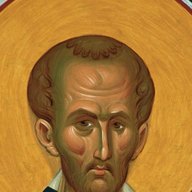
St. John ChrysostomHomily 3 on Hebrews · on Hebrews 2:1
And having spoken concerning the Son, both what related to the Economy, and what related to the Creation, and to His sovereignty, and having shown His co-equal dignity, and that as absolute Master He ruleth not men only but also the powers above, he next exhorts them, having made out his argument, that we ought to…
St. John ChrysostomHomily 3 on Hebrews · on Hebrews 2:1
Why ought we to "give more earnest heed to the things which we have heard"? were not those former things of God, as well as these? Either then he meaneth "more earnest" than [to] the Law, or "very earnest"; not making comparison, God forbid. For since, on account of the long space of time, they had a great opinion of…
St. John ChrysostomHomily 3 on Hebrews · on Hebrews 2:2–3
"For if the word spoken by Angels" (saith he) "was steadfast, and every transgression and disobedience received a just recompense of reward; how shall we escape if we neglect so great salvation, which at the first began to be spoken to us by the Lord, and was confirmed unto us by them that heard Him?" Next, when he…
St. John ChrysostomHomily 3 on Hebrews · on Hebrews 2:2–3
But what is this, "For if the word spoken by Angels was steadfast"? For in the Epistle to the Galatians also he saith to this effect, "Being ordained by angels in the hand of a Mediator." And again, "Ye received a law by the disposition of Angels, and have not kept it." And everywhere he saith it was given by angels.…
How shall we escape, if we neglect so great salvation; which at the first began to be spoken by the Lord, and was confirmed unto us by them that heard him;
St. John ChrysostomHomily 3 on Hebrews · on Hebrews 2:4
How doth He bear witness? not by word or by voice, (though this also would have been worthy of belief): but how? "By signs, and wonders, and divers miracles." (Well said he, "divers miracles," declaring the abundance of the gifts: which was not so in the former dispensation, neither so great signs and so various.)…
St. John ChrysostomHomily 4 on Hebrews · on Hebrews 2:5
"For not to angels," he says, "did He put in subjection the world to come, whereof we speak." Is he then discoursing concerning some other world? No, but concerning this. Therefore he added "whereof we speak," that he might not allow the mind to wander away in search of some other. How then does he call it "the world…
St. John ChrysostomHomily 4 on Hebrews · on Hebrews 2:6
Then he brings forward another testimony also and says, "but one in a certain place testified, saying." Wherefore did he not mention the name of the prophet, but hid it? Yea, and in other testimonies also he doth this: as when he saith, "but when He bringeth in again the First-Begotten into the world, He saith, And…
St. John ChrysostomHomily 4 on Hebrews · on Hebrews 2:7
"What is man that Thou art mindful of him, or the son of man that Thou visitest him? Thou madest him a little lower than the angels: Thou crownedst him with glory and honor." "Thou hast put all things in subjection under his feet." Now although these things were spoken of human nature generally, they would…
Thou hast put all things in subjection under his feet. For in that he put all in subjection under him, he left nothing that is not put under him. But now we see not yet all things put under him.
πάντα ὑπέταξας ὑποκάτω τῶν ποδῶν αὐτοῦ· ἐν γὰρ τῷ ὑποτάξαι αὐτῷ τὰ πάντα οὐδὲν ἀφῆκεν αὐτῷ ἀνυπότακτον. νῦν δὲ οὔπω ὁρῶμεν αὐτῷ τὰ πάντα ὑποτεταγμένα·
St. John ChrysostomHomily 4 on Hebrews · on Hebrews 2:8
"For," he says, "in that He hath put all things in subjection under Him, He left nothing not put under Him: but now we see not yet all things put under Him." What he means is this: since he had said, "Until I make Thine enemies Thy footstool," and it was likely that they would still be grieved, then having inserted a…
But we see Jesus, who was made a little lower than the angels for the suffering of death, crowned with glory and honour; that he by the grace of God should taste death for every man.
St. John ChrysostomHomily 4 on Hebrews · on Hebrews 2:9
Then again there is another consolation if indeed He who is hereafter to have all put in subjection under Him, hath Himself also died and submitted to sufferings innumerable. "But," he says, "we see Him who was made a little lower than the angels, even Jesus, for the suffering of death" - then the good things again, -…
For it became him, for whom are all things, and by whom are all things, in bringing many sons unto glory, to make the captain of their salvation perfect through sufferings.
St. John ChrysostomHomily 4 on Hebrews · on Hebrews 2:10
"For it became Him, for whom are all things, and by whom are all things, in bringing many sons unto glory, to make the Captain of their salvation perfect through sufferings." He speaks here of the Father. Seest thou how again he applies the expression "by whom" to Him? Which he would not have done, had it been an…
St. John ChrysostomHomily 4 on Hebrews · on Hebrews 2:11
"For," he says, "both He that sanctifieth, and they who are sanctified, are all of one, for which cause He is not ashamed to call them brethren." Behold again how he brings them together, honoring and comforting them, and making them brethren of Christ, in this respect that they are "of one." Then again guarding…
St. John ChrysostomHomily 4 on Hebrews · on Hebrews 2:12
"Saying, I will declare Thy name unto My brethren." (Ps. xxii. 22.) For when He clothed Himself with flesh, He clothed Himself also with the brotherhood, and at the same time came in the brotherhood.
St. John ChrysostomHomily 4 on Hebrews · on Hebrews 2:13
This indeed he brings forward naturally. But this "I will put my trust in Him" (2 Sam. xxii. 3), what does it mean? For what follows this is also introduced naturally. "Behold, I and the children which God hath given Me." (Isa. viii. 18.) For as here He shows Himself a Father, so before, a Brother. "I will declare Thy…
Forasmuch then as the children are partakers of flesh and blood, he also himself likewise took part of the same; that through death he might destroy him that had the power of death, that is, the devil;
St. John ChrysostomHomily 4 on Hebrews · on Hebrews 2:14
And again he indicates the superiority and the great interval between us, by what follows: "Since then the children," he saith, "are partakers of flesh and blood" (thou seest where he saith the likeness is? in reference to the flesh), "in like manner He also Himself took part of the same." Let all the Heretics be…
St. John ChrysostomHomily 4 on Hebrews · on Hebrews 2:15
"And should deliver them," he says, "who through fear of death were all their lifetime subject to bondage." Why (he means) do ye shudder? Why do you fear him that hath been brought to nought? He is no longer terrible, but has been trodden under foot, hath been utterly despised; he is vile and of no account. (2 Tim. i.…
St. John ChrysostomHomily 5 on Hebrews · on Hebrews 2:16
Paul wishing to show the great kindness of God towards man, and the Love which He had for the human race, after saying: "Forasmuch then as the children were partakers of blood and flesh, He also Himself likewise took part of the same" - follows up the subject in this passage. For do not regard lightly what is spoken,…
St. John ChrysostomHomily 5 on Hebrews · on Hebrews 2:16
Since they wished for something great, and to have an advantage over the converts from the Gentiles, he shows that they have an advantage in this while he did not hurt those from the Gentiles at all. In what respect now is this? Because of them is the salvation, because He took hold of them first, because from that…
Wherefore in all things it behoved him to be made like unto his brethren, that he might be a merciful and faithful high priest in things pertaining to God, to make reconciliation for the sins of the people.
St. John ChrysostomHomily 5 on Hebrews · on Hebrews 2:17
"Wherefore it behooved Him in all things to be made like unto His brethren." What is this, "in all things"? He was born (he means), was brought up, grew, suffered all things necessary, at last He died. This is, "in all things to be made like unto His brethren." For after he had discoursed much concerning His majesty…
St. John ChrysostomHomily 5 on Hebrews · on Hebrews 2:17
"That He might become a merciful and faithful High Priest in things pertaining to God." For this cause (he means) He took on Him our flesh, only for Love to man, that He might have mercy upon us. For neither is there any other cause of the economy, but this alone. For He saw us, cast on the ground, perishing,…
St. John ChrysostomHomily 5 on Hebrews · on Hebrews 2:17
Why said he not, of the world, instead of "the people"? for He bare away the sins of all. Because thus far his discourse was concerning them, the Hebrews. Since the Angel also said to Joseph, "Thou shalt call His name Jesus, for He shall save His people." For this too ought to have taken place first, and for this…
St. John ChrysostomHomily 5 on Hebrews · on Hebrews 2:18
"For," he says, "in that He hath suffered Himself being tempted, He is able to succor them that are tempted." This is altogether low and mean, and unworthy of God. "For in that He hath suffered Himself," he says. It is of Him who was made flesh that he here speaks, and it was said for the full assurance of the…
St. John ChrysostomHomily 5 on Hebrews · on Hebrews 2:18
And be not astonished, that the words "Himself being tempted" are spoken more after the manner of men. For if the Scripture says of the Father, who was not made flesh, "The Lord looked down from heaven, and beheld all the sons of men," that is, accurately acquainted Himself with all things; and again, "I will go down,…
Every note is a real passage, quoted word for word from a published English translation, with its source. Nothing here is summarised or written by us. Some verses have many notes and some have none, because the Fathers wrote more on some passages than others.
St. John Chrysostom, Homilies on Hebrews, Nicene and Post-Nicene Fathers, series 1, vol. 14 (1888–1889).
Scripture: the King James Version (1611); the Greek (tap Ελ) is the 1904 Patriarchal text of the Ecumenical Patriarchate.
All of these translations are in the public domain. The passages were matched to their verses by the Historical Christian Commentaries project, which also hosts the full texts we link to. The Fathers are a treasury of the Church's mind, and they are best read alongside the life of the Church: if a passage raises a question, bring it to your priest.