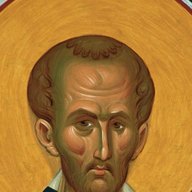
St. John ChrysostomHomily 6 on Hebrews · on Hebrews 4:1–2
"Let us fear lest a promise being left us of entering into His rest, any of you should seem to come short of it; for to us was the Gospel preached as well as unto them when it is said, To-day if ye hear His voice" (for "To-day" is "at every time"). Then he adds "but the word of hearing did not profit them, as they…
St. John ChrysostomHomily 6 on Hebrews · on Hebrews 4:1–2
Then, again, from gloomy ones, "Let us fear, lest at any time a promise being left us of entering into His rest, any of you should seem to come short of it." For that is manifest and confessed.
For unto us was the gospel preached, as well as unto them: but the word preached did not profit them, not being mixed with faith in them that heard it.
For we which have believed do enter into rest, as he said, As I have sworn in my wrath, if they shall enter into my rest: although the works were finished from the foundation of the world.
St. John ChrysostomHomily 6 on Hebrews · on Hebrews 4:3
For "we who have believed," he says, "do enter into rest." From what this is evident, he adds: "as He said, as I have sworn in My wrath, if they shall enter into My rest: although the works were finished from the foundation of the world." This indeed, is not evidence that we shall enter in, but that they did not enter…
St. John ChrysostomHomily 6 on Hebrews · on Hebrews 4:4–5
For because he means this, he says, "For he spake in a certain place of the seventh day on this wise, And God did rest the seventh day from all His works. And in this place again, If they shall enter into My rest." Thou seest how that doth not hinder this from being a rest?
St. John ChrysostomHomily 6 on Hebrews · on Hebrews 4:6–7
"Seeing therefore it remaineth" (he says) "that some must enter therein, and they to whom it was first preached entered not in because of unbelief: again he limiteth a certain day, saying in David, To-day, after so long a time; as it has been said before." But what is it that he means? "Seeing then" (he means) that…
Again, he limiteth a certain day, saying in David, To day, after so long a time; as it is said, To day if ye will hear his voice, harden not your hearts.
St. John ChrysostomHomily 6 on Hebrews · on Hebrews 4:8
"For if Joshua had given them rest he would not afterward have spoken of another day." It is evident, that he says these things, as of persons who are to attain some recompense.
There remaineth therefore a rest to the people of God.
ἄρα ἀπολείπεται σαββατισμὸς τῷ λαῷ τοῦ Θεοῦ.
St. John ChrysostomHomily 6 on Hebrews · on Hebrews 4:9
"There remaineth therefore a rest for the people of God." Whence does this appear? From the exhortation, "Harden not your hearts": for if there were no rest, these exhortations would not have been given. Neither would they have been exhorted not to do the same things with the Jews lest they should suffer the same…
St. John ChrysostomHomily 6 on Hebrews · on Hebrews 4:9
What then does he say? "There remaineth therefore a rest for the people of God." And see how he has summed up the whole argument. "He sware," saith he, to those former ones, "that they should not enter into" the "rest," and they did not enter in. Then long after their time discoursing to the Jews, he says, "Harden not…
St. John ChrysostomHomily 6 on Hebrews · on Hebrews 4:10
However it is not he who spoke thus, but what? "For he that is entered into his rest, he also hath ceased from his own works, as God did from His." As God ceased from His works, he says, so he that hath entered into His rest hath ceased. For since his discourse to them was concerning rest, and they were desirous to…
St. John ChrysostomHomily 7 on Hebrews · on Hebrews 4:11
Faith is indeed great and bringeth salvation, and without it, it is not possible ever to be saved. It suffices not however of itself to accomplish this, but there is need of a right conversation also. So that on this account Paul also exhorts those who had already been counted worthy of the mysteries; saying, "Let us…
St. John ChrysostomHomily 7 on Hebrews · on Hebrews 4:11
But what is, "after the same example of unbelief"? As if one should say, why did they of old not see the land? They had received an earnest of the power of God; they ought to have believed, but yielding too much to fear and imagining nothing great concerning God, and being faint-hearted,-so they perished. And there is…
For the word of God is quick, and powerful, and sharper than any twoedged sword, piercing even to the dividing asunder of soul and spirit, and of the joints and marrow, and is a discerner of the thoughts and intents of the heart.
St. John ChrysostomHomily 7 on Hebrews · on Hebrews 4:12
In the next place, lest hearing the words "after the same example," thou shouldest think that the punishment is the same, hear what he adds; "For the Word of God is quick and powerful, and sharper than any two-edged sword, and pierceth even to the dividing asunder of soul and spirit, and of the joints and marrow, and…
St. John ChrysostomHomily 7 on Hebrews · on Hebrews 4:12
For lest on hearing the things that belong to the soul we should grow negligent, he adds also what concerns the body. For then it is as a king, when his officers are guilty of some great fault, first strips them (say) of their command, and after depriving them of their belt, and their rank, and their herald, then…
St. John ChrysostomHomily 6 on Hebrews · on Hebrews 4:12
Then, lest any think that they will simply be deprived of rest only, he adds also the punishment, saying, "For the Word of God is quick, and powerful; and sharper than any two-edged sword, and pierceth even to the dividing asunder of soul and spirit, and of the joints and marrow: and is a discerner of the thoughts and…
St. John ChrysostomHomily 7 on Hebrews · on Hebrews 4:13
And why speak I of men? he says. For even if thou speak of Angels, of Archangels, of the Cherubim, of the Seraphim, even of any "creature" whatsoever: all things are laid open to that Eye, all things are clear and manifest; there is nothing able to escape it; "All things are naked and opened unto the eyes of Him, with…
St. John ChrysostomHomily 7 on Hebrews · on Hebrews 4:14
These things indeed (he would say) are sufficient to instruct us. But we have also "a great High Priest, that is passed into the heavens, Jesus the Son of God." Because he added it, for this reason he went on, "For we have not an High Priest who cannot be touched with the feeling of our infirmities." Therefore he said…
For we have not an high priest which cannot be touched with the feeling of our infirmities; but was in all points tempted like as we are, yet without sin.
St. John ChrysostomHomily 7 on Hebrews · on Hebrews 4:15
"For we have not an High Priest, who cannot be touched with the feeling of our infirmities." He is not (he means) ignorant of what concerns us, as many of the High Priests, who know not those in tribulations, nor that there is tribulation at any time. For in the case of men it is impossible that one should know the…
St. John ChrysostomHomily 7 on Hebrews · on Hebrews 4:16
"Let us come then boldly with confidence unto the throne of His grace, that we may obtain mercy, and find grace to help in time of need." What "throne of grace" is he speaking of? that royal throne concerning which it is said, "The Lord said unto my Lord, Sit Thou on My right hand." (Ps. cx. 1.) What is "let us come…
Every note is a real passage, quoted word for word from a published English translation, with its source. Nothing here is summarised or written by us. Some verses have many notes and some have none, because the Fathers wrote more on some passages than others.
St. John Chrysostom, Homilies on Hebrews, Nicene and Post-Nicene Fathers, series 1, vol. 14 (1888–1889).
Scripture: the King James Version (1611); the Greek (tap Ελ) is the 1904 Patriarchal text of the Ecumenical Patriarchate.
All of these translations are in the public domain. The passages were matched to their verses by the Historical Christian Commentaries project, which also hosts the full texts we link to. The Fathers are a treasury of the Church's mind, and they are best read alongside the life of the Church: if a passage raises a question, bring it to your priest.