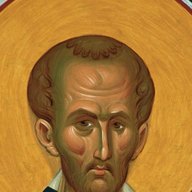
St. John ChrysostomHomily 12 on Hebrews · on Hebrews 7:1
Paul wishing to show the difference between the New and Old Covenant, scatters it everywhere; and shoots from afar, and noises it abroad, and prepares beforehand. For at once even from the introduction, he laid down this saying, that "to them indeed He spake by prophets, but to us by the Son," and to them "at sundry…
To whom also Abraham gave a tenth part of all; first being by interpretation King of righteousness, and after that also King of Salem, which is, King of peace;
St. John ChrysostomHomily 12 on Hebrews · on Hebrews 7:2
And first from the name. "First" (he says) "being by interpretation King of righteousness": for Sedec means "righteousness"; and Melchi, "King": Melchisedec, "King of righteousness." Seest thou his exactness even in the names? But who is "King of righteousness," save our Lord Jesus Christ? "King of righteousness. And…
Without father, without mother, without descent, having neither beginning of days, nor end of life; but made like unto the Son of God; abideth a priest continually.
St. John ChrysostomHomily 12 on Hebrews · on Hebrews 7:3
He then adds another distinction, "Without father, without mother, without genealogy, having neither beginning of days nor end of life, but made like unto the Son of God, abideth a Priest continually." Since then there lay in his way as an objection the words "Thou art a Priest for ever, after the order of…
St. John ChrysostomHomily 12 on Hebrews · on Hebrews 7:4
"Now consider" (saith he) "how great this man is to whom even the Patriarch Abraham gave the tenth of the spoils." Up to this point he has been applying the type: henceforward he boldly shows him Melchisedec to be more glorious than the Jewish realities. But if he who bears a type of Christ is so much better not…
And verily they that are of the sons of Levi, who receive the office of the priesthood, have a commandment to take tithes of the people according to the law, that is, of their brethren, though they come out of the loins of Abraham:
St. John ChrysostomHomily 12 on Hebrews · on Hebrews 7:5
"And verily they that are of the sons of Levi who receive the office of Priesthood, have a commandment to take tithes of the people according to the law, that is, of their brethren, though they come out of the loins of Abraham." So great (he would say) is the superiority of the priesthood, that they who from their…
St. John ChrysostomHomily 12 on Hebrews · on Hebrews 7:6
"But he whose descent is not counted from them, received tithes of Abraham." And after that he did not simply pass on, but added, "and blessed him that had the promises." Inasmuch as throughout, this was regarded with reverence, he shows that Melchisedec was to be reverenced more than Abraham, from the common judgment…
St. John ChrysostomHomily 12 on Hebrews · on Hebrews 7:7
And after that he did not simply pass on, but added, "and blessed him that had the promises." Inasmuch as throughout, this was regarded with reverence, he shows that Melchisedec was to be reverenced more than Abraham, from the common judgment of all men. "And without all contradiction," he says, "the less is blessed…
St. John ChrysostomHomily 12 on Hebrews · on Hebrews 7:8
"And here men that die receive tithes: but there he of whom it is testified that he liveth." But lest we should say, Tell us, why goest thou so far back? He says, "And as I may so say" (and he did well in softening it) "Levi also who receiveth tithes payed tithes in Abraham." How? "For he was yet in his loins when…
St. John ChrysostomHomily 12 on Hebrews · on Hebrews 7:9–10
How? "For he was yet in his loins when Melchisedec met him," i.e. Levi was in him, although he was not yet born. And he said not the Levites but Levi. Hast thou seen the superiority? Hast thou seen how great is the interval between Abraham and Melchisedec, who bears the type of our High Priest? And he shows that the…
If therefore perfection were by the Levitical priesthood, (for under it the people received the law,) what further need was there that another priest should rise after the order of Melchisedec, and not be called after the order of Aaron?
St. John ChrysostomHomily 13 on Hebrews · on Hebrews 7:11
"If therefore" (he says) "perfection were by the Levitical priesthood." Having spoken concerning Melchisedec, and shown how much superior he was to Abraham, and having set forth the great difference between them, he begins from this point forward to prove the wide difference as to the covenant itself, and how the one…
St. John ChrysostomHomily 13 on Hebrews · on Hebrews 7:11
"For under it the people have received the Law [or have been legislated for]." What is "under it"? Ordereth itself by it; through it does all things. You cannot say that it was given to others, "the people under it have received the law," that is, have used it, and did use it. You cannot say indeed that it was…
St. John ChrysostomHomily 13 on Hebrews · on Hebrews 7:12
What need was there then of another priesthood? "For the priesthood being changed, there is of necessity a change of the law also." But if there must be another priest, or rather another priesthood, there must needs be also another law. This is for those who say, What need was there of a new Covenant? For he could…
St. John ChrysostomHomily 13 on Hebrews · on Hebrews 7:12
In the next place, as to the ground of objection: "How could He be a priest if He were not a Levite?" Having overthrown this by what had been said above, he does not even think it worth answering, but introduces it in passing. I said (he means) that the priesthood was changed, therefore also the Covenant is. And it…
St. John ChrysostomHomily 13 on Hebrews · on Hebrews 7:13–14
"For He of whom these things are spoken pertained to another tribe, of which no man gave attendance at the altar. For it is evident that our Lord sprang out of Judah, of which tribe Moses spake nothing concerning priests." I myself also say it, I know that this tribe of Judah had nothing of priesthood. For there is a…
St. John ChrysostomHomily 13 on Hebrews · on Hebrews 7:15
"And it is yet far more evident, if after the similitude of Melchisedec there ariseth another priest." What is evident? The interval between the two priesthoods, the difference; how much superior He is "who was made not according to the law of a carnal commandment." (Who? Melchisedec? Nay; but Christ.)
St. John ChrysostomHomily 13 on Hebrews · on Hebrews 7:16–17
Yea and I am showing another difference also (he would say): not only from the tribe, nor yet only from the Person, nor from the character of the Priesthood, nor from the covenant, but also from the type itself. "Who was made not according to the law of a carnal commandment, but according to the power of an endless…
St. John ChrysostomHomily 13 on Hebrews · on Hebrews 7:16–17
"But according to the power of an endless life. For He testifieth, Thou art a Priest for ever after the order of Melchisedec"; that is, not for a time, nor having any limit, "but according to the power of an endless life," that is, by means of power, by means of "endless life." And yet this does not follow after, "who…
St. John ChrysostomHomily 13 on Hebrews · on Hebrews 7:18
"For there is verily a disannulling of the commandment going before, for the weakness and unprofitableness thereof." Here the Heretics press on. But listen attentively. He did not say "for the evil," nor, "for the viciousness," but "for the weakness and unprofitableness thereof," yea and in other places also he shows…
St. John ChrysostomHomily 13 on Hebrews · on Hebrews 7:19
"For the Law made nothing perfect." What is, "make nothing perfect"? Made no man perfect, being disobeyed. And besides, even if it had been listened to, it would not have made one perfect and virtuous. But as yet he does not say this here, but that it had no strength: and with good reason. For written precepts were…
St. John ChrysostomHomily 13 on Hebrews · on Hebrews 7:19
"But the bringing in of a better hope." For that system also had a hope, but not such as this. For they hoped that, if they were well pleasing to God, they should possess the land, that they should suffer nothing fearful. But in this dispensation we hope that, if we are well pleasing to God, we shall possess not…
St. John ChrysostomHomily 13 on Hebrews · on Hebrews 7:20
"And forasmuch as not without the taking of an oath." Thou seest that the matter of the oath becomes necessary for him here. Accordingly for this reason he previously treated much hereon, how that God swore; and swore for the sake of our fuller assurance.
(For those priests were made without an oath; but this with an oath by him that said unto him, The Lord sware and will not repent, Thou art a priest for ever after the order of Melchisedec:)
St. John ChrysostomHomily 13 on Hebrews · on Hebrews 7:21–24
"And inasmuch as not without an oath." What is "And inasmuch as not without an oath"? That is, Behold another difference also. And these things were not merely promised (he says). "For those priests were made without an oath, but This with an oath, by Him that said unto Him, The Lord swore and will not repent, Thou…
St. John ChrysostomHomily 13 on Hebrews · on Hebrews 7:25
"Wherefore He is able also to save them to the uttermost, that come unto God by Him, seeing He ever liveth to make intercession for them." Thou seest that he says this in respect of that which is according to the flesh. For when He appears as Priest, then He also intercedes. Wherefore also when Paul says, "who also…
St. John ChrysostomHomily 13 on Hebrews · on Hebrews 7:26
"For such an High Priest also became us, who is holy, harmless, undefiled, separate from the sinners." Thou seest that the whole is said with reference to the manhood. (But when I say "the manhood," I mean the manhood having Godhead; not dividing one from the other, but leaving you to suppose what is suitable.) Didst…
Who needeth not daily, as those high priests, to offer up sacrifice, first for his own sins, and then for the people’s: for this he did once, when he offered up himself.
St. John ChrysostomHomily 13 on Hebrews · on Hebrews 7:27
Does then this alone show the difference, or does the sacrifice itself also? How? "He needeth not daily, as the High Priest, to offer up sacrifices for his sins, for this He did once for all, when He offered up Himself." "This," what? Here what follows sounds a prelude concerning the exceeding greatness of the…
For the law maketh men high priests which have infirmity; but the word of the oath, which was since the law, maketh the Son, who is consecrated for evermore.
St. John ChrysostomHomily 13 on Hebrews · on Hebrews 7:28
"But the word of the oath which was since the Law maketh the Son who has been consecrated for evermore." "Consecrated": what is that? Paul does not set down the common terms of contradistinction; for after saying "having Infirmity," he did not say "the Son" who is mighty, but "consecrated": i.e. mighty, as one might…
Every note is a real passage, quoted word for word from a published English translation, with its source. Nothing here is summarised or written by us. Some verses have many notes and some have none, because the Fathers wrote more on some passages than others.
St. John Chrysostom, Homilies on Hebrews, Nicene and Post-Nicene Fathers, series 1, vol. 14 (1888–1889).
Scripture: the King James Version (1611); the Greek (tap Ελ) is the 1904 Patriarchal text of the Ecumenical Patriarchate.
All of these translations are in the public domain. The passages were matched to their verses by the Historical Christian Commentaries project, which also hosts the full texts we link to. The Fathers are a treasury of the Church's mind, and they are best read alongside the life of the Church: if a passage raises a question, bring it to your priest.