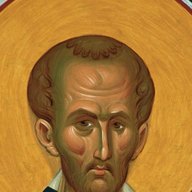
St. John ChrysostomHomily 64 on Matthew · on Matthew 20:1–16
"For the kingdom of Heaven," He said, "is like to a man that is an householder, which went out early in the morning to hire laborers into his vineyard. And when he had agreed with them for a penny a day, he sent them into his vineyard." "And at the third hour he saw others standing idle, and to them too he said, Go ye…
So when even was come, the lord of the vineyard saith unto his steward, Call the labourers, and give them their hire, beginning from the last unto the first.
St. John ChrysostomHomily 65 on Matthew · on Matthew 20:17–19
He goeth not up at once to Jerusalem when He is come out of Galilee, but having first wrought miracles, and having stopped the mouths of Pharisees, and having discoursed with His disciples of renouncing possessions: for, "if thou wilt be perfect," saith He, "sell that thou hast:" and of virginity, "He that is able to…
St. John ChrysostomHomily 65 on Matthew · on Matthew 20:20–23
So far at least were they from understanding clearly what He said, that the sons of Zebedee at the same time came to Him, and spake to Him of precedence. "We desire," it is said, "that one should sit on Thy right hand, and one on Thy left." How then doth this evangelist say, that their mother came to Him? It is…
And he said unto her, What wilt thou? She saith unto him, Grant that these my two sons may sit, the one on thy right hand, and the other on the left, in thy kingdom.
But Jesus answered and said, Ye know not what ye ask. Are ye able to drink of the cup that I shall drink of, and to be baptized with the baptism that I am baptized with? They say unto him, We are able.
And he saith unto them, Ye shall drink indeed of my cup, and be baptized with the baptism that I am baptized with: but to sit on my right hand, and on my left, is not mine to give, but it shall be given to them for whom it is prepared of my Father.
And when the ten heard it, they were moved with indignation against the two brethren.
καὶ ἀκούσαντες οἱ δέκα ἠγανάκτησαν περὶ τῶν δύο ἀδελφῶν.
St. John ChrysostomHomily 65 on Matthew · on Matthew 20:24–28
"Then were the ten moved with indignation with respect to the two." Then. When? When He had reproved them. So long as the judgment was Christ's, they were not moved with indignation; but seeing them preferred, they were contented, and held their peace, out of reverence and honor to their Master. And if they were vexed…
But Jesus called them unto him, and said, Ye know that the princes of the Gentiles exercise dominion over them, and they that are great exercise authority upon them.
St. John ChrysostomHomily 66 on Matthew · on Matthew 20:29–34
But let us keep to the things set before us, and let us listen to these blind men, who were better than many that see. For neither having a guide, nor being able to see Him when come near to them, nevertheless they strove to come unto Him, and began to cry with a loud voice, and when rebuked for speaking, they cried…
St. John ChrysostomHomily 66 on Matthew · on Matthew 20:29–34
Wherefore doth He ask them? Lest any one should think that when they wish to receive one thing, He giveth them another thing. For indeed it is usual with Him on every occasion, first to make manifest and discover to all the virtue of those He is healing, and then to apply the cure, for one reason, that He might lead…
And, behold, two blind men sitting by the way side, when they heard that Jesus passed by, cried out, saying, Have mercy on us, O Lord, thou son of David.
Every note is a real passage, quoted word for word from a published English translation, with its source. Nothing here is summarised or written by us. Some verses have many notes and some have none, because the Fathers wrote more on some passages than others.
St. John Chrysostom, Homilies on the Gospel of Matthew, Nicene and Post-Nicene Fathers, series 1, vol. 10 (1888–1889).
Scripture: the King James Version (1611); the Greek (tap Ελ) is the 1904 Patriarchal text of the Ecumenical Patriarchate.
All of these translations are in the public domain. The passages were matched to their verses by the Historical Christian Commentaries project, which also hosts the full texts we link to. The Fathers are a treasury of the Church's mind, and they are best read alongside the life of the Church: if a passage raises a question, bring it to your priest.