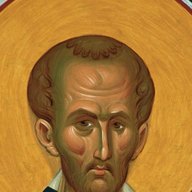
St. John ChrysostomHomily 85 on Matthew · on Matthew 27:1–2
For because they were desirous to put Him to death, but were not able themselves because of the feast, they lead Him to the governor. But mark, I pray thee, how the act was forced on, so as to take place at the feast. For so was it typified from the first.
Then Judas, which had betrayed him, when he saw that he was condemned, repented himself, and brought again the thirty pieces of silver to the chief priests and elders,
St. John ChrysostomHomily 85 on Matthew · on Matthew 27:3–5
This was a charge both against him, and against these men; against him, not because he repented, but because he did so, late, and slowly, and became self-condemned (for that he delivered Him up, he himself confessed); and against them, for that having the power to reverse it, they repented not. But mark, when it is…
St. John ChrysostomHomily 85 on Matthew · on Matthew 27:6–10
What then did that man? When he saw that he was laboring to no profit, and that they would not consent to receive the pieces of silver, "he cast them down in the temple, and went and hanged himself. And the chief priests took the pieces of silver, and said, it is not lawful for to put them into the treasury, because…
Then was fulfilled that which was spoken by Jeremy the prophet, saying, And they took the thirty pieces of silver, the price of him that was valued, whom they of the children of Israel did value;
St. John ChrysostomHomily 86 on Matthew · on Matthew 27:11–12
Seest thou what He is first asked? which thing most of all they were continually bringing forward in every way? For since they saw Pilate making no account of the matters of the law, they direct their accusation to the state charges. So likewise did they in the case of the apostles, ever bringing forward these things,…
Then said Pilate unto him, Hearest thou not how many things they witness against thee?
τότε λέγει αὐτῷ ὁ Πιλᾶτος· οὐκ ἀκούεις πόσα σου καταμαρτυροῦσι;
St. John ChrysostomHomily 86 on Matthew · on Matthew 27:13
What then saith Pilate? "Hearest thou not how many things these witness against thee?" He wished that He should defend Himself and be acquitted, wherefore also he said these things; but since He answered nothing, he devises another thing again. Of what nature was this? It was a custom for them to release one of the…
When he was set down on the judgment seat, his wife sent unto him, saying, Have thou nothing to do with that just man: for I have suffered many things this day in a dream because of him.
St. John ChrysostomHomily 86 on Matthew · on Matthew 27:19
"And when he was set down on the judgment seat, his wife sent unto him, saying, have thou nothing to do with this just man, for I have suffered many things this day in a dream because of Him." See what a thing takes place again, sufficient to recall them all. For together with the proof from the things done, the dream…
St. John ChrysostomHomily 86 on Matthew · on Matthew 27:20
See how much care he taketh for them to relieve them from blame, and how much diligence they employed, so as not to leave to themselves so much as a shadow of an excuse. For which was right? to let go the acknowledged criminal, or Him about whose guilt there was a question? For, if in the case of acknowledged…
St. John ChrysostomHomily 86 on Matthew · on Matthew 27:22
Since therefore they ask for the other, He saith, "What shall I do then with the Christ," in this way desiring to put them to the blush, by giving them the power to choose, that at least out of shame they might ask for Him, and the whole should be of their bountifulness. For though to say, He had not done wrong, made…
When Pilate saw that he could prevail nothing, but that rather a tumult was made, he took water, and washed his hands before the multitude, saying, I am innocent of the blood of this just person: see ye to it.
St. John ChrysostomHomily 87 on Matthew · on Matthew 27:25
For as though they were afraid lest they should seem to fall short at all in the crime, having killed the prophets with their own hands, but this man with the sentence of a judge, so they do in every deed; and make it the work of their own hands, and condemn and sentence both among themselves and before Pilate,…
St. John ChrysostomHomily 86 on Matthew · on Matthew 27:25
What then did they? When they saw the judge washing his hands, and saying, "I am innocent," they cried out "His blood be on us, and on our children." Then at length when they had given sentence against themselves, he yielded that all should be done. See here too their great madness. For passion and wicked desire are…
St. John ChrysostomHomily 86 on Matthew · on Matthew 27:26
"Then released he Barabbas unto them, but Jesus, when he had scourged Him, he delivered to be crucified." And wherefore did he scourge Him. Either as one condemned, or willing to invest the judgment with due form, or to please them. And yet he ought to have resisted them. For indeed even before this he had said, "Take…
St. John ChrysostomHomily 87 on Matthew · on Matthew 27:27–30
As though on some signal the devil then was entering in triumph into all. For, be it that Jews pining with envy and jealousy were mad against Him, as to the soldiers, whence was it, and from what sort of cause? Is it not clear that it was the devil who was then entering in fury into the hearts of all? For indeed they…
And when they had platted a crown of thorns, they put it upon his head, and a reed in his right hand: and they bowed the knee before him, and mocked him, saying, Hail, King of the Jews!
St. John ChrysostomHomily 87 on Matthew · on Matthew 27:34
And they gave Him gall to drink, and this to insult Him, but He would not. But another saith, that having tasted it, He said, "It is finished." And what meaneth, "It is finished?" The prophecy was fulfilled concerning Him. "For they gave me," it is said, "gall for my meat, and for my thirst they gave me vinegar to…
And they crucified him, and parted his garments, casting lots: that it might be fulfilled which was spoken by the prophet, They parted my garments among them, and upon my vesture did they cast lots.
St. John ChrysostomHomily 87 on Matthew · on Matthew 27:35–36
For after "they had mocked Him, they led Him to crucify Him," it is said, and when they had stripped Him, they took His garments, and sat down and watched Him, when He should die. And they divide His garments amongst them, which sort of thing is done in the case of very vile and abject criminals, and such as have no…
St. John ChrysostomHomily 87 on Matthew · on Matthew 27:35–38
They parted the garments, by which such great miracles were done. But they wrought none now, Christ restraining His unspeakable power. And this was no small addition of insult. For as to one base and abject, as I said, and the vilest of all men; so do they dare to do all things. To the thieves at any rate they did…
St. John ChrysostomHomily 87 on Matthew · on Matthew 27:39
But nevertheless not even here doth their contumely stop, but after having stripped and crucified Him, and offered Him vinegar, they proceeded still further, and beholding Him impaled upon the cross, they revile Him, both they themselves and the passers by; and this was more grievous than all, that on the charge of…
St. John ChrysostomHomily 87 on Matthew · on Matthew 27:40
And yet who would not have been moved by the multitude that was following Him, and lamenting Him? Nay, not these wild beasts. Wherefore also He to the multitude vouchsafes an answer, but to these men not so. For after having done what they would, they endeavor also to injure His honor, fearing His resurrection.…
St. John ChrysostomHomily 87 on Matthew · on Matthew 27:42–43
Wherefore they said those things, and also these. If "He is the king of Israel, let Him come down now from the cross. He saved others, Himself He cannot save," aiming hereby to bring discredit even on His former miracles. And again, "If He be Son of God, and He will have Him, let Him save Him." O execrable; most…
St. John ChrysostomHomily 87 on Matthew · on Matthew 27:43
O execrable; most execrable! What, were not the prophets prophets, nor the righteous men righteous, because God rescued them not out of their dangers. Nay surely they were, though suffering these things. What then could be equal to your folly? For if the coming of the dangers upon them did not injure their honor with…
St. John ChrysostomHomily 87 on Matthew · on Matthew 27:44
Yet nevertheless, even when these things were said and done, they prevailed nothing, not even at the very time. At any rate, he, who was depraved in such great wickedness, and who had spent his whole life in murders and house-breakings, when these things were being said, then confessed Him, and made mention of a…
St. John ChrysostomHomily 88 on Matthew · on Matthew 27:45
This is the sign which before He had promised to give them when they asked it, saying, "An evil and adulterous generation seeketh after a sign, and there shall no sign be given to it, but the sign of the prophet Jonas;" meaning His cross, and His death, His burial, and His resurrection. And again, declaring in another…
St. John ChrysostomHomily 88 on Matthew · on Matthew 27:46
And for this reason, even after this He speaks, that they might learn that He was still alive, and that He Himself did this, and that they might become by this also more gentle, and He saith, "Eli, Eli, lama sabachthani?" that unto His last breath they might see that He honors His Father, and is no adversary of God.…
St. John ChrysostomHomily 88 on Matthew · on Matthew 27:48
But mark herein also their wantonness, and intemperance, and folly. They thought (it is said) that it was Elias whom He called, and straightway they gave Him vinegar to drink. But another came unto Him, and "pierced His side with a spear." What could be more lawless, what more brutal, than these men; who carried their…
St. John ChrysostomHomily 88 on Matthew · on Matthew 27:50
"And Jesus, when He had cried with a loud voice, yielded up the Ghost." This is what He said, "I have power to lay down my life, and I have power to take it again," and, "I lay it down of myself." So for this cause He cried with the voice, that it might be shown that the act is done by power. Mark at any rate saith,…
St. John ChrysostomHomily 88 on Matthew · on Matthew 27:51
This cry rent the veil, and opened the tombs, and made the house desolate. And He did this, not as offering insult to the temple (for how should He, who saith, "Make not my Father's house a house of merchandise," but declaring them to be unworthy even of His abiding there; like as also when He delivered it over to the…
St. John ChrysostomHomily 88 on Matthew · on Matthew 27:51
Marvel not therefore if at this time also they were perverse, being thus altogether prepared to set themselves impudently against all things; but observe this other point, how great signs He had wrought, some from Heaven, some on earth, some in the very temple, at once marking His indignation, and at the same time…
St. John ChrysostomHomily 88 on Matthew · on Matthew 27:52–53
And together with these things He showed Himself also by what followed after these things, by the raising of the dead. For in the instance of Elisha; one on touching a dead body rose again, but now by a voice He raised them, His body continuing up there, on the cross. And besides, those things were a type of this. For…
St. John ChrysostomHomily 88 on Matthew · on Matthew 27:52–53
For if for Lazarus to rise on the fourth day was a great thing, how much more for all those who had long ago fallen asleep, at once to appear alive, which was a sign of the future resurrection. For, "many bodies of the saints which slept, arose," it is said, "and went into the holy city, and appeared to many." For in…
Now when the centurion, and they that were with him, watching Jesus, saw the earthquake, and those things that were done, they feared greatly, saying, Truly this was the Son of God.
St. John ChrysostomHomily 88 on Matthew · on Matthew 27:54
And the Centurion too then glorified God, saying, "Truly this was a righteous man. And the multitudes that came together to that sight, returned beating their breasts." So great was the power of the crucified, that after so many mockings, and scoffs, and jeers, both the centurion was moved to compunction, and the…
St. John ChrysostomHomily 88 on Matthew · on Matthew 27:55–56
"And many women were there beholding afar off, which had followed Him, ministering unto Him, Mary Magdalene, and Mary the mother of James, and Joses, and the mother of Zebedee's sons." These things the women see done, these who were most inclined to feel for Him, who were most of all bewailing Him. And mark how great…
St. John ChrysostomHomily 88 on Matthew · on Matthew 27:57–60
"But Joseph went, and begged the body." This was Joseph, who was concealing his discipleship of late; now however he had become very bold after the death of Christ. For neither was he an obscure person, nor of the unnoticed; but one of the council, and highly distinguished; from which circumstance especially one may…
St. John ChrysostomHomily 88 on Matthew · on Matthew 27:61
"And there was Mary Magdalene, and the other Mary, sitting over against the sepulchre." For what purpose do these wait by it? As yet they knew nothing great, as was meet, and high about Him, wherefore also they had brought ointments, and were waiting at the tomb, so that if the madness of the Jews should relax, they…
St. John ChrysostomHomily 89 on Matthew · on Matthew 27:62–66
Everywhere deceit recoils upon itself, and against its will supports the truth. And observe. It was necessary for it to be believed that He died, and that He rose again, and that He was buried, and all these things are brought to pass by His enemies. See, at any rate, these words bearing witness to every one of these…
Command therefore that the sepulchre be made sure until the third day, lest his disciples come by night, and steal him away, and say unto the people, He is risen from the dead: so the last error shall be worse than the first.
Every note is a real passage, quoted word for word from a published English translation, with its source. Nothing here is summarised or written by us. Some verses have many notes and some have none, because the Fathers wrote more on some passages than others.
St. John Chrysostom, Homilies on the Gospel of Matthew, Nicene and Post-Nicene Fathers, series 1, vol. 10 (1888–1889).
Scripture: the King James Version (1611); the Greek (tap Ελ) is the 1904 Patriarchal text of the Ecumenical Patriarchate.
All of these translations are in the public domain. The passages were matched to their verses by the Historical Christian Commentaries project, which also hosts the full texts we link to. The Fathers are a treasury of the Church's mind, and they are best read alongside the life of the Church: if a passage raises a question, bring it to your priest.