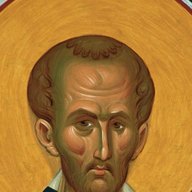
St. John ChrysostomHomily 13 on Matthew · on Matthew 4:1
Then When? After the descent of the Spirit, after the voice that was borne from above, and said, "This is My Beloved Son, in whom I am well pleased." And what was marvellous, it was of the Holy Spirit; for this, he here saith, led Him up. For since with a view to our instruction He both did and underwent all things;…
St. John ChrysostomHomily 13 on Matthew · on Matthew 4:2
Having then found Him in the wilderness, and in a pathless wilderness (for that the wilderness was such, Mark hath declared, saying, that He "was with the wild beasts"), behold with how much craft he draws near, and wickedness; and for what sort of opportunity he watches. For not in his fast, but in his hunger he…
St. John ChrysostomHomily 13 on Matthew · on Matthew 4:3
But that we may not, by hurrying over these victories, mar your profit, let us begin from the first assault, and examine each with exact care. Thus, after He was an hungered, it is said, "The tempter came, and said unto Him, If Thou be Son of God, command that these stones be made bread." For, because he had heard a…
St. John ChrysostomHomily 13 on Matthew · on Matthew 4:4
What then saith Christ? To put down his pride, and to signify that there was nothing shameful in what had happened, nor unbecoming His wisdom; that which the other had passed over in silence to flatter Him, He brings forward and sets it forth, saying, "Man shall not live by bread alone." So that He begins with the…
And saith unto him, If thou be the Son of God, cast thyself down: for it is written, He shall give his angels charge concerning thee: and in their hands they shall bear thee up, lest at any time thou dash thy foot against a stone.
St. John ChrysostomHomily 13 on Matthew · on Matthew 4:6
What then doth this accursed one? Overcome, and unable to persuade Him to do his bidding, and that when pressed by such violent hunger, he proceeds to another thing, saying, "If Thou be Son of God, cast Thyself down; for it is written, He shall give His angels charge concerning Thee, and in their hands they shall bear…
St. John ChrysostomHomily 13 on Matthew · on Matthew 4:7
How then doth Christ? He is not indignant, nor provoked, but with that extreme gentleness He reasons with him again from the Scriptures, saying, "Thou shalt not tempt the Lord thy God:" teaching us that we must overcome the devil, not by miracles, but by forbearance and long-suffering, and that we should do nothing at…
St. John ChrysostomHomily 13 on Matthew · on Matthew 4:9
And how saith Luke, that "he ended all temptation." To me it seems that in mentioning the chief of the temptations, he had spoken of all, as though the rest too were included in these. For the things that form the substance of innumerable evils are these: to be a slave to the belly, to do anything for vainglory, to be…
St. John ChrysostomHomily 13 on Matthew · on Matthew 4:10
"Then saith He, Get thee behind me, Satan, for it is written, Thou shalt worship the Lord thy God, and Him only shalt thou serve." For since he was now come to sinning against the Father, saying, that all that is the Father's was his, and was endeavoring to make himself out to be God, as artificer of the universe; He…
St. John ChrysostomHomily 13 on Matthew · on Matthew 4:11
"And, behold, angels came and ministered unto Him." For when the assault was going on, He suffered them not to appear, that He might not thereby drive away the prey; but after He had convicted him in all points, and caused him to take to flight, then they appear: that thou also mayest learn, that after thy victories…
St. John ChrysostomHomily 14 on Matthew · on Matthew 4:12
But mark, I pray thee, how in every case when He is about to depart unto the Gentiles, He hath the occasion given Him by Jews. For so in this instance, by plotting against His forerunner, and casting him into prison, they thrust out Christ into the Galilee of the Gentiles.
St. John ChrysostomHomily 14 on Matthew · on Matthew 4:12–13
Wherefore doth He depart? Again instructing us not to go to meet temptations, but to give place and withdraw ourselves. For it is no reproach, the not casting one's self into danger, but the falling to stand manfully when fallen into it. To teach us this accordingly, and to soothe the envy of the Jews, He retires to…
St. John ChrysostomHomily 14 on Matthew · on Matthew 4:15–16
But mark, I pray thee, how in every case when He is about to depart unto the Gentiles, He hath the occasion given Him by Jews. For so in this instance, by plotting against His forerunner, and casting him into prison, they thrust out Christ into the Galilee of the Gentiles. For to show that He neither speaks of the…
St. John ChrysostomHomily 14 on Matthew · on Matthew 4:16
Then implying that they did not of themselves seek and find, but that God showed Himself to them from above, he saith to them, "Light is sprung up;" that is, the light of itself sprang up and shone forth: it was not that they first ran to the light. For in truth the condition of men was at the worst before Christ's…
St. John ChrysostomHomily 14 on Matthew · on Matthew 4:17
"From that time:" what time? After John was cast into prison. And wherefore did He not preach to them from the beginning? Indeed what occasion for John at all, when the witness of His works was proclaiming Him? That hence also thou mightest learn His dignity; namely, that as the Fathers, so He too hath prophets; to…
And Jesus, walking by the sea of Galilee, saw two brethren, Simon called Peter, and Andrew his brother, casting a net into the sea: for they were fishers.
St. John ChrysostomHomily 14 on Matthew · on Matthew 4:18–19
And yet John saith that they were called in another manner. Whence it is evident that this was a second call; and from many things one may perceive this. For there it is said, that they came to Him when "John was not yet cast into prison;" but here, after he was in confinement. And there Andrew calls Peter, but here…
And they straightway left their nets, and followed him.
οἱ δὲ εὐθέως ἀφέντες τὰ δίκτυα ἠκολούθησαν αὐτῷ.
St. John ChrysostomHomily 14 on Matthew · on Matthew 4:20
But mark both their faith, and their obedience. For though they were in the midst of their work (and ye know how greedy a thing fishing is), when they heard His command they delayed not, they procrastinated not, they said not, "let us return home, and converse with our kinsfolk," but "they forsook all and followed,"…
And going on from thence, he saw other two brethren, James the son of Zebedee, and John his brother, in a ship with Zebedee their father, mending their nets; and he called them.
St. John ChrysostomHomily 14 on Matthew · on Matthew 4:21
To these, then, such was His promise: but to James and John He saith no such thing. For the obedience of those that had gone before had by this time paved the way for these. And besides they had also heard many things before concerning Him. And see how he doth with exact care intimate unto us their poverty also: in…
And Jesus went about all Galilee, teaching in their synagogues, and preaching the gospel of the kingdom, and healing all manner of sickness and all manner of disease among the people.
St. John ChrysostomHomily 14 on Matthew · on Matthew 4:23
When therefore He had caught them, then He begins in their presence to work miracles, by His deeds confirming the words of John concerning Him. And He was continually frequenting their synagogues, even by this instructing them that He was not a sort of adversary of God and deceiver, but that He was come in accordance…
And his fame went throughout all Syria: and they brought unto him all sick people that were taken with divers diseases and torments, and those which were possessed with devils, and those which were lunatick, and those that had the palsy; and he healed them.
St. John ChrysostomHomily 14 on Matthew · on Matthew 4:24
And mark the evangelist's care to avoid superfluity of words; how he tells us not of every one of them that are healed, but in a few words speeds over showers of miracles. For "they brought unto Him," saith he, "all that were sick with divers diseases, and torments, and those which were possessed with devils, and…
Every note is a real passage, quoted word for word from a published English translation, with its source. Nothing here is summarised or written by us. Some verses have many notes and some have none, because the Fathers wrote more on some passages than others.
St. John Chrysostom, Homilies on the Gospel of Matthew, Nicene and Post-Nicene Fathers, series 1, vol. 10 (1888–1889).
Scripture: the King James Version (1611); the Greek (tap Ελ) is the 1904 Patriarchal text of the Ecumenical Patriarchate.
All of these translations are in the public domain. The passages were matched to their verses by the Historical Christian Commentaries project, which also hosts the full texts we link to. The Fathers are a treasury of the Church's mind, and they are best read alongside the life of the Church: if a passage raises a question, bring it to your priest.