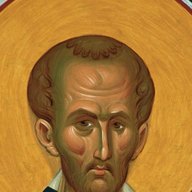
St. John ChrysostomHomily 19 on Matthew · on Matthew 6:1
He roots out in what remains the most tyrannical passion of all, the rage and madness with respect to vainglory, which springs up in them that do right. For at first He had not at all discoursed about it; it being indeed superfluous, before He had persuaded them to do any of the things which they ought, to teach in…
Therefore when thou doest thine alms, do not sound a trumpet before thee, as the hypocrites do in the synagogues and in the streets, that they may have glory of men. Verily I say unto you, They have their reward.
St. John ChrysostomHomily 19 on Matthew · on Matthew 6:2
Nor even at this did He stop, but proceeds yet further, by other motives also increasing their disgust. For as above He set forth publicans and heathens, by the quality of the person shaming their imitators, so also in this place the hypocrites. "Therefore when thou doest thine alms," saith He, "do not sound a trumpet…
St. John ChrysostomHomily 19 on Matthew · on Matthew 6:3
"Let not thy left hand know," saith He, "what thy right hand doeth." Here again His enigmatical meaning is not of the hands, but He hath put the thing hyperbolically. As thus: "If it can be," saith He, "for thyself not to know it, let this be the object of thine endeavor; that, if it were possible, it may be concealed…
St. John ChrysostomHomily 19 on Matthew · on Matthew 6:4
And then the reward too; consider how great it is. For after He had spoken of the punishment from the one, He points out also the honor derived from the other; from either side urging them, and leading them on to high lessons. Yea, for He is persuading them to know that God is everywhere present, and that not by our…
And when thou prayest, thou shalt not be as the hypocrites are: for they love to pray standing in the synagogues and in the corners of the streets, that they may be seen of men. Verily I say unto you, They have their reward.
St. John ChrysostomHomily 19 on Matthew · on Matthew 6:5–6
"And when ye pray," saith He, "ye shall not be as the hypocrites, for they love to pray standing in the synagogues, and in the corners of the streets. Verily I say unto you, they have their reward." "But thou, when thou prayest, enter into thy closet, and when thou hast shut thy door, pray to thy Father which is in…
But thou, when thou prayest, enter into thy closet, and when thou hast shut thy door, pray to thy Father which is in secret; and thy Father which seeth in secret shall reward thee openly.
St. John ChrysostomHomily 19 on Matthew · on Matthew 6:7–8
Then He speaks even the very words of the prayer. "When ye pray," saith He, "use no vain repetitions, even as the heathen do." You see that when He was discoursing of almsgiving, He removed only that mischief which comes of vainglory, and added nothing more; neither did He say whence one should give alms; as from…
St. John ChrysostomHomily 19 on Matthew · on Matthew 6:9
"After this manner, therefore, pray ye," saith He: "Our Father, which art in heaven." See how He straightway stirred up the hearer, and reminded him of all God's bounty in the beginning. For he who calls God Father, by him both remission of sins, and taking away of punishment, and righteousness, and sanctification,…
St. John ChrysostomHomily 19 on Matthew · on Matthew 6:10
"Thy kingdom come." And this again is the language of a right-minded child, not to be rivetted to things that are seen, neither to account things present some great matter; but to hasten unto our Father, and to long for the things to come. And this springs out of a good conscience, and a soul set free from things that…
St. John ChrysostomHomily 19 on Matthew · on Matthew 6:11
"Give us this day our daily bread." What is "daily bread"? That for one day. For because He had said thus, "Thy will be done in earth as it is in heaven," but was discoursing to men encompassed with flesh, and subject to the necessities of nature, and incapable of the same impassibility with the angels:-while He…
St. John ChrysostomHomily 19 on Matthew · on Matthew 6:12
Then forasmuch as it comes to pass that we sin even after the washing of regeneration, He, showing His love to man to be great even in this case, commands us for the remission of our sins to come unto God who loves man, and thus to say, "Forgive us our debts, as we also forgive our debtors." Seest thou surpassing…
St. John ChrysostomHomily 19 on Matthew · on Matthew 6:13
"And lead us not into temptation; but deliver us from the evil one: for Thine is the kingdom, and the power, and the glory, for ever. Amen." Here He teaches us plainly our own vileness, and quells our pride, instructing us to deprecate all conflicts, instead of rushing upon them. For so both our victory will be more…
St. John ChrysostomHomily 19 on Matthew · on Matthew 6:14–15
Then, as I said before, meaning to signify, that of all things He most loathes and hates bearing malice, and most of all accepts the virtue which is opposite to that vice; He hath after the prayer also again put us in mind of this same point of goodness; both by the punishment set, and by the reward appointed, urging…
Moreover when ye fast, be not, as the hypocrites, of a sad countenance: for they disfigure their faces, that they may appear unto men to fast. Verily I say unto you, They have their reward.
St. John ChrysostomHomily 20 on Matthew · on Matthew 6:16
Here it were well to sigh aloud, and to wail bitterly: for not only do we imitate the hypocrites, but we have even surpassed them. For I know, yea I know many, not merely fasting and making a display of it, but neglecting to fast, and yet wearing the masks of them that fast, and cloaking themselves with an excuse…
St. John ChrysostomHomily 20 on Matthew · on Matthew 6:17–18
As therefore, when He said, "Let not thy left hand know what thy right hand doeth," it was not of hands that He was speaking, but of the duty of being strictly concealed from all; and as when He commanded us to enter into our closet, not there alone absolutely, nor there primarily, did He command us to pray, but He…
St. John ChrysostomHomily 20 on Matthew · on Matthew 6:19
Thus, after He hath cast out the disease of vainglory, and not before, He seasonably introduces His discourse of voluntary poverty. For nothing so trains men to be fond of riches, as the fondness for glory. This, for instance, is why men devise those herds of slaves, and that swarm of eunuchs, and their horses with…
St. John ChrysostomHomily 20 on Matthew · on Matthew 6:19
But even this cloud may be easily scattered and broken, if we will receive the beam of the doctrine of Christ; if we will hear Him admonishing us, and saying, "Lay not up for yourselves treasures upon earth." "But," saith one, "what avails the hearing to me, as long as I am possessed by the desire?" Now in the first…
St. John ChrysostomHomily 20 on Matthew · on Matthew 6:20
For the present He signifies the hurtfulness of the treasure here, and the profit of what is there, both from the place, and from the things which mar it. And first, what things they most fear, from these He urges them. For "of what art thou afraid?" saith He: "lest thy goods should be spent, if thou give alms? Nay,…
St. John ChrysostomHomily 20 on Matthew · on Matthew 6:20
Seest thou how by those very things, through which most especially men everywhere affect wickedness, even by these most of all He deters them from it, and brings them back to virtue? "For with what intent dost thou desire riches?" saith He; "is it not that thou mayest enjoy pleasure and luxury? Why now, this above all…
St. John ChrysostomHomily 20 on Matthew · on Matthew 6:21
On this account then He adds another argument, which I have already mentioned, saying, "Where the man's treasure is, there is his heart also." For though none of these things should come to pass, saith He, thou wilt undergo no small harm, in being nailed to the things below, and in becoming a slave instead of a…
St. John ChrysostomHomily 20 on Matthew · on Matthew 6:22–23
What He saith is like this: Bury not gold in the earth, nor do any other such thing, for thou dost but gather it for the moth, and the rust, and the thieves. And even if thou shouldest entirely escape these evils, yet the enslaving of thine heart, the nailing it to all that is below, thou wilt not escape: "For…
St. John ChrysostomHomily 20 on Matthew · on Matthew 6:22–23
And as they that are in darkness see nothing distinct, but if they look at a rope, they suppose it to be a serpent, if at mountains and ravines, they are dead with fear; so these also: what is not alarming to them that have sight, that they regard with suspicion. Thus among other things they tremble at poverty: or…
No man can serve two masters: for either he will hate the one, and love the other; or else he will hold to the one, and despise the other. Ye cannot serve God and mammon.
St. John ChrysostomHomily 21 on Matthew · on Matthew 6:24
Seest thou how by degrees He withdraws us from the things that now are, and at greater length introduces what He hath to say, touching voluntary poverty, and casts down the dominion of covetousness? For He was not contented with His former sayings, many and great as they were, but He adds others also, more and more…
St. John ChrysostomHomily 21 on Matthew · on Matthew 6:24
Having thus, you see, spoken generally, that He might persuade the hearer to be an uncorrupt judge of His words, and to sentence according to the very nature of the things; when he hath made sure of his assent, then, and not till then, He discovers Himself. Thus He presently adds, "Ye cannot serve God and mammon." Let…
St. John ChrysostomHomily 28 on Matthew · on Matthew 6:24
These things any one may see happening now also, even many in the tombs possessed of evil spirits, whom nothing restrains from their madness; not iron, nor chain, nor multitude of men, nor advice, nor admonition, nor terror, nor threat, nor any other such thing. For so when any man is dissolute, eager after all…
Therefore I say unto you, Take no thought for your life, what ye shall eat, or what ye shall drink; nor yet for your body, what ye shall put on. Is not the life more than meat, and the body than raiment?
St. John ChrysostomHomily 21 on Matthew · on Matthew 6:25
Having now, as you see, in all ways taught the advantage of contemning riches, as well for the very preservation of the riches, as for the pleasure of the soul, and for acquiring self-command, and for the securing of godliness; He proceeds to establish the practicability of this command. For this especially pertains…
Behold the fowls of the air: for they sow not, neither do they reap, nor gather into barns; yet your heavenly Father feedeth them. Are ye not much better than they?
St. John ChrysostomHomily 21 on Matthew · on Matthew 6:26
From what we have already, then, He urges us in this way: and from examples of other things, by saying, "Behold the fowls of the air." Thus, lest any should say, "we do good by taking thought," He dissuades them both by that which is greater, and by that which is less; by the greater, i.e. the soul and the body; by…
St. John ChrysostomHomily 21 on Matthew · on Matthew 6:27
Wherefore neither did He simply say, "Take no thought what ye shall eat," or "wherewithal ye shall be clothed;" but, "for the body," and, "for the soul:" forasmuch as from them He was to make His demonstrations, carrying on His discourse in the way of comparison. Now the soul He hath given once for all, and it abides…
St. John ChrysostomHomily 21 on Matthew · on Matthew 6:27
But if thou canst not bear, upon hearing so high words, to release thyself from these grievous bonds, consider the unprofitableness of the thing, and so put an end to thy care. For "Which of you by taking thought" (saith He) "can add one cubit unto his stature." Seest thou how by that which is evident, He hath…
St. John ChrysostomHomily 22 on Matthew · on Matthew 6:28
Having spoken of our necessary food, and having signified that not even for this should we take thought, He passes on in what follows to that which is more easy. For raiment is not so necessary as food. Why then did He not make use here also of the same example, that of the birds, neither mention to us the peacock,…
St. John ChrysostomHomily 22 on Matthew · on Matthew 6:29
But if Solomon was surpassed by their beauty, and that not once nor twice, but throughout all his reign;-for neither can one say, that at one time He was clothed with such apparel, but after that He was so no more; rather not so much as on one day did He array Himself so beautifully: for this Christ declared by…
Wherefore, if God so clothe the grass of the field, which to day is, and to morrow is cast into the oven, shall he not much more clothe you, O ye of little faith?
St. John ChrysostomHomily 22 on Matthew · on Matthew 6:30
For this cause, when He hath decked them out, He doth not so much as call them lilies any more, but "grass of the field." And He is not satisfied even with this name, but again adds another circumstance of vileness, saying, "which to-day is." And He said not, "and to-morrow is not," but what is much baser yet, "is…
St. John ChrysostomHomily 22 on Matthew · on Matthew 6:31
"Therefore take no thought, saying, what shall we eat? or, what shall we drink? or, wherewithal shall we be clothed? For after all these things do the nations of the world seek." Seest thou how again He hath both shamed them the more, and hath also shown by the way, that He had commanded nothing grievous nor…
St. John ChrysostomHomily 22 on Matthew · on Matthew 6:32
He doth not however stop at the rebuke, but having by this reproved and roused them, and shamed them with all strength of expression, by another argument He also comforts them, saying, "For your Heavenly Father knoweth that ye have need of all these things." He said not, "God knoweth," but, "your Father knoweth;" to…
St. John ChrysostomHomily 22 on Matthew · on Matthew 6:33
For together with what hath been said, He puts also yet another reason for feeling confidence about such things, saying, "Seek ye the kingdom of Heaven, and all these things shall be added unto you." Thus when He had set the soul free from anxiety, then He made mention also of Heaven. For indeed He came to do away…
St. John ChrysostomHomily 22 on Matthew · on Matthew 6:34
"Take therefore no thought for the morrow: for sufficient unto the day is the evil thereof:" that is to say, the affliction, and the bruising thereof. Is it not enough for thee, to eat thy bread in the sweat of thy face? Why add the further affliction that comes of anxiety, when thou art on the point to be delivered…
Every note is a real passage, quoted word for word from a published English translation, with its source. Nothing here is summarised or written by us. Some verses have many notes and some have none, because the Fathers wrote more on some passages than others.
St. John Chrysostom, Homilies on the Gospel of Matthew, Nicene and Post-Nicene Fathers, series 1, vol. 10 (1888–1889).
Scripture: the King James Version (1611); the Greek (tap Ελ) is the 1904 Patriarchal text of the Ecumenical Patriarchate.
All of these translations are in the public domain. The passages were matched to their verses by the Historical Christian Commentaries project, which also hosts the full texts we link to. The Fathers are a treasury of the Church's mind, and they are best read alongside the life of the Church: if a passage raises a question, bring it to your priest.