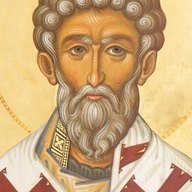
A writing of David. Keep me, O Lord; For I have hoped in thee.
Στηλογραφία τῷ Δαυίδ. Φύλαξον με Κύριε, ὅτι ἐπὶ σοὶ ἤλπισα.
Blessed AugustineExposition on Psalm 15 · on Psalm 15:1
Our King in this Psalm speaks in the character of the human nature He assumed, of whom the royal title at the time of His passion was eminently set forth. Now He saith as follows; "Preserve me, O Lord, for in Thee have I hoped" (ver. 1): "I have said to the Lord, Thou art my God, for Thou requirest not my goods" (ver.…
Blessed AugustineExposition on Psalm 15 · on Psalm 15:3
"To the saints who are on His earth": to the saints who have placed their hope in the land of the living, the citizens of the heavenly Jerusalem, whose spiritual conversation is, by the anchor of hope, fixed in that country, which is rightly called God's earth; although as yet in this earth too they be conversant in…
Their weaknesses have been multiplied; Afterward they hastened. I will by no means assemble their bloody meetings, Neither will I make mention of their names with my lips.
Blessed AugustineExposition on Psalm 15 · on Psalm 15:4
"Their infirmities have been multiplied": their infirmities have been multiplied not for their destruction, but that they might long for the Physician. "Afterwards they made haste." Accordingly after infirmities multiplied they made haste, that they might be healed. "I will not gather together their assemblies by…
Blessed AugustineExposition on Psalm 15 · on Psalm 15:5
"For You will not leave My soul in hell." For You will neither give My soul for a possession to those parts below. "Neither will You grant Your Holy One to see corruption." Neither will You suffer that sanctified body, whereby others are to be also sanctified, to see corruption.
Blessed AugustineExposition on Psalm 15 · on Psalm 15:5
"You have made known to Me the paths of life." You have made known through Me the paths of humiliation, that men might return to life, from whence they fell through pride; in whom because I am, "You have made known to Me." "You will fill Me with joy with Your countenance." You will fill them with joy, that they should…
Blessed AugustineExposition on Psalm 15 · on Psalm 15:5
"The Lord is the portion of Mine inheritance, and of My cup". For together with Me they shall possess the inheritance, the Lord Himself. Let others choose for themselves portions, earthly and temporal, to enjoy: the portion of the Saints is the Lord eternal. Let others drink of deadly pleasures, the portion of My cup…
Blessed AugustineExposition on Psalm 15 · on Psalm 15:5
"The lines have fallen to me in glorious places" (ver. 6). The boundaries of my possession have fallen in Thy glory as it were by lot, like as God is the possession of the Priests and Levites. "For Mine inheritance is glorious to Me." "For Mine inheritance is glorious," not to all, but to them that see; in whom…
Blessed AugustineExposition on Psalm 15 · on Psalm 15:5
"I will bless the Lord, who has given Me understanding": whereby this inheritance may be seen and possessed. "Yea moreover too even unto night my reins have chastened Me." Yea besides understanding, even unto death, My inferior part, the assumption of flesh, has instructed Me, that I might experience the darkness of…
Blessed AugustineExposition on Psalm 15 · on Psalm 15:5
"I foresaw the Lord in My sight always". But coming into things that pass away, I removed not My eye from Him who abides ever, foreseeing this, that to Him I should return after passing through the things temporal. "For He is on My right hand, that I should not be moved." For He favours Me, that I should abide fixedly…
Blessed AugustineExposition on Psalm 15 · on Psalm 15:5
"Wherefore My heart was glad, and My tongue exulted". Wherefore both in My thoughts is gladness, and in my words exultation. "Moreover too My flesh shall rest in hope." Moreover too My flesh shall not fail unto destruction, but shall sleep in hope of the resurrection.
Every note is a real passage, quoted word for word from a published English translation, with its source. Nothing here is summarised or written by us. Some verses have many notes and some have none, because the Fathers wrote more on some passages than others.
Blessed Augustine, Expositions on the Book of Psalms, tr. A. Cleveland Coxe from the Oxford translation, Nicene and Post-Nicene Fathers, series 1, vol. 8 (1888).
Scripture: the Septuagint, in the translation of Sir Lancelot Brenton (1851), with spelling updated by Adam Boyd (2020); the Greek is Brenton's Septuagint text.
All of these translations are in the public domain. The passages were matched to their verses by the Historical Christian Commentaries project, which also hosts the full texts we link to. The Fathers are a treasury of the Church's mind, and they are best read alongside the life of the Church: if a passage raises a question, bring it to your priest.