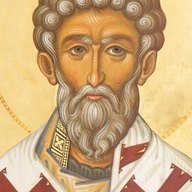
Blessed AugustineExposition on Psalm 33 · on Psalm 33:2
"I will bless the Lord at all times; His praise shall be ever in my mouth". So speaks Christ, so also let a Christian speak; for a Christian is in the Body of Christ; and therefore was Christ made Man, that that Christian might be enabled to be an Angel, who says, "I will bless the Lord at all times." When shall I…
Blessed AugustineExposition on Psalm 33 · on Psalm 33:3
But wherefore doth man bless the Lord at all times? Because he is humble. What is it to be humble? To take not praise unto himself. Who would himself be praised, is proud: who is not proud, is humble. Wouldest thou not then be proud? That thou mayest be humble, say what is here written; "In the Lord shall my soul be…
Blessed AugustineExposition on Psalm 33 · on Psalm 33:4
Now followeth, "O magnify the Lord with me" (ver. 3). Who is this that exhorteth us, that we should magnify the Lord with him? Whoever, Brethren, is in the body of Christ, ought for this to labour, that the Lord may be magnified with him. For he loveth the Lord, whoever he is. And how doth he love Him? So as not to…
Blessed AugustineExposition on Psalm 33 · on Psalm 33:5
"I sought the Lord, and He heard me" (ver. 4). Where heard the Lord? Within. Where giveth He? Within. There thou prayest, there thou art heard, there thou art blessed. Thou hast prayed, thou art heard, thou art blessed; and he knoweth not who standeth by thee: it is all carried on in secret, as the Lord saith in the…
Blessed AugustineExposition on Psalm 33 · on Psalm 33:6
I have said who was the exhorter, namely, that lover who would not alone embrace what he loveth, and saith, "Approach unto Him, and be ye lightened" (ver. 5). For he saith what he himself proved. For some spiritual person in the Body of Christ, or even our Lord Jesus Christ Himself according to the flesh, the Head…
Blessed AugustineExposition on Psalm 33 · on Psalm 33:7–8
As the Prophet testifies, "The poor man cried, and the Lord heard him". He teaches you how you may be heard. Therefore are you not heard, because you are rich. Lest haply thou say, you cried and wast not heard, hear wherefore; "The poor man cried, and the Lord heard him." As poor cry thou, and the Lord hears. And how…
Blessed AugustineExposition on Psalm 33 · on Psalm 33:9
Now will He speak openly of the same Sacrament, whereby He was carried in His Own Hands. "O taste and see that the Lord is good". Does not the Psalm now open itself, and show you that seeming insanity and constant madness, the same insanity and sober inebriety of that David, who in a figure showed I know not what,…
Blessed AugustineExposition on Psalm 33 · on Psalm 33:10–11
"O fear the Lord, all you His saints, for there is no want to them that fear Him". For many therefore will not fear God the Lord, lest they suffer hunger. It is said to them, Defraud not; and they say, Whence can I feed myself? No art can be without imposture; no business can be without fraud. But fraud God punishes:…
Blessed AugustineExposition on Psalm 33 · on Psalm 33:12
"Come, ye children, hearken unto me: I will teach you the fear of the Lord" (ver. 11). Ye think, brethren, that I say this: think that David saith it; think that an Apostle saith it; nay think that our Lord Jesus Christ Himself saith it; "Come, ye children, hearken unto Me." Let us hearken unto Him together: hearken…
Blessed AugustineExposition on Psalm 33 · on Psalm 33:13
"What man is he that desireth life, and loveth to see good days?" (ver. 12). He asketh a question. Doth not every one among you answer, I? Is there any man among you that loveth not life, that is, that desireth not life, and loveth not to see good days? Do ye not daily thus murmur, and thus speak; How long shall we…
Blessed AugustineExposition on Psalm 33 · on Psalm 33:14
Let not a Christian then murmur, let him see whose steps he follows: but if he loves good days, let him hearken unto Him teaching and saying, "Come, you children, hearken unto Me; I will teach you the fear of the Lord." What would you? Life and good days. Hear, and do. "Keep your tongue from evil". This do. I will…
Blessed AugustineExposition on Psalm 33 · on Psalm 33:15
But what is, "Depart from evil"? (ver. 14). It is little that thou injure none, murder none, steal not, commit not adultery, do no wrong, speak no false witness; "Depart from evil." When thou hast departed, thou sayest, Now I am safe, I have done all, I shall have life, I shall see good days. Not only saith he,…
Blessed AugustineExposition on Psalm 33 · on Psalm 33:16
"The Eyes of the Lord are upon the righteous:" fear not then; labour; the eyes of the Lord are upon you. "And His Ears are open unto their prayers". What would you more? If an householder in a great house should not hearken to a servant murmuring, he would complain, and say, What hardship do we here suffer, and none…
Blessed AugustineExposition on Psalm 33 · on Psalm 33:17
Haply say the wicked, I securely do evil, because the Eyes of the Lord are not upon me: God attends to the righteous, me He sees not, and whatever I do, I do securely. Immediately added the Holy Spirit, seeing the thoughts of men, and said, "But the Face of the Lord is against them that do evil; to cut off the…
Blessed AugustineExposition on Psalm 33 · on Psalm 33:18
"The righteous cried, and the Lord heard them, and delivered them out of all their troubles". Righteous were the Three Children; out of the furnace cried they unto the Lord, and in His praises their flames cooled. The flame could not approach nor hurt the innocent and righteous Children praising God, and He delivered…
Blessed AugustineExposition on Psalm 33 · on Psalm 33:19
"The Lord is near unto them that have broken their heart; and saves such as be lowly in spirit". God is High: let a Christian be lowly. If he would that the Most High God draw near unto him, let him be lowly. A great mystery, Brethren. God is above all: you raise yourself, and touchest not Him: you humble yourself,…
Blessed AugustineExposition on Psalm 33 · on Psalm 33:20
"Many are the troubles of the righteous" (ver. 19): doth He say, "Therefore let Christians be righteous, therefore let them hear My Word, that they may suffer no tribulation? He promiseth not this; but saith, "Many are the troubles of the righteous." Rather, if they be unrighteous they have fewer troubles, if…
Blessed AugustineExposition on Psalm 33 · on Psalm 33:21
"The Lord keeps all their bones: not one of them shall be broken": this also, Brethren, let us not receive carnally. Bones are the firm supports of the faithful. For as in flesh our bones give firmness, so in the heart of a Christian it is faith that gives firmness. The patience then which is in faith, is as the bones…
Blessed AugustineExposition on Psalm 33 · on Psalm 33:22
"The death of sinners is the worst". Attend, Brethren, for the sake of those things which I said. Truly Great is the Lord, and His Mercy, truly Great is He who gave to us to eat His Body, wherein He suffered such great things, and His Blood to drink. How regards He them that think evil and say, "Such an one died ill,…
Blessed AugustineExposition on Psalm 33 · on Psalm 33:22
But because there are many kinds of sinners, and not to be a sinner is difficult, or perhaps in this life impossible, he added immediately, of what kind of sinners the death is worst. "And they that hate the righteous one" (says he) "shall perish." What righteous one, but "Him that justifies the ungodly"? [Romans 4:5]…
Every note is a real passage, quoted word for word from a published English translation, with its source. Nothing here is summarised or written by us. Some verses have many notes and some have none, because the Fathers wrote more on some passages than others.
Blessed Augustine, Expositions on the Book of Psalms, tr. A. Cleveland Coxe from the Oxford translation, Nicene and Post-Nicene Fathers, series 1, vol. 8 (1888).
Scripture: the Septuagint, in the translation of Sir Lancelot Brenton (1851), with spelling updated by Adam Boyd (2020); the Greek is Brenton's Septuagint text.
All of these translations are in the public domain. The passages were matched to their verses by the Historical Christian Commentaries project, which also hosts the full texts we link to. The Fathers are a treasury of the Church's mind, and they are best read alongside the life of the Church: if a passage raises a question, bring it to your priest.