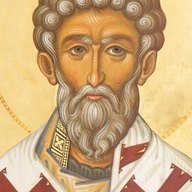
Blessed AugustineExposition on Psalm 44 · on Psalm 44:3
Lo! now then that Word, so uttered, Eternal, the Co-eternal Offspring of the Eternal, will come as "the Bridegroom;" "Fairer than the children of men" (ver. 2). "Than the children of men." I ask, why not than the Angels also? Why did he say, "than the children of men," except because He was Man? Lest you should think…
Blessed AugustineExposition on Psalm 44 · on Psalm 44:4
"Gird Thy sword upon Thy thigh, O most Mighty" (ver. 3). What is meant by "Thy sword, but "Thy word"? It was by that sword He scattered His enemies; by that sword he divided the son from the father, "the daughter from the mother, the daughter-in-law from the mother-in-law." We read these words in the Gospel, "I came…
Blessed AugustineExposition on Psalm 44 · on Psalm 44:5
What does he mean to express by the "thigh"? The flesh. Whence those words, "A prince shall not depart from Judah; and a lawgiver from his thighs"? Did not Abraham himself (to whom was promised the seed in which "all the nations of the earth were to be blessed"), when he sent his servant to seek and to bring home a…
Blessed AugustineExposition on Psalm 44 · on Psalm 44:6
"Your arrows are sharp, are most powerful"; words that pierce the heart, that kindle love. Whence in the Song of Songs it is said, "I am wounded with love." [Song of Songs 2:5] For she speaks of being "wounded with love;" that is, of being in love, of being inflamed with passion, of sighing for the Bridegroom, from…
Blessed AugustineExposition on Psalm 44 · on Psalm 44:7
"Thy throne, O God, is for ever and ever" (ver. 6). Because God has "'blessed Thee' for ever," on account of the "grace poured over Thy lips." Now the throne of the Jewish Kingdom was a temporal one; belonging to those who were under the Law, not to those who were under "grace:" He came to "redeem those who were under…
Blessed AugustineExposition on Psalm 44 · on Psalm 44:8
"You have loved righteousness, and hated iniquity". See there "the rod of direction" described. "You have loved righteousness, and hated iniquity." Draw near to that "rod;" let Christ be your King: let Him "rule" you with that rod, not crush you with it. For that rod is "a rod of iron;" an inflexible rod. "You shall…
Blessed AugustineExposition on Psalm 44 · on Psalm 44:9
"Out of Your garments is the smell of myrrh, amber, and cassia". Out of Your garments is perceived the smell of fragrant odours. By His garments are meant His Saints, His elect, His whole Church, which he shows forth, as His garment, so to speak; His robe "without spot and wrinkle," [Ephesians 5:27] which on account…
With which kings’ daughters have gladdened thee for thine honor: The queen stood by on thy right hand, clothed in vesture wrought with gold, And arrayed in diverse colors.
Blessed AugustineExposition on Psalm 44 · on Psalm 44:10
What a nuptial song! Behold in the midst of songs full of rejoicing, comes forth the Bride herself. For the Bridegroom was coming. It was He who was being described: it was on Him all our attention was fixed. "Upon Your right hand stood the Queen". She which stands on the left is no Queen. For there will be one…
Blessed AugustineExposition on Psalm 44 · on Psalm 44:11
The Prophet addresses this Queen (for he delights in singing to her), and moreover each one of us, provided, however, we know where we are, and endeavour to belong to that body, and do belong to it in faith and hope, being united in the membership of Christ. For it is us whom he addresses, saying, "Hearken, O…
Blessed AugustineExposition on Psalm 44 · on Psalm 44:12
"For the King has greatly desired your beauty". What "beauty" is that, save that which is His own work? "Greatly desired the beauty"— Of whom? Of her the sinner, the unrighteous, the ungodly, such as she was with her "father," the devil, and among her own "people"? No, but hers of whom it is said, "Who is this that…
Blessed AugustineExposition on Psalm 44 · on Psalm 44:14
"All the glory of her, the King's daughter, is from within" (ver. 13). Not only is her robe, outwardly, "of gold, and of divers colours;" but He who loved her beauty, knew her to be also beautiful within. What are those inward charms? Those of conscience. It is there Christ sees; it is there Christ loves her: it is…
Blessed AugustineExposition on Psalm 44 · on Psalm 44:15
"With fringes of gold, clothed with divers colours" (ver. 14). Her beauty is from within; yet in the "fringes of gold" is the diversity of languages: the beauty of doctrine. What do these avail, if them be not that beauty "from within"? "The virgins shall be brought unto the King after her." It has been fulfilled…
Blessed AugustineExposition on Psalm 44 · on Psalm 44:16
"With gladness and rejoicing shall they be brought and shall be led into the Temple of the King" (ver. 15). The "Temple of the King" is the Church itself: it is the Church itself that enters into "the Temple of the King." Whereof is that Temple constructed? Of the men who enter the Temple? Who but God's "faithful"…
Blessed AugustineExposition on Psalm 44 · on Psalm 44:17
"Instead of thy fathers, children are born to thee" (ver. 16). Nothing can be more manifest. Now consider the "Temple of the King" itself, for it is on its behalf he speaks, on account of the unity of the body that is spread throughout all the world: for those very persons who have chosen to be virgins, cannot find…
Blessed AugustineExposition on Psalm 44 · on Psalm 44:18
"They shall be mindful of thy name in every generation and generation; therefore shall the peoples confess unto Thee" (ver. 17). What does it profit then to "confess" indeed and yet to confess out of "the Temple"? What does it profit to pray, and yet not to pray on the Mount? "I cried," says he, "unto the Lord with my…
Every note is a real passage, quoted word for word from a published English translation, with its source. Nothing here is summarised or written by us. Some verses have many notes and some have none, because the Fathers wrote more on some passages than others.
Blessed Augustine, Expositions on the Book of Psalms, tr. A. Cleveland Coxe from the Oxford translation, Nicene and Post-Nicene Fathers, series 1, vol. 8 (1888).
Scripture: the Septuagint, in the translation of Sir Lancelot Brenton (1851), with spelling updated by Adam Boyd (2020); the Greek is Brenton's Septuagint text.
All of these translations are in the public domain. The passages were matched to their verses by the Historical Christian Commentaries project, which also hosts the full texts we link to. The Fathers are a treasury of the Church's mind, and they are best read alongside the life of the Church: if a passage raises a question, bring it to your priest.