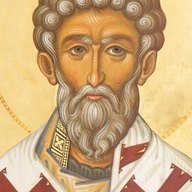
Blessed AugustineExposition on Psalm 5 · on Psalm 5:2
"Hear my words, O Lord". Being called she calls upon the Lord; that the same Lord being her helper, she may pass through the wickedness of this world, and attain unto Him. "Understand my cry." The Psalmist well shows what this cry is; how from within, from the chamber of the heart, without the body's utterance, it…
Blessed AugustineExposition on Psalm 5 · on Psalm 5:3
"Attend Thou to the voice of my supplication;" that is, to that voice, which he maketh request that God would understand: of which what the nature is, he hath already intimated, when he said, "Understand my cry. Attend Thou to the voice of my supplication, my King, and my God" (ver. 2). Although both the Son is God,…
Blessed AugustineExposition on Psalm 5 · on Psalm 5:4
"Because I will pray unto You. O Lord, in the morning You will hear my voice." What does that, which he said above, "Hear Thou," mean, as if he desired to be heard immediately? But now he says, "in the morning You will hear;" not, hear Thou: and, "I will pray unto You;" not, I do pray unto You: and, as follows, "in…
Blessed AugustineExposition on Psalm 5 · on Psalm 5:4
"In the morning I will stand by You, and will see". What is, "I will stand," but "I will not lie down"? Now what else is, to lie down, but to take rest on the earth, which is a seeking happiness in earthly pleasures? "I will stand by," he says, "and will see." We must not then cleave to things earthly, if we would see…
Blessed AugustineExposition on Psalm 5 · on Psalm 5:5
"For You are not a God who hast pleasure in iniquity. The malignant man shall not dwell near You, nor shall the unrighteous abide before Your eyes. You have hated all that work iniquity, You will destroy all that speak a lie. The man of blood, and the crafty man, the Lord will abominate". Iniquity, malignity, lying,…
Blessed AugustineExposition on Psalm 5 · on Psalm 5:6
"You have hated all that work iniquity." God's hatred may be understood from that form of expression, by which every sinner hates the truth. For it seems that she too hates those, whom she suffers not to abide in her. Now they do not abide, who cannot bear the truth.
Blessed AugustineExposition on Psalm 5 · on Psalm 5:6
"Nor shall the unrighteous abide before Your eyes." For their eyes, that is, their mind is beaten back by the light of truth, because of the darkness of their sins; by the habitual practice of which they are not able to sustain the brightness of right understanding. Therefore even they who see sometimes, that is, who…
Blessed AugustineExposition on Psalm 5 · on Psalm 5:7
"The man of blood, and the crafty man, the Lord will abominate." What he said above, "Thou hast hated all that work iniquity, Thou wilt destroy all that speak a lie," may well seem to be repeated here: so that one may refer "the man of blood" to "the worker of iniquity," and "the crafty man" to the "lie." For it is…
Blessed AugustineExposition on Psalm 5 · on Psalm 5:7
"Thou wilt destroy all that speak a lie." For this is the opposite to truth. But lest any one should suppose that any substance or nature is opposite to truth, let him understand that "a lie" has relation to that which is not, not to that which is. For if that which is be spoken, truth is spoken: but if that which is…
Blessed AugustineExposition on Psalm 5 · on Psalm 5:8
"But I, in the multitude of Your mercy, will enter into Your house." "In the multitude of mercy:" perhaps he means in the multitude of perfected and blessed men, of whom that city shall consist, of which the Church is now in travail, and is bearing few by few. Now that many men regenerated and perfected, are rightly…
Blessed AugustineExposition on Psalm 5 · on Psalm 5:9
"Direct in Your sight my way." Nothing is clearer, than that he here sets forth that time, in which he is journeying onward. For this is a way which is traversed not in any regions of the earth, but in the affections of the heart. "In Your sight," he says, "direct my way:" that is, where no man sees; who are not to be…
Blessed AugustineExposition on Psalm 5 · on Psalm 5:10
"For truth is not in their mouth" (ver. 9). To whose judgment of course then there is no trusting, and therefore must we fly within to conscience, and the sight of God. "Their heart is vain." How then can truth be in their mouth, whose heart is deceived by sin, and the punishment of sin? Whence men are called back by…
Judge them, O God; Let them fail of their counsels: Cast them out according to the abundance of their ungodliness; For they have provoked thee, O Lord.
Blessed AugustineExposition on Psalm 5 · on Psalm 5:11
"Judge them, O God: let them fall from their own thoughts". It is a prophecy, not a curse. For he does not wish that it should come to pass; but he perceives what will come to pass. For this happens to them, not because he appears to have wished for it, but because they are such as to deserve that it should happen.…
But let all that trust on thee be glad in thee: They shall exult forever, and thou shalt dwell among them; And all that love thy name shall rejoice in thee.
Blessed AugustineExposition on Psalm 5 · on Psalm 5:12
"And let all rejoice that hope in You;" those of course to whose taste the Lord is sweet. "They will exult for evermore, and You will dwell in them". This will be the exultation for evermore, when the just become the Temple of God, and He, their Indweller, will be their joy. "And all that love Your name shall glory in…
Blessed AugustineExposition on Psalm 5 · on Psalm 5:13
"For You will bless the just man". This is blessing, to glory in God, and to be inhabited by God. Such sanctification is given to the just. But that they may be justified, a calling goes before: which is not of merit, but of the grace of God. "For all have sinned, and want the glory of God." [Romans 3:23] "For whom He…
Every note is a real passage, quoted word for word from a published English translation, with its source. Nothing here is summarised or written by us. Some verses have many notes and some have none, because the Fathers wrote more on some passages than others.
Blessed Augustine, Expositions on the Book of Psalms, tr. A. Cleveland Coxe from the Oxford translation, Nicene and Post-Nicene Fathers, series 1, vol. 8 (1888).
Scripture: the Septuagint, in the translation of Sir Lancelot Brenton (1851), with spelling updated by Adam Boyd (2020); the Greek is Brenton's Septuagint text.
All of these translations are in the public domain. The passages were matched to their verses by the Historical Christian Commentaries project, which also hosts the full texts we link to. The Fathers are a treasury of the Church's mind, and they are best read alongside the life of the Church: if a passage raises a question, bring it to your priest.