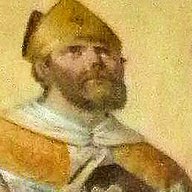
St. Victorinus of PettauCommentary on the Apocalypse · on Revelation 15:1
"And I saw another great and wonderful sign, seven angels having the seven last plagues; for in them is completed the indignation of God." For the wrath of God always strikes the obstinate people with seven plagues, that is, perfectly, as it is said in Leviticus; and these shall be in the last time, when the Church…
And I saw as it were a sea of glass mingled with fire: and them that had gotten the victory over the beast, and over his image, and over his mark, and over the number of his name, stand on the sea of glass, having the harps of God.
St. Victorinus of PettauCommentary on the Apocalypse · on Revelation 15:2
"Standing upon the sea of glass, having harps." That is, that they stood stedfastly in the faith upon their baptism, and having their confession in their mouth, that they shall exult in the kingdom before God. But let us return to what is set before us.
And they sing the song of Moses the servant of God, and the song of the Lamb, saying, Great and marvellous are thy works, Lord God Almighty; just and true are thy ways, thou King of saints.
Who shall not fear thee, O Lord, and glorify thy name? for thou only art holy: for all nations shall come and worship before thee; for thy judgments are made manifest.
And the seven angels came out of the temple, having the seven plagues, clothed in pure and white linen, and having their breasts girded with golden girdles.
And the temple was filled with smoke from the glory of God, and from his power; and no man was able to enter into the temple, till the seven plagues of the seven angels were fulfilled.
Every note is a real passage, quoted word for word from a published English translation, with its source. Nothing here is summarised or written by us. Some verses have many notes and some have none, because the Fathers wrote more on some passages than others.
St. Victorinus of Pettau, Commentary on the Apocalypse of the Blessed John, tr. Robert Ernest Wallis, Ante-Nicene Fathers, vol. 7 (1886).
Scripture: the King James Version (1611); the Greek (tap Ελ) is the 1904 Patriarchal text of the Ecumenical Patriarchate.
All of these translations are in the public domain. The passages were matched to their verses by the Historical Christian Commentaries project, which also hosts the full texts we link to. The Fathers are a treasury of the Church's mind, and they are best read alongside the life of the Church: if a passage raises a question, bring it to your priest.