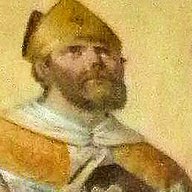
St. Victorinus of PettauCommentary on the Apocalypse · on Revelation 6:1–2
"And when the Lamb had opened one of the seven seals, I saw, and heard one of the four living creatures saying, Come and see. And, lo, a white horse, and He who sate upon him had a bow." The first seal being opened, he says that he saw a white horse, and a crowned horseman having a bow. For this was at first done by…
St. Victorinus of PettauCommentary on the Apocalypse · on Revelation 6:3–4
"And when He had opened the second seal, I heard the second living creature saying, Come and see. And there went out another horse that was red, and to him that sate upon him was given a great sword." The red horse, and he that sate upon him, having a sword, signify the coming wars, as we read in the Gospel: "For…
And there went out another horse that was red: and power was given to him that sat thereon to take peace from the earth, and that they should kill one another: and there was given unto him a great sword.
And when he had opened the third seal, I heard the third beast say, Come and see. And I beheld, and lo a black horse; and he that sat on him had a pair of balances in his hand.
St. Victorinus of PettauCommentary on the Apocalypse · on Revelation 6:5
"And when He had opened the third seal. I heard the third living creature saying, Come and see. And, lo, a black horse; and he who sate upon it had a balance in his hand." The black horse signifies famine, for the Lord says, "There shall be famines in divers places; "but the word is specially extended to the times of…
And I heard a voice in the midst of the four beasts say, A measure of wheat for a penny, and three measures of barley for a penny; and see thou hurt not the oil and the wine.
St. Victorinus of PettauCommentary on the Apocalypse · on Revelation 6:7–8
"And when He had opened the fourth seal, I heard the fourth living creature saying, Come and see. And, lo, a pale horse; and he who sate upon him was named Death." For the pale horse and he who sate upon him bore the name of Death. These same things also the Lord had promised among the rest of the coming…
And I looked, and behold a pale horse: and his name that sat on him was Death, and Hell followed with him. And power was given unto them over the fourth part of the earth, to kill with sword, and with hunger, and with death, and with the beasts of the earth.
And when he had opened the fifth seal, I saw under the altar the souls of them that were slain for the word of God, and for the testimony which they held:
St. Victorinus of PettauCommentary on the Apocalypse · on Revelation 6:9
"And when He had opened the fifth seal, I saw under the altar the souls of them that were slain." He relates that he saw under the altar of God, that is, under the earth, the souls of them that were slain. For both heaven and earth are called God's altar, as saith the law, commanding in the symbolical form of the…
St. Victorinus of PettauCommentary on the Apocalypse · on Revelation 6:10–11
He who sees all things would have us to know that these saints, therefore-that is, the souls of the slain-are asking for vengeance for their blood, that is, of their body, from those that dwell upon the earth; but because in the last time, moreover, the reward of the saints will be perpetual, and the condemnation of…
And white robes were given unto every one of them; and it was said unto them, that they should rest yet for a little season, until their fellowservants also and their brethren, that should be killed as they were, should be fulfilled.
And I beheld when he had opened the sixth seal, and, lo, there was a great earthquake; and the sun became black as sackcloth of hair, and the moon became as blood;
St. Victorinus of PettauCommentary on the Apocalypse · on Revelation 6:12
"And I saw, when he had opened the sixth seal, there was a great earthquake." In the sixth seal, then, was a great earthquake: this is that very last persecution. "And the sun became black as sackcloth of hair." The sun becomes as sackcloth; that is, the brightness of doctrine will be obscured by unbelievers. "And the…
St. Victorinus of PettauCommentary on the Apocalypse · on Revelation 6:13
"And the stars fell to the earth." The falling of the stars are the faithful who are troubled for Christ's sake. "Even as a fig-tree casteth her untimely figs." The fig-tree, when shaken, loses its untimely figs-when men are separated from the Church by persecution.
St. Victorinus of PettauCommentary on the Apocalypse · on Revelation 6:14
"And the heaven withdrew as a scroll that is rolled up." For the heaven to be rolled away, that is, that the Church shall be taken away. "And every mountain and the islands were moved from their places." Mountains and islands removed from their places intimate that in the last persecution all men departed from their…
And the kings of the earth, and the great men, and the rich men, and the chief captains, and the mighty men, and every bondman, and every free man, hid themselves in the dens and in the rocks of the mountains;
Every note is a real passage, quoted word for word from a published English translation, with its source. Nothing here is summarised or written by us. Some verses have many notes and some have none, because the Fathers wrote more on some passages than others.
St. Victorinus of Pettau, Commentary on the Apocalypse of the Blessed John, tr. Robert Ernest Wallis, Ante-Nicene Fathers, vol. 7 (1886).
Scripture: the King James Version (1611); the Greek (tap Ελ) is the 1904 Patriarchal text of the Ecumenical Patriarchate.
All of these translations are in the public domain. The passages were matched to their verses by the Historical Christian Commentaries project, which also hosts the full texts we link to. The Fathers are a treasury of the Church's mind, and they are best read alongside the life of the Church: if a passage raises a question, bring it to your priest.