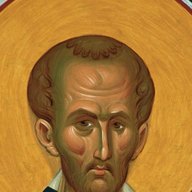
St. John ChrysostomHomily 25 on Romans · on Romans 14:1–2
I Am aware that to most what is here said is a difficulty. And therefore I must first give the subject of the whole of this passage, and what he wishes to correct in writing this. What does he wish to correct then? There were many of the Jews which believed, who adhered of conscience to the Law, and after their…
St. John ChrysostomHomily 25 on Romans · on Romans 14:3
"Let not him that eateth, despise him that eateth not." He does not say, let him alone, nor does he say, do not blame him, nor yet, do not set him right; but do not reproach him, do not "despise" him, to show they were doing a thing perfectly ridiculous. But of this he speaks in other words. "Let not him which eateth…
Who art thou that judgest another man’s servant? to his own master he standeth or falleth. Yea, he shall be holden up: for God is able to make him stand.
St. John ChrysostomHomily 25 on Romans · on Romans 14:4
"Who art thou that judgest another man's servant?" Whence it appears that they too judged, and did not despise only. "To his own Master he standeth or falleth." See here is another stroke. And the indignation seems to be against the strong man, and he attacks him. When he says, "Yea, he shall be holden up," he shows…
St. John ChrysostomHomily 25 on Romans · on Romans 14:5
"One man esteemeth one day above another, another esteemeth every day alike." Here he seems to me to be giving a gentle hint about fasting. For it is not unlikely that some who fasted were always judging those who did not, or among the observances it is likely that there were some that on fixed days abstained, and on…
He that regardeth the day, regardeth it unto the Lord; and he that regardeth not the day, to the Lord he doth not regard it. He that eateth, eateth to the Lord, for he giveth God thanks; and he that eateth not, to the Lord he eateth not, and giveth God thanks.
St. John ChrysostomHomily 25 on Romans · on Romans 14:6
"He that regardeth the day, regardeth it unto the Lord; and he that regardeth not the day, to the Lord he doth not regard it." And, "He that eateth, eateth to the Lord, for he giveth God thanks; and he that eateth not, to the Lord he eateth not, and giveth God thanks." He still keeps to the same subject. And what he…
St. John ChrysostomHomily 25 on Romans · on Romans 14:7–8
"For none of us liveth unto himself, and no man dieth unto himself. For whether we live, we live unto the Lord; and whether we die, we die unto the Lord," by this too he makes the same clearer. For how can he that liveth unto the Law, be living unto Christ? But this is not the only thing that he effects by this, he…
St. John ChrysostomHomily 25 on Romans · on Romans 14:9
"For to this end Christ both died, and rose, and revived, that He might be Lord both of the dead and living." And so let us at least convince thee, that He is thoughtful for our salvation. For had He not had this great care for us, where were the need of the Dispensation (or Incarnation)? He then that hath shown so…
St. John ChrysostomHomily 25 on Romans · on Romans 14:10
"But why dost thou judge thy brother? or why dost thou set at nought thy brother?" And so he seems to be setting them upon a level, but from that he has said, he shows that the difference between them is great. First then by the appellation of "brother" he does away with disputatiousness, and then also by calling that…
St. John ChrysostomHomily 25 on Romans · on Romans 14:11–12
"For it is written, As I live, saith the Lord, every knee shall bow to Me, and every tongue shall confess to God. So then every one of us shall give account of himself to God." See how he again puts his mind into confusion, while he seems to be rebuking the other. For he intimates some such thing, as if he had said,…
St. John ChrysostomHomily 25 on Romans · on Romans 14:13
"Let us not therefore judge one another any more: but judge this rather, that no man put a stumbling-block or an occasion to fall in his brother's way." This does not apply to one less than the other: wherefore it may well fit with both, both the advanced man that was offended at the observance of meats, and the…
I know, and am persuaded by the Lord Jesus, that there is nothing unclean of itself: but to him that esteemeth any thing to be unclean, to him it is unclean.
St. John ChrysostomHomily 26 on Romans · on Romans 14:14
After first rebuking the person who judgeth his brother, and moving him to leave off this reproaching, he then explains himself further upon the doctrinal part, and instructs in a dispassionate tone the weaker sort, displaying in this case too a great deal of gentleness. For he does not say he shall be punished, nor…
St. John ChrysostomHomily 26 on Romans · on Romans 14:15
You see how far, for the present, he goes in affection for him, showing that he makes so great account of him, that with a view not to grieve him he does not venture even to enjoin things of great urgency, but by yieldingness would rather draw him to himself, and by charity. For even when he has freed him of his…
St. John ChrysostomHomily 26 on Romans · on Romans 14:16–17
By their "good," he means here either their faith, or the hope of rewards hereafter, or the perfectness of their religious state. For it is not only that you fail to profit your brother, he means, but the doctrine itself, and the grace of God, and His gift, you cause to be evil spoken of. Now when thou fightest, when…
St. John ChrysostomHomily 26 on Romans · on Romans 14:18
For they will not admire thee so much for thy perfect state, as all will for peace and amity. For this is a goodly thing, that all will have the benefit of, but of that not one even will.
St. John ChrysostomHomily 26 on Romans · on Romans 14:19
This applies to the other, that he may grow peaceable. But the other to the latter too, that he may not destroy his brother. Still he has made both apply to either again, by saying, "one another," and showing that without peace it is not easy to edify.
St. John ChrysostomHomily 26 on Romans · on Romans 14:20
Giving this name to the salvation of a brother, and adding greatly to the fears, and showing that he is doing the opposite of that he desires. For thou, he says, art so far from building up as thou intendest, that thou dost even destroy, and that a building too not of man but of God, and not for any great end either,…
St. John ChrysostomHomily 26 on Romans · on Romans 14:21
Again, he requires the greater alternative, that they should not only not force him, but even condescend to him. For he often did this himself also, as when he circumcised (Acts xvi. 3), when he was shorn (ib. xviii. 18), when he sacrificed that Jewish sacrifice. (ib. xxi. 26). And he does not say to the man "do so,"…
St. John ChrysostomHomily 26 on Romans · on Romans 14:22
Here he seems to me to be giving a gentle warning to the more advanced on the score of vanity. And what he says is this, Dost thou wish to show me that thou art perfect, and fully furnished? Do not show it to me, but let thy conscience suffice. And by faith, he here means that concerned not with doctrines, but with…
St. John ChrysostomHomily 26 on Romans · on Romans 14:23
Again, it is to exhort him to spare the weaker, that he says this. For what good is it if he eat in doubt, and condemn himself? For I approve of him, who both eateth, and doeth it not with doubting. See how he induces him not to eating only, but to eating with a good conscience too. Then he mentions likewise the…
Every note is a real passage, quoted word for word from a published English translation, with its source. Nothing here is summarised or written by us. Some verses have many notes and some have none, because the Fathers wrote more on some passages than others.
St. John Chrysostom, Homilies on Romans, Nicene and Post-Nicene Fathers, series 1, vol. 11 (1888–1889).
Scripture: the King James Version (1611); the Greek (tap Ελ) is the 1904 Patriarchal text of the Ecumenical Patriarchate.
All of these translations are in the public domain. The passages were matched to their verses by the Historical Christian Commentaries project, which also hosts the full texts we link to. The Fathers are a treasury of the Church's mind, and they are best read alongside the life of the Church: if a passage raises a question, bring it to your priest.