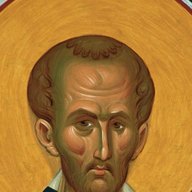
St. John ChrysostomHomily 30 on Romans · on Romans 16:1
"I commend unto you Phebe our sister, which is a deaconess (A. V. servant) of the church which is at Cenchrea." See how many ways he takes to give her dignity. For he has both mentioned her before all the rest, and called her sister. And it is no slight thing to be called the sister of Paul. Moreover he has added her…
St. John ChrysostomHomily 30 on Romans · on Romans 16:1–2
"I commend unto you Phebe our sister, which is a deaconess of the church which is at Cenchrea." See how many ways he takes to give her dignity. For he has both mentioned her before all the rest, and called her sister. And it is no slight thing to be called the sister of Paul. Moreover he has added her rank, by…
That ye receive her in the Lord, as becometh saints, and that ye assist her in whatsoever business she hath need of you: for she hath been a succourer of many, and of myself also.
St. John ChrysostomHomily 30 on Romans · on Romans 16:2
"That ye receive her in the Lord, as becometh saints. (Gr. "the saints.") That is, for the Lord's sake, that she may enjoy honor among you. For he that receives a person for the Lord's sake, though it be no great one that he receives, yet receives him with attention. But when it is a saint, consider what attention he…
St. John ChrysostomHomily 30 on Romans · on Romans 16:3
"Greet," he says, "Priscilla and Aquila, my helpers in Christ Jesus." To the excellence of these St. Luke also bears witness. Partly when he says that Paul "abode with them, for by their occupation they were tent-makers" (Acts xviii. 3); and partly when he points out the woman as receiving Apollos, and instructing him…
St. John ChrysostomHomily 30 on Romans · on Romans 16:3–4
"Greet Priscilla and Aquila, my helpers in Christ Jesus." To the excellence of these St. Luke also bears witness. Partly when he says that Paul "abode with them, for by their occupation they were tent-makers"; and partly when he points out the woman as receiving Apollos, and instructing him in the way of the Lord. Now…
St. John ChrysostomHomily 30 on Romans · on Romans 16:4
"Who for my life have laid down their own necks." You see they are thoroughly furnished martyrs. For in Nero's time it is probable that there were thousands of dangers, at the time as he even commanded all Jews to be removed from Rome." (Acts viii. 2). "Unto whom not only I give thanks, but also all the Churches of…
St. John ChrysostomHomily 30 on Romans · on Romans 16:5
"Likewise greet the Church that is in their house." For she had been so estimable as even to make their house a Church, both by making all in it believers, and because they opened it to all strangers. For he was not in the habit of calling any houses Churches, save where there was much piety, and much fear of God…
St. John ChrysostomHomily 31 on Romans · on Romans 16:5
"Salute my well-beloved Epenetus, who is the first-fruits of Achaia unto Christ." I think that many even of those who have the appearance of being extremely good men, hasten over this part of the Epistle as superfluous, and having no great weight in it. And I think that the same befalls them in regard to the genealogy…
St. John ChrysostomHomily 31 on Romans · on Romans 16:6
"Greet Mary, who bestowed much labor on us." How is this? a woman again is honored and proclaimed victorious! Again are we men put to shame. Or rather, we are not put to shame only, but have even an honor conferred upon us. For an honor we have, in that there are such women amongst us, but we are put to shame, in that…
St. John ChrysostomHomily 31 on Romans · on Romans 16:7
"Salute Andronicus and Junia my kinsmen." This also looks like an encomium. And what follows is much more so. And what sort is this of? "And my fellow-prisoners." For this is the greatest honor, the noble proclamation. And where was Paul a prisoner, that he should call them "my fellow-prisoners?" A prisoner indeed he…
St. John ChrysostomHomily 31 on Romans · on Romans 16:8
"Greet Amplias my beloved." Here again he passes encomiums upon his person by his love. For the love of Paul was for God, carrying countless blessings with it. For if being loved by the king is a great thing, what a great encomium must it be to be beloved by Paul? For if he had not acquired great virtue, he would not…
St. John ChrysostomHomily 31 on Romans · on Romans 16:9
"Salute Urbane, my helper in the Lord." This is a greater encomium than the other. For this even comprehends that. "And Stachys, my beloved." This again is an honor of the same kind.
St. John ChrysostomHomily 31 on Romans · on Romans 16:10
"Salute Apelles, approved in Christ." There is no praise like this, being unblamable, and giving no handle in the things of God. For when he says, "approved in Christ," he includes the whole list of virtues. And on what ground does he nowhere say my Lord such an one, my Master this? It is because these encomiums were…
St. John ChrysostomHomily 31 on Romans · on Romans 16:11
"Salute Herodion my kinsman; greet them which be of the household of Narcissus;" Who, it is likely, were not so worthy as the afore-mentioned, on which account also he does not mention them all by name even, and after giving them the encomium which was suited to them, that of being faithful, (and this the meaning of,…
St. John ChrysostomHomily 31 on Romans · on Romans 16:12
"Salute Tryphena and Tryphosa, who labor in the Lord." And in regard to the former woman, he says that "she bestowed labor upon you," but of these that they are still laboring. And this is no small encomium, that they should be in work throughout, and should not only work, but labor even. But Persis he calls beloved…
St. John ChrysostomHomily 31 on Romans · on Romans 16:13
"Salute Rufus, chosen in the Lord, and his mother and mine." Here again the good things are without any drawback, since the son and the mother are each of such a character, and the house is full of blessing, and the root agreeth with the fruit; for he would not have simply said, "his mother and mine," unless he had…
St. John ChrysostomHomily 31 on Romans · on Romans 16:14
"Salute Asyncritus, Phlegon, Hermas, Patrobas, Hermes, and the brethren which are with them." Here do not be looking to how he starts them without any encomium, but how he did not reckon them, though far inferior, as it seems, to all, unworthy of being addressed by him. Or rather even this is no slight praise that he…
St. John ChrysostomHomily 31 on Romans · on Romans 16:15
"Salute Philologus, and Julius, and Nereus and his sister, and Olympas, and all the saints which are with them;" Which was the greatest dignity, and unspeakable height of honor. Then to prevent any jealousy rising from his addressing one in one way and another in another, and some by name and some with no distinction,…
St. John ChrysostomHomily 31 on Romans · on Romans 16:16
"Salute one another with an holy kiss." To cast out of them, by this salutation, all arguing that confused them, and all grounds for little pride; that neither the great might despise the little, nor the little grudge at the greater, but that haughtiness and envy might be more driven away, when this kiss soothed down…
St. John ChrysostomHomily 32 on Romans · on Romans 16:17–18
Again an exhortation, and prayer after the exhortation. For after telling them to "mark them which cause divisions," and not to listen to them, he proceeds, "And the God of peace shall bruise Satan under your feet shortly:" and, "The grace of our Lord be with you." And notice how gently too he exhorts them: doing it…
For your obedience is come abroad unto all men. I am glad therefore on your behalf: but yet I would have you wise unto that which is good, and simple concerning evil.
St. John ChrysostomHomily 32 on Romans · on Romans 16:19
"For your obedience is come abroad unto all men." This he does, not to leave them free to be shameless, but to win them beforehand with encomiums, and the number of his witnesses, to arrest their attention. For neither is it I alone that am the witness, but the whole world. And he does not say for your understanding,…
St. John ChrysostomHomily 32 on Romans · on Romans 16:20
"And the God of peace shall bruise Satan under your feet shortly." For since he had spoken of those who "caused divisions and offences among them," he has mentioned "the God of peace" also, that they might feel hopeful about the riddance of these evils. For he that rejoiceth in this (i. e., peace) will put an end to…
St. John ChrysostomHomily 32 on Romans · on Romans 16:21
"Timotheus my work-fellow saluteth you." Observe the customary encomiums again. "And Lucius, and Jason, and Sosipater my kinsmen." This Jason Luke also mentions, and sets before us his manliness also, when he says, that "they drew" him "to the rulers of the city, crying," etc. And it is likely that the others too were…
St. John ChrysostomHomily 32 on Romans · on Romans 16:22
"I Tertius, who wrote this Epistle, salute you." This too is no small encomium, to be Paul's amanuensis. Still it is not to pass encomiums on himself that he says this, but that he might attach a warm love to him on their part, for this ministration.
St. John ChrysostomHomily 32 on Romans · on Romans 16:23
"Gaius mine host, and of the whole Church, saluteth you." See what a crown he has framed for him by bearing witness to such great hospitality in him, and brought in the entire Church into this man's house! For by the word used here, he means a host, not a guest. But when you hear that he was Paul's host, do not admire…
St. John ChrysostomHomily 32 on Romans · on Romans 16:24
"The grace of our Lord Jesus Christ be with you all. Amen." See what we ought to begin and to end with everywhere! For in this he laid the foundation of the Epistle, and in this he putteth on the roof, at once praying for the mother of all good things for them, and calling the whole of his loving-kindness to their…
Now to him that is of power to stablish you according to my gospel, and the preaching of Jesus Christ, according to the revelation of the mystery, which was kept secret since the world began,
St. John ChrysostomHomily 27 on Romans · on Romans 16:25–27
It is always a custom with Paul to conclude his exhortation with prayers and doxologies. For he knows that the thing is one of no slight importance. And it is out of affectionateness and caution that he is in the habit of doing this. For it is the character of a teacher devoted to his children, and to God, not to…
But now is made manifest, and by the scriptures of the prophets, according to the commandment of the everlasting God, made known to all nations for the obedience of faith:
To God only wise, be glory through Jesus Christ for ever. Amen.
About these notes
Every note is a real passage, quoted word for word from a published English translation, with its source. Nothing here is summarised or written by us. Some verses have many notes and some have none, because the Fathers wrote more on some passages than others.
St. John Chrysostom, Homilies on Romans, Nicene and Post-Nicene Fathers, series 1, vol. 11 (1888–1889).
Scripture: the King James Version (1611); the Greek (tap Ελ) is the 1904 Patriarchal text of the Ecumenical Patriarchate.
All of these translations are in the public domain. The passages were matched to their verses by the Historical Christian Commentaries project, which also hosts the full texts we link to. The Fathers are a treasury of the Church's mind, and they are best read alongside the life of the Church: if a passage raises a question, bring it to your priest.