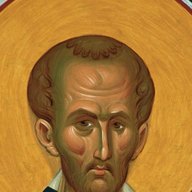
St. John ChrysostomHomily 6 on Romans · on Romans 3:1
"What advantage then hath the Jew?" Since he has set all aside, the hearing, the teaching, the name of the Jew, the circumcision, and all the other particulars by his saying that "he is not a Jew which is one outwardly, but he which is one inwardly;" he next sees an objection which starts up, and against this makes…
St. John ChrysostomHomily 6 on Romans · on Romans 3:2
"Much every way: chiefly, because that they were entrusted with the oracles of God." Do you see that, as I said above, it is not their well doings, but the benefits of God, that he everywhere counts up? And what is the word "entrusted?" It means, that they had the Law put into their hands because He held them to be of…
St. John ChrysostomHomily 6 on Romans · on Romans 3:3–4
"For what if some did not believe?" And what comes next makes the same point clear. For he again adds and follows; "Shall their unbelief make the faith of God without effect? God forbid." The word "entrusted," then, proclaims God's gift. And I would have you here also note his judgment. For again he does not bring in…
God forbid: yea, let God be true, but every man a liar; as it is written, That thou mightest be justified in thy sayings, and mightest overcome when thou art judged.
St. John ChrysostomHomily 6 on Romans · on Romans 3:5–6
"But if our unrighteousness commend the righteousness of God, what shall we say? is God unrighteous Who taketh vengeance? I speak as a man. God forbid." He solves one perplexity by another again. Yet as this is not clear, we must needs declare it more clearly. What is it then he means? God honored the Jews: they did…
St. John ChrysostomHomily 6 on Romans · on Romans 3:7
"For if the truth of God hath more abounded through my lie unto His glory: why yet am I also judged as a sinner?" For if God, he means is shown to be a Lover of man, and righteous, and good, by your acts of disobedience, you ought not only to be exempt from punishment but even to have good done unto you. But if so,…
St. John ChrysostomHomily 6 on Romans · on Romans 3:8
"If not (as some affirm that we say,) Let us do evil that good may come? Whose damnation is just." For whereas Paul said, "where sin abounded grace did much more abound" (Rom. v. 20), in ridicule of him and perverting what he said to another meaning, they said, We must cling to vice that we may get what is good. But…
St. John ChrysostomHomily 7 on Romans · on Romans 3:9–18
"What then have we more than they? For we have proved both Jews and Gentiles, that they are all under sin. As it is written, There is none righteous, no, not one." He had accused the Gentiles, he had accused the Jews; it came next in order to mention the righteousness which is by faith. For if the law of nature…
Now we know that what things soever the law saith, it saith to them who are under the law: that every mouth may be stopped, and all the world may become guilty before God.
St. John ChrysostomHomily 7 on Romans · on Romans 3:19
"Now we know that what things soever the Law saith, it saith to them who are under the Law." This then is why, next to Isaiah, who confessedly aimed at them, he brought in David; that he might show that these things also belonged to the same subject. For what need was there, he means, that a prophet who was sent for…
St. John ChrysostomHomily 7 on Romans · on Romans 3:20
"For by the Law is the knowledge of sin." He springs upon the Law again, with forbearance however (for what he says is not an accusation of it, but of the listlessness of the Jews). Yet nevertheless he has been earnest here with a view (as he was going to introduce his discourse about faith) to show its utter…
St. John ChrysostomHomily 7 on Romans · on Romans 3:21
"But now the righteousness of God without the Law is manifested." Here he utters a great thing, and such as needed much proof. For if they that lived in the Law not only did not escape punishment, but were even the more weighed down thereby, how without the Law is it possible not only to escape vengeance, but even to…
St. John ChrysostomHomily 7 on Romans · on Romans 3:22–23
After saying, "the righteousness of God," he adds straightway, "by faith unto all and upon all that believe." Here again the Jew is alarmed by his not having anything better than the rest, and being numbered with the whole world. Now that he may not feel this, he again lowers him with fear by adding, "For there is no…
St. John ChrysostomHomily 7 on Romans · on Romans 3:24–25
"Being justified freely by His grace through the redemption that is in Christ Jesus: Whom God hath set forth to be a propitiation through faith in His blood, to declare His righteousness." See by how many proofs he makes good what was said. First, from the worthiness of the person, for it is not a man who doeth these…
Whom God hath set forth to be a propitiation through faith in his blood, to declare his righteousness for the remission of sins that are past, through the forbearance of God;
St. John ChrysostomHomily 7 on Romans · on Romans 3:26
"To declare His righteousness." What is declaring of righteousness? Like the declaring of His riches, not only for Him to be rich Himself, but also to make others rich, or of life, not only that He is Himself living, but also that He makes the dead to live; and of His power, not only that He is Himself powerful, but…
St. John ChrysostomHomily 7 on Romans · on Romans 3:27
"Where is boasting then? it is excluded," he says. "By what law? of works? Nay, but by the law of faith." Paul is at great pains to show that faith is mighty to a degree which was never even fancied of the Law. For after he had said that God justifieth man by faith, he grapples with the Law again. And he does not say,…
St. John ChrysostomHomily 7 on Romans · on Romans 3:28
"Therefore we conclude that a man is justified by faith without the deeds of the Law." When he had shown that by faith they were superior to the Jews, then he goes on with great confidence to discourse upon it also, and what seemed therein to annoy he again heals up. For these two things were what confused the Jews;…
St. John ChrysostomHomily 7 on Romans · on Romans 3:29
"Is He the God of the Jews only?" As if he said, On what foot does it then seem to you amiss that every man should be saved? Is God partial? So showing from this, that in wishing to flout the Gentiles, they are rather offering an insult to God's glory, if, that is, they would not allow Him to be the God of all. But if…
St. John ChrysostomHomily 7 on Romans · on Romans 3:30
"Seeing it is one God." That is, the same is the Master of both these and those. But if you tell me of the ancient state of things, then too the dealings of Providence were shared by both, although in diverse ways. For as to thee was given the written law, so to them was the natural; and they came short in nothing,…
St. John ChrysostomHomily 7 on Romans · on Romans 3:31
"Do we then," he says, "make void the Law through faith? God forbid: yea, we establish the Law." Do you see his varied and unspeakable judgment? For the bare use of the word "establish" shows that it was not then standing, but was worn out. And note also Paul's exceeding power, and how superabundantly he maintains…
Every note is a real passage, quoted word for word from a published English translation, with its source. Nothing here is summarised or written by us. Some verses have many notes and some have none, because the Fathers wrote more on some passages than others.
St. John Chrysostom, Homilies on Romans, Nicene and Post-Nicene Fathers, series 1, vol. 11 (1888–1889).
Scripture: the King James Version (1611); the Greek (tap Ελ) is the 1904 Patriarchal text of the Ecumenical Patriarchate.
All of these translations are in the public domain. The passages were matched to their verses by the Historical Christian Commentaries project, which also hosts the full texts we link to. The Fathers are a treasury of the Church's mind, and they are best read alongside the life of the Church: if a passage raises a question, bring it to your priest.