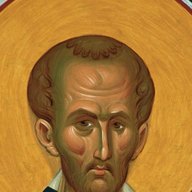
St. John ChrysostomHomily 9 on Romans · on Romans 5:1
What does "Let us have peace" mean? Some say, "Let us not be at variance, through a peevish obstinacy for bringing in the Law." But to me he seems to be speaking now of our conversation. For after having said much on the subject of faith, he had set it before righteousness which is by works, to prevent any one from…
St. John ChrysostomHomily 9 on Romans · on Romans 5:2
If then He hath brought us near to Himself, when we were far off, much more will He keep us now that we are near. And let me beg you to consider how he everywhere sets down these two points; His part, and our part. On His part, however, there be things varied and numerous and diverse. For He died for us, and farther…
St. John ChrysostomHomily 9 on Romans · on Romans 5:3
Now, consider how great the things to come are, when even at things that seem to be distressful we can be elated; so great is God's gift, and such a nothing any distastefulness in them! For in the case of external goods, the struggle for them brings trouble and pain and irksomeness along with it; and it is the crowns…
St. John ChrysostomHomily 9 on Romans · on Romans 5:4–5
Tribulations; that is, are so far from confuting these hopes, that they even prove them. For before the things to come are realized, there is a very great fruit which tribulation hath-patience; and the making of the man that is tried, experienced. And it contributes in some degree too to the things to come, for it…
For scarcely for a righteous man will one die: yet peradventure for a good man some would even dare to die.
μόλις γὰρ ὑπὲρ δικαίου τις ἀποθανεῖται· ὑπὲρ γὰρ τοῦ ἀγαθοῦ τάχα τις καὶ τολμᾷ ἀποθανεῖν.
St. John ChrysostomHomily 9 on Romans · on Romans 5:7–8
Now what he says is somewhat of this kind. For if for a virtuous man, no one would hastily choose to die, consider thy Master's love, when it is not for virtuous men, but for sinners and enemies that He is seen to have been crucified-which he says too after this, "In that, if when we were sinners Christ died for us."
St. John ChrysostomHomily 9 on Romans · on Romans 5:9–10
And what he has said looks indeed like tautology, but it is not to any one who accurately attends to it. Consider then. He wishes to give them reasons for confidence respecting things to come. And first he gives them a sense of shame from the righteous man's decision, when he says, that he also "was fully persuaded…
St. John ChrysostomHomily 9 on Romans · on Romans 5:11
What meaneth the "not only so?" Not only were we saved, he means, but we even glory for this very reason, for which some suppose we ought to hide our faces. For, for us who lived in so great wickedness to be saved, was a very great mark of our being exceedingly beloved by Him that saved us. For it was not by angels or…
St. John ChrysostomHomily 10 on Romans · on Romans 5:12
As the best physicians always take great pains to discover the source of diseases, and go to the very fountain of the mischief, so doth the blessed Paul also. Hence after having said that we were justified, and having shown it from the Patriarch, and from the Spirit, and from the dying of Christ (for He would not have…
St. John ChrysostomHomily 10 on Romans · on Romans 5:13
The phrase "till the Law" some think he used of the time before the giving of the Law-that of Abel, for instance, or of Noah, or of Abraham-till Moses was born. What was the sin in those days, at this rate? some say he means that in Paradise. For hitherto it was not done away, (he would say,) but the fruit of it was…
Nevertheless death reigned from Adam to Moses, even over them that had not sinned after the similitude of Adam’s transgression, who is the figure of him that was to come.
St. John ChrysostomHomily 10 on Romans · on Romans 5:14
How did it reign? "After the similitude of Adam's transgression, who is the figure of Him that was to come." Now this is why Adam is a type of Christ. How a type? it will be said. Why in that, as the former became to those who were sprung from him, although they had not eaten of the tree, the cause of that death which…
But not as the offence, so also is the free gift. For if through the offence of one many be dead, much more the grace of God, and the gift by grace, which is by one man, Jesus Christ, hath abounded unto many.
St. John ChrysostomHomily 10 on Romans · on Romans 5:15
For what he says is somewhat of this kind. If sin had so extensive effects, and the sin of one man too; how can grace, and that the grace of God, not the Father only, but also the Son, do otherwise than be the more abundant of the two? For the latter is far the more reasonable supposition. For that one man should be…
And not as it was by one that sinned, so is the gift: for the judgment was by one to condemnation, but the free gift is of many offences unto justification.
St. John ChrysostomHomily 10 on Romans · on Romans 5:16
And what is this that he is speaking of? It is that sin had power to bring in death and condemnation; but grace did not do away that one sin only, but also those that followed after in its train. Lest then the words "as" and "so" might seem to make the measure of the blessings and the evils equal, and that you might…
For if by one man’s offence death reigned by one; much more they which receive abundance of grace and of the gift of righteousness shall reign in life by one, Jesus Christ.)
St. John ChrysostomHomily 10 on Romans · on Romans 5:17
What he says, amounts to this nearly. What armed death against the world? The one man's eating from the tree only. If then death attained so great power from one offence, when it is found that certain received a grace and righteousness out of all proportion to that sin, how shall they still be liable to death? And for…
Therefore as by the offence of one judgment came upon all men to condemnation; even so by the righteousness of one the free gift came upon all men unto justification of life.
St. John ChrysostomHomily 10 on Romans · on Romans 5:18
And he insists again upon it, showing that the second was greater than the first, he wants again here also further confirmation of these. For, before, he had said that if one man's sin slew all, much more will the grace of One have the power to save. After that he shows that it was not that sin only that was done away…
St. John ChrysostomHomily 10 on Romans · on Romans 5:19
What he says seems indeed to involve no small question: but if any one attends to it diligently, this too will admit of an easy solution. What then is the question? It is the saying that through the offence of one many were made sinners. For the fact that when he had sinned and become mortal, those who were of him…
St. John ChrysostomHomily 10 on Romans · on Romans 5:20
Since then he had shown that the world was condemned from Adam, but from Christ was saved and freed from condemnation, he now seasonably enters upon the discussion of the Law, here again undermining the high notions of it. For it was so far from doing any good, he means, or from being any way helpful, but the disorder…
St. John ChrysostomHomily 10 on Romans · on Romans 5:21
This he says to show that the latter ranks as a king, the former, death, as a soldier, being marshalled under the latter, and armed by it. If then the latter (i.e. sin) armed death, it is plain enough that the righteousness destructive hereof, which by grace was introduced, not only disarms death, but even destroys…
Every note is a real passage, quoted word for word from a published English translation, with its source. Nothing here is summarised or written by us. Some verses have many notes and some have none, because the Fathers wrote more on some passages than others.
St. John Chrysostom, Homilies on Romans, Nicene and Post-Nicene Fathers, series 1, vol. 11 (1888–1889).
Scripture: the King James Version (1611); the Greek (tap Ελ) is the 1904 Patriarchal text of the Ecumenical Patriarchate.
All of these translations are in the public domain. The passages were matched to their verses by the Historical Christian Commentaries project, which also hosts the full texts we link to. The Fathers are a treasury of the Church's mind, and they are best read alongside the life of the Church: if a passage raises a question, bring it to your priest.