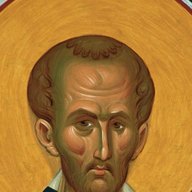
St. John ChrysostomHomily 5 on Titus · on Titus 3:1–2
Chap. iii. 1. "Put them in mind to be subject to principalities and powers, to obey magistrates, to be ready to every good work, to speak evil of no man, to be no brawlers." What then? even when men do evil, may we nor revile them? nay, but "to be ready to every good work, to speak evil of no man." Hear the…
For we ourselves also were sometimes foolish, disobedient, deceived, serving divers lusts and pleasures, living in malice and envy, hateful, and hating one another.
St. John ChrysostomHomily 5 on Titus · on Titus 3:3
Ver. 3. "For we ourselves also were sometimes foolish." Thus also he does in his Epistle to the Galatians, where he says, "Even so we, when we were children, were in bondage under the elements of the world." (Gal. iv. 4.) Therefore he says, Revile no one, for such also thou wast thyself. "For we ourselves also were…
St. John ChrysostomHomily 5 on Titus · on Titus 3:4–5
Ver. 4. "But after that the kindness and love of God our Saviour toward man appeared." How? "Not by works of righteousness which we have done, but according to His mercy He saved us, by the washing of regeneration, and renewing of the Holy Ghost." Strange! How were we drowned in wickedness, so that we could not be…
Not by works of righteousness which we have done, but according to his mercy he saved us, by the washing of regeneration, and renewing of the Holy Ghost;
St. John ChrysostomHomily 5 on Titus · on Titus 3:7
"That being justified by His grace"-again by grace and not by debt-"we may be made heirs according to the hope of eternal life." At the same time there is an incitement to humility, and a hope for the future. For if when we were so abandoned, as to require to be born again, to be saved by grace, to have no good in us,…
This is a faithful saying, and these things I will that thou affirm constantly, that they which have believed in God might be careful to maintain good works. These things are good and profitable unto men.
St. John ChrysostomHomily 6 on Titus · on Titus 3:8
Having spoken of the love of God to man, of His ineffable regard for us, of what we were and what He has done for us, he has added, "These things I will that thou affirm constantly, that they which have believed in God might be careful to maintain good works"; that is, Discourse of these things, and from a…
St. John ChrysostomHomily 6 on Titus · on Titus 3:9
"But avoid foolish questions, and genealogies, and contentions, and strivings about the law, for they are unprofitable and vain." What do these "genealogies" mean? For in his Epistle to Timothy he mentions "fables and endless genealogies." (1 Tim. i. 4.) Perhaps both here and there glancing at the Jews, who, priding…
St. John ChrysostomHomily 6 on Titus · on Titus 3:10–11
How then does he elsewhere say, "If God peradventure will give them repentance" (2 Tim. ii. 25); but here, "A man that is an heretic after the first and second admonition reject, knowing that he that is such is subverted and sinneth, being condemned of himself"? In the former passage he speaks of the correction of…
When I shall send Artemas unto thee, or Tychicus, be diligent to come unto me to Nicopolis: for I have determined there to winter.
Ὅταν πέμψω Ἀρτεμᾶν πρός σε ἢ Τυχικόν, σπούδασον ἐλθεῖν πρός με εἰς Νικόπολιν· ἐκεῖ γὰρ κέκρικα παραχειμάσαι.
St. John ChrysostomHomily 6 on Titus · on Titus 3:12
Ver. 12. "When I shall send Artemas unto thee, or Tychicus; be diligent to come unto me to Nicopolis." What sayest thou? After having appointed him to preside over Crete, dost thou again summon him to thyself? It was not to withdraw him from that occupation, but to discipline him the more for it. For that he does not…
St. John ChrysostomHomily 6 on Titus · on Titus 3:13
Ver. 14. "Bring Zenas the lawyer and Apollos on their journey diligently, that nothing be wanting unto them." These were not of the number to whom Churches had been intrusted, but of the number of his companions. But Apollos was the more vehement, being "an eloquent man, and mighty in the Scriptures." (Acts xviii.…
St. John ChrysostomHomily 6 on Titus · on Titus 3:14
Ver. 14, 15. "And let ours also learn to maintain good works for necessary uses, that they be not unfruitful. All that are with me salute thee. Greet them that love us in the faith." That is, either those that love Paul himself, or those men that are faithful. "Grace be with you all. Amen." "And let ours," he says,…
Every note is a real passage, quoted word for word from a published English translation, with its source. Nothing here is summarised or written by us. Some verses have many notes and some have none, because the Fathers wrote more on some passages than others.
St. John Chrysostom, Homilies on Titus, Nicene and Post-Nicene Fathers, series 1, vol. 13 (1888–1889).
Scripture: the King James Version (1611); the Greek (tap Ελ) is the 1904 Patriarchal text of the Ecumenical Patriarchate.
All of these translations are in the public domain. The passages were matched to their verses by the Historical Christian Commentaries project, which also hosts the full texts we link to. The Fathers are a treasury of the Church's mind, and they are best read alongside the life of the Church: if a passage raises a question, bring it to your priest.