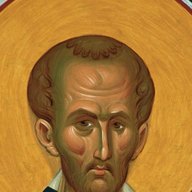
St. John ChrysostomHomily 32 on 1 Corinthians · on 1 Corinthians 13:1
And see whence he first begins; from that which was marvellous in their eyes and great, the gift of tongues. And in bringing forward that gift, he mentions it not just in the degree they had it in, but far more. For he did not say, "if I speak with tongues," but, "If I speak with the tongues of men,-" What is, "of…
And though I have the gift of prophecy, and understand all mysteries, and all knowledge; and though I have all faith, so that I could remove mountains, and have not charity, I am nothing.
St. John ChrysostomHomily 32 on 1 Corinthians · on 1 Corinthians 13:2
Then, in order that his discourse may be acceptable, he stops not at the gift of tongues, but proceeds also to the remaining gifts; and having depreciated all in the absence of love, he then depicts her image. And because he preferred to conduct his argument by amplification, he begins from the less and ascends to the…
St. John ChrysostomHomily 32 on 1 Corinthians · on 1 Corinthians 13:3
"And if I bestow all my goods to feed the poor, and if I give my body to be burned, but have not love, it profiteth me nothing." Wonderful amplification! For even these things too he states with another addition: in that he said not, "if I give to the poor the half of my goods," or "two or three parts," but, "though I…
St. John ChrysostomHomily 33 on 1 Corinthians · on 1 Corinthians 13:4
Thus, whereas he had showed, that both faith and knowledge and prophecy and tongues and gifts and healing and a perfect life and martyrdom, if love be absent, are no great advantage; of necessity he next makes an outline of its matchless beauty, adorning its image with the parts of virtue as with a sort of colors, and…
St. John ChrysostomHomily 33 on 1 Corinthians · on 1 Corinthians 13:5
"Doth not behave itself unseemly." Nay, why, saith he, do I say, she "is not puffed up," when she is so far from that feeling, that in suffering the most shameful things for him whom she loves, she doth not even count the thing an unseemliness? Again, he did not say, "she suffereth unseemliness but beareth the shame…
Rejoiceth not in iniquity, but rejoiceth in the truth;
οὐ χαίρει ἐπὶ τῇ ἀδικίᾳ, συγχαίρει δὲ τῇ ἀληθείᾳ·
St. John ChrysostomHomily 33 on 1 Corinthians · on 1 Corinthians 13:6
"Rejoiceth not in unrighteousness:" i.e., doth not feel pleasure over those that suffer ill: and not this only, but also, what is much greater, "rejoiceth with the truth." "She feels pleasure," saith he, "with them that are well spoken of," as Paul saith, "Rejoice with them that rejoice, and weep with them that weep."…
Beareth all things, believeth all things, hopeth all things, endureth all things.
πάντα στέγει, πάντα πιστεύει, πάντα ἐλπίζει, πάντα ὑπομένει.
St. John ChrysostomHomily 33 on 1 Corinthians · on 1 Corinthians 13:7
Wherefore he saith, "beareth all things." From her long-suffering, from her goodness; whether they be burdensome, or grievous, or insults, or stripes, or death, or whatsoever else. And this again one may perceive from the case of blessed David. For what could be more intolerable than to see a son rising up against…
St. John ChrysostomHomily 33 on 1 Corinthians · on 1 Corinthians 13:7
Nevertheless, he is not content with these, but hath something even more than these to say: according to his plan of stating the stronger points later. Wherefore he saith, "beareth all things." From her long-suffering, from her goodness; whether they be burdensome, or grievous, or insults, or stripes, or death, or…
Charity never faileth: but whether there be prophecies, they shall fail; whether there be tongues, they shall cease; whether there be knowledge, it shall vanish away.
St. John ChrysostomHomily 34 on 1 Corinthians · on 1 Corinthians 13:8
Having shown the excellency of love from its being requisite both to the spiritual gifts, and to the virtues of life; and from rehearsal of all its good qualities, and by showing it to be the foundation of exact self-denial; from another, a third head, again he points out its worth. And this he doth, first from a wish…
St. John ChrysostomHomily 33 on 1 Corinthians · on 1 Corinthians 13:8
"Love never faileth." Seest thou when he put the crown on the arch, and what of all things is peculiar to this gift? For what is, "faileth not?" it is not severed, is not dissolved by endurance. For it puts up with everything: since happen what will, he that loves never can hate. This then is the greatest of its…
St. John ChrysostomHomily 34 on 1 Corinthians · on 1 Corinthians 13:9–10
"We know in part, and we prophesy in part. But when that which is perfect is come, then that which is in part shall be done away." It is not therefore knowledge that is done away, but the circumstance that our knowledge is in part. For we shall not only know as much but even a great deal more. But that I may also make…
St. John ChrysostomHomily 34 on 1 Corinthians · on 1 Corinthians 13:11
"When I was a child, I spake as a child, I felt as a child, I thought as a child; but now that I am become a man, I have put away childish things." Next he points out also how great is the distance between the two, and that our deficiency is no small one.
St. John ChrysostomHomily 34 on 1 Corinthians · on 1 Corinthians 13:12
"For now we see in a mirror." Further, because the glass sets before us the thing seen indefinitely, he added, "darkly," to show very strongly that the present knowledge is most partial. "But then face to face." Not as though God hath a face, but to express the notion of greater clearness and perspicuity. Seest thou…
St. John ChrysostomHomily 34 on 1 Corinthians · on 1 Corinthians 13:13
"And now abideth, faith, hope, love, these three; and the greatest of these is love." For faith indeed and hope, when the good things believed and hoped for are come, cease. And to show this Paul said, "For hope that is seen is not hope; for who hopeth for that which he seeth." Again, "Now faith is the assurance of…
Every note is a real passage, quoted word for word from a published English translation, with its source. Nothing here is summarised or written by us. Some verses have many notes and some have none, because the Fathers wrote more on some passages than others.
St. John Chrysostom, Homilies on 1 Corinthians, Nicene and Post-Nicene Fathers, series 1, vol. 12 (1888–1889).
Scripture: the King James Version (1611); the Greek (tap Ελ) is the 1904 Patriarchal text of the Ecumenical Patriarchate.
All of these translations are in the public domain. The passages were matched to their verses by the Historical Christian Commentaries project, which also hosts the full texts we link to. The Fathers are a treasury of the Church's mind, and they are best read alongside the life of the Church: if a passage raises a question, bring it to your priest.