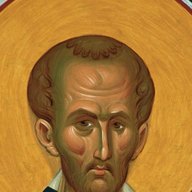
St. John ChrysostomHomily 34 on 1 Corinthians · on 1 Corinthians 14:1
If now so great is the virtue of love, with good reason doth he add and say, "Follow after love." For there is surely need of "following," and a kind of vehement running after her: in such sort doth she fly from us, and so many are the things which trip us up in that direction. Wherefore we have ever need of great…
St. John ChrysostomHomily 35 on 1 Corinthians · on 1 Corinthians 14:1
Thus, inasmuch as he had with exactness rehearsed unto them all the excellence of love, he exhorts them in what follows, with alacrity to lay hold of it. Wherefore also he said, "Follow after:" for he that is in chase beholds that only which is chased, and towards that he strains himself, and leaves not off until he…
For he that speaketh in an unknown tongue speaketh not unto men, but unto God: for no man understandeth him; howbeit in the spirit he speaketh mysteries.
St. John ChrysostomHomily 35 on 1 Corinthians · on 1 Corinthians 14:2
At this point he makes a comparison between the gifts, and lowers that of the tongues, showing it to be neither altogether useless, nor very profitable by itself. For in fact they were greatly puffed up on account of this, because the gift was considered to be a great one. And time of building the tower the one tongue…
St. John ChrysostomHomily 35 on 1 Corinthians · on 1 Corinthians 14:3
"But he that prophesieth speaketh unto men edification, and exhortation, and comfort." Seest thou by what he signifies the choice nature of this gift? i.e., by the common benefit? and how every where he gives the higher honor to that which tends to the profit of the many? For do not the former speak unto men also?…
St. John ChrysostomHomily 35 on 1 Corinthians · on 1 Corinthians 14:4
What then? Did they edify no man? "Yes," saith he, "themselves alone:" wherefore also he adds, "He that speaketh in tongue edifieth himself." And how, if he know not what he saith? Why, for the present, he is speaking of them who understand what they say; understand it themselves, but know not how to render it unto…
I would that ye all spake with tongues, but rather that ye prophesied: for greater is he that prophesieth than he that speaketh with tongues, except he interpret, that the church may receive edifying.
St. John ChrysostomHomily 35 on 1 Corinthians · on 1 Corinthians 14:5
Next, lest they should suppose that in envy to them he depresses the tongues, (for the more part had this gift,) to correct their suspicion he saith, "I would have you all speak with tongues, but rather that ye should prophesy: for greater is he that prophesieth than he that speaketh with tongues, except he interpret,…
Now, brethren, if I come unto you speaking with tongues, what shall I profit you, except I shall speak to you either by revelation, or by knowledge, or by prophesying, or by doctrine?
St. John ChrysostomHomily 35 on 1 Corinthians · on 1 Corinthians 14:6
"But now, brethren, if I come unto you speaking with tongues, what shall I profit you, unless I speak to you either by way of revelation, or of knowledge, or of prophesying, or of teaching?" "And why speak I," saith he, "of the rest? Nay, let the person who speaketh with tongues be Paul: for not even so will any good…
And even things without life giving sound, whether pipe or harp, except they give a distinction in the sounds, how shall it be known what is piped or harped?
St. John ChrysostomHomily 35 on 1 Corinthians · on 1 Corinthians 14:7
"Even things without life, giving a voice, whether pipe or harp, if they give not a distinction in the sounds, how shall it be known what is piped?" "And why do I say," saith he, "that in our case this is unprofitable, and that only useful which is dear and easy to be apprehended by the hearers? Since even in musical…
St. John ChrysostomHomily 35 on 1 Corinthians · on 1 Corinthians 14:8
"For if the trumpet give an uncertain voice, who shall prepare himself for war?" Thus from things merry ornamental he carries on his argument to those which are more necessary and useful; and saith that not in the harp alone, but in the trumpet also one may see this effect produced. For in that also there are certain…
St. John ChrysostomHomily 35 on 1 Corinthians · on 1 Corinthians 14:9
"So also ye, unless ye utter by the tongue, speech easy to be understood, ye will be speaking into the air:" i. e., calling to nobody, speaking unto no one. Thus every where he shows its unprofitableness. "But if it be unprofitable, why was it given?" saith one. So as to be useful to him that hath received it. But if…
St. John ChrysostomHomily 35 on 1 Corinthians · on 1 Corinthians 14:10–11
"There are, it may be, so many kinds of voices in the world, and no kind is without signification:" i. e., so many tongues, so many voices of Scythians, Thracians, Romans, Persians, Moors, Indians, Egyptians, innumerable other nations. "If then I know not the meaning of the voice, I shall be to him that speaketh a…
St. John ChrysostomHomily 35 on 1 Corinthians · on 1 Corinthians 14:12
"What then must be done?" saith he. Why, so far from disparaging, one ought to recommend and to teach it; as indeed himself also doth. Since after he had accused and rebuked it and shown its unprofitableness, he proceeds to counsel them; saying, "So also ye, since as ye are zealous of spiritual gifts, seek that ye may…
Wherefore let him that speaketh in an unknown tongue pray that he may interpret.
Διόπερ ὁ λαλῶν γλώσσῃ προσευχέσθω ἵνα διερμηνεύῃ.
St. John ChrysostomHomily 35 on 1 Corinthians · on 1 Corinthians 14:13
"Wherefore let him that speaketh in a tongue pray that he may interpret." Here he shows that it is in their power to obtain the gift. For, "let him pray," saith he, i.e., "let him contribute his own part," since if thou ask diligently, thou wilt surely receive. Ask accordingly not to have the gift of tongue only, but…
St. John ChrysostomHomily 35 on 1 Corinthians · on 1 Corinthians 14:14–15
"For if I pray in a tongue, my spirit prayeth, but my understanding is unfruitful." "What is it then? I will pray with the spirit, and I will pray with the understanding also; I will sing with the spirit, and I will sing with the understanding also." Seest thou how by degrees bringing his argument to a point, he…
What is it then? I will pray with the spirit, and I will pray with the understanding also: I will sing with the spirit, and I will sing with the understanding also.
Else when thou shalt bless with the spirit, how shall he that occupieth the room of the unlearned say Amen at thy giving of thanks, seeing he understandeth not what thou sayest?
St. John ChrysostomHomily 35 on 1 Corinthians · on 1 Corinthians 14:16–17
"Else," saith he, "if thou bless with the spirit, how shall he that filleth the place of the unlearned say the Amen at thy giving of thanks, seeing he knoweth not what thou sayest?" "For thou verily givest thanks well, but the other is not edified." Observe how again here he brings his stone to the plumb-line every…
St. John ChrysostomHomily 35 on 1 Corinthians · on 1 Corinthians 14:18
Further, because he had run down the possessors of this gift, as though they had no such great thing; that he might not seem to hold them cheap, as being himself destitute of it, see what he saith: "I thank God, speaking with tongues more than ye all." And this he doth also in another place intending, namely, to take…
Yet in the church I had rather speak five words with my understanding, that by my voice I might teach others also, than ten thousand words in an unknown tongue.
St. John ChrysostomHomily 35 on 1 Corinthians · on 1 Corinthians 14:19
"Howbeit in the Church I had rather speak five words with my understanding, that I might instruct others also." What is that, "speak with my understanding, that I might instruct others also?" "Understanding what I say," and "words which I can both interpret to others, and speak intelligently, and teach the hearers.…
St. John ChrysostomHomily 36 on 1 Corinthians · on 1 Corinthians 14:20
As might be expected, after his long argument and demonstration he adopts a more vehement style and abundance of rebuke; and mentions an example suited to the subject. For children too are wont to gape after trifles and to be fluttered, but of things very great they have not so much admiration. Since then these also…
In the law it is written, With men of other tongues and other lips will I speak unto this people; and yet for all that will they not hear me, saith the LORD.
St. John ChrysostomHomily 36 on 1 Corinthians · on 1 Corinthians 14:21
Yet surely it is no where written in the Law, but as I said before, he calls always the whole of the Old Testament, the Law: both the prophets and the historical books And he brings forward his testimony from Esaias the prophet, again covertly detracting from the glory of the gift, for their profit; nevertheless, even…
Wherefore tongues are for a sign, not to them that believe, but to them that believe not: but prophesying serveth not for them that believe not, but for them which believe.
St. John ChrysostomHomily 36 on 1 Corinthians · on 1 Corinthians 14:22
Having shown then even from the prophecy, that the sign in question is not of great use, he adds, "Wherefore tongues are for a sign, not to them that believe, but to the unbelieving: but prophesying is for a sign not to the unbelieving, but to them that believe." Great in this place is the difficulty which one seems…
If therefore the whole church be come together into one place, and all speak with tongues, and there come in those that are unlearned, or unbelievers, will they not say that ye are mad?
St. John ChrysostomHomily 36 on 1 Corinthians · on 1 Corinthians 14:23
And to show thee that he introduced the term "sign" here, not as a thing which of course did some good, he added that which resulted from it. And what was this? "They will say," saith he, "that ye are mad" This however not from the nature of the sign, but from their folly. But when thou hearer of unbelievers, do not…
St. John ChrysostomHomily 36 on 1 Corinthians · on 1 Corinthians 14:24–25
But prophecy is not for a sign merely, but is also suitable and useful for faith and for profit unto both classes. And this, if not directly, yet in the sequel he more clearly explained, saying, "he is reproved by all. For, if all prophesy," saith he, "and there come in one unbelieving or unlearned, he is reproved by…
How is it then, brethren? when ye come together, every one of you hath a psalm, hath a doctrine, hath a tongue, hath a revelation, hath an interpretation. Let all things be done unto edifying.
St. John ChrysostomHomily 36 on 1 Corinthians · on 1 Corinthians 14:26
"What is it then, brethren? When ye come together, each one hath a psalm, hath a teaching, hath a tongue, hath a revelation, hath an interpretation. Let all things be done unto edifying." Seest thou the foundation and the rule of Christianity? how, as it is the artificer's work to build, so it is the Christian's to…
If any man speak in an unknown tongue, let it be by two, or at the most by three, and that by course; and let one interpret.
εἴτε γλώσσῃ τις λαλεῖ, κατὰ δύο ἢ τὸ πλεῖστον τρεῖς, καὶ ἀνὰ μέρος, καὶ εἷς διερμηνευέτω·
St. John ChrysostomHomily 36 on 1 Corinthians · on 1 Corinthians 14:27–28
"And if any man speaketh in a tongue, let it be by two, or at the most by three, and that in turn; and let one interpret. But if there be no interpreter, let him keep silence in the Church; and let him speak to himself, and to God." What sayest thou, tell me? Having spoken so much of tongues, that the gift is a thing…
Let the prophets speak two or three, and let the other judge.
προφῆται δὲ δύο ἢ τρεῖς λαλείτωσαν, καὶ οἱ ἄλλοι διακρινέτωσαν·
St. John ChrysostomHomily 36 on 1 Corinthians · on 1 Corinthians 14:29
"Let the prophets speak by two or three, and let the others discern." No where hath he added, "at the most," as in the case of the tongues. And how is this, one saith? For he makes out that neither is prophesy sufficient in itself, if at least he permitteth the judgment to others. Nay, surely it is quite sufficient;…
If any thing be revealed to another that sitteth by, let the first hold his peace.
ἐὰν δὲ ἄλλῳ ἀποκαλυφθῇ καθημένῳ, ὁ πρῶτος σιγάτω.
St. John ChrysostomHomily 36 on 1 Corinthians · on 1 Corinthians 14:30–31
"But if a revelation he made to another sitting by, let the first keep silence. For ye all can prophesy one by one, that all may learn, and all may be comforted." What may this be which is spoken? "If when thou prophesiest," saith he, "and art speaking, the spirit of another stir him up, be silent thenceforth." For…
And the spirits of the prophets are subject to the prophets.
καὶ πνεύματα προφητῶν προφήταις ὑποτάσσεται·
St. John ChrysostomHomily 36 on 1 Corinthians · on 1 Corinthians 14:32
"And the spirits of the prophets are subject to the prophets." Seest thou how he put him to shame earnestly and fearfully? For that the man might not strive nor be factious, he signifies that the gift itself was under subjection. For by "spirit" here, he means its actual working. But if the spirit be subject, much…
For God is not the author of confusion, but of peace, as in all churches of the saints.
οὐ γάρ ἐστιν ἀκαταστασίας ὁ Θεός, ἀλλὰ εἰρήνης.
St. John ChrysostomHomily 36 on 1 Corinthians · on 1 Corinthians 14:33
Then he signifies that this is pleasing also to God, subjoining and saying, "For God is not a God of confusion, but of peace, as [I teach] in all the Churches of the saints." Seest thou by how many reasons he leads him to silence and soothes him, in the act of giving way to the other? By one thing and that the chief,…
Let your women keep silence in the churches: for it is not permitted unto them to speak; but they are commanded to be under obedience, as also saith the law.
St. John ChrysostomHomily 37 on 1 Corinthians · on 1 Corinthians 14:34
Having abated the disturbance both from the tongues and from the prophesyings; and having made a law to prevent confusion, that they who speak with tongues should do this in turn, and that they who prophesy should be silent when another begins; he next in course proceeds to the disorder which arose from the women,…
St. John ChrysostomHomily 37 on 1 Corinthians · on 1 Corinthians 14:34
Further, because they supposed this to be an ornament to them, I mean their speaking in public; again he brings round the discourse to the opposite point, saying, "For it is shameful for a woman to speak in the church." That is, first he made this out from the law of God, then from common reason and our received…
St. John ChrysostomHomily 37 on 1 Corinthians · on 1 Corinthians 14:35
"And if they would learn any thing, let them ask their own husbands at home." Thus, "not only, as it seems, are they not allowed to speak," saith he, "at random, but not even to ask any question in the church." Now if they ought not to ask questions, much more is their speaking at pleasure contrary to law. And what…
St. John ChrysostomHomily 37 on 1 Corinthians · on 1 Corinthians 14:36
But besides these things, he also shames them by consideration of what all agreed on, and what was every where prescribed; which topic also here he hath set down, saying, "What? was it from you that the word of God went forth? or came it unto you alone?" Thus he brings in the other Churches also as holding this law,…
St. John ChrysostomHomily 37 on 1 Corinthians · on 1 Corinthians 14:37–38
Next, what is strongest of all he puts last, saying, "God ordains these things even at this time by me." "If any man thinketh himself to be a prophet, or spiritual, let him take knowledge of the things which I write unto you that they are the commandments of the Lord. But if any man is ignorant, let him be ignorant."…
St. John ChrysostomHomily 37 on 1 Corinthians · on 1 Corinthians 14:39
Then, as he is ever wont to do, unto the former subject whence he digressed to say these things, he brings back his discourse as follows: "Wherefore, brethren, desire earnestly to prophesy, and forbid not to speak with tongues." For this too is his wont, not only to work out what is before him, but also starting from…
St. John ChrysostomHomily 37 on 1 Corinthians · on 1 Corinthians 14:40
Then, as in brief summary, setting all things right, he adds the words, "Let all things be done decently and in order." Again giving a blow to them who chose to behave themselves unseemly without cause, and to incur the imputation of madness; and who keep not their proper rank. For nothing doth so build up as good…
Every note is a real passage, quoted word for word from a published English translation, with its source. Nothing here is summarised or written by us. Some verses have many notes and some have none, because the Fathers wrote more on some passages than others.
St. John Chrysostom, Homilies on 1 Corinthians, Nicene and Post-Nicene Fathers, series 1, vol. 12 (1888–1889).
Scripture: the King James Version (1611); the Greek (tap Ελ) is the 1904 Patriarchal text of the Ecumenical Patriarchate.
All of these translations are in the public domain. The passages were matched to their verses by the Historical Christian Commentaries project, which also hosts the full texts we link to. The Fathers are a treasury of the Church's mind, and they are best read alongside the life of the Church: if a passage raises a question, bring it to your priest.