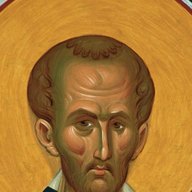
St. John ChrysostomHomily 38 on 1 Corinthians · on 1 Corinthians 15:1–2
"I make known unto you, brethren," saith he, "the gospel which I preached unto you." Seest thou with what modesty he commences? Seest thou how from the beginning he points out that he is bringing in no new nor strange thing? For he who "maketh known" that which was already known but afterwards had fallen into…
St. John ChrysostomHomily 38 on 1 Corinthians · on 1 Corinthians 15:3
"For I delivered unto you first of all that which I also received." Neither here doth he say, "I said unto you," nor, "I taught you," but uses the same expression again, saying, "I delivered unto you that which also I received:" nor again here doth he say, "I was taught," but, "I received:" establishing these two…
St. John ChrysostomHomily 38 on 1 Corinthians · on 1 Corinthians 15:4
"And that he was buried." And this also confirms the former topics, for that which is buried is doubtless a body. And here he no longer adds, "according to the Scriptures." He had wherewithal, nevertheless he adds it not. For what cause? Either because the burial was evident unto all, both then and now, or because the…
And that he was seen of Cephas, then of the twelve:
καὶ ὅτι ὤφθη Κηφᾷ, εἶτα τοῖς δώδεκα·
St. John ChrysostomHomily 38 on 1 Corinthians · on 1 Corinthians 15:5
"And that He appeared to Cephas:" he names immediately the most credible of all. "Then to the twelve." Thus, since he had mentioned the proof from the Scriptures, he adds also that by the events, producing as witnesses of the resurrection, after the prophets, the apostles and other faithful men. Whereas if he meant…
St. John ChrysostomHomily 38 on 1 Corinthians · on 1 Corinthians 15:6
"Then he appeared to above five hundred brethren at once; of whom the greater part remain until now, but some are fallen asleep." Some say that "above," is above from heaven; that is, "not walking upon earth, but above and overhead He appeared to them:" adding, that it was Paul's purpose to confirm, not the…
After that, he was seen of James; then of all the apostles.
ἔπειτα ὤφθη Ἰακώβῳ, εἶτα τοῖς ἀποστόλοις πᾶσιν·
St. John ChrysostomHomily 38 on 1 Corinthians · on 1 Corinthians 15:7
"After that, He was seen of James." I suppose, His brother. For the Lord is said to have Himself ordained him and made him Bishop in Jerusalem first. "Then to all the apostles." For there were also other apostles, as the seventy.
St. John ChrysostomHomily 38 on 1 Corinthians · on 1 Corinthians 15:8
"And last of all he appeared unto me also, as unto one born out of due time." This is rather an expression of modesty than any thing else. For not because he was the least, therefore did he appear to him after the rest. Since even if He did call him last, yet he appeared more illustrious than many which were before…
St. John ChrysostomHomily 38 on 1 Corinthians · on 1 Corinthians 15:9
"For I am the least of the apostles, that am not meet to be called an apostle, because I persecuted the Church of God." And he said not, of the twelve alone, but also of all the other apostles. And all these things he spake, both as one speaking modestly and because he was really so disposed as I said, making…
But by the grace of God I am what I am: and his grace which was bestowed upon me was not in vain; but I laboured more abundantly than they all: yet not I, but the grace of God which was with me.
St. John ChrysostomHomily 38 on 1 Corinthians · on 1 Corinthians 15:10
"But by the grace of God I am what I am." Seest thou again another excess of humility? in that the defects he imputes to himself, but of the good deeds nothing; rather he refers all to God. Next, lest he might hereby render his hearer supine, he saith, "And His grace which was bestowed upon me was not found vain." And…
St. John ChrysostomHomily 38 on 1 Corinthians · on 1 Corinthians 15:11
But wherefore did he utter at all that same lofty expression, "I labored more abundantly than they?" He saw that the occasion compelled him. For had he not said this, had he only depreciated himself, how could he with boldness call himself to witness, and number himself with the rest, and say, "Whether then it be I or…
St. John ChrysostomHomily 39 on 1 Corinthians · on 1 Corinthians 15:11
Having exalted the Apostles and abased himself, then again having exalted himself above them that he might make out an equality: (for he did effect an equality, when he showed that he had advantages over them as well as they over him,) and having thereby proved himself worthy of credit; neither so doth he dismiss…
St. John ChrysostomHomily 39 on 1 Corinthians · on 1 Corinthians 15:12
"Now if Christ is preached that He hath been raised from the dead, how say some among you that there is no resurrection of the dead?" Seest thou how excellently he reasons, and proves the resurrection from the fact of Christ's being raised, having first established the former in many ways? "For both the prophets spake…
St. John ChrysostomHomily 39 on 1 Corinthians · on 1 Corinthians 15:13
"But if there is no resurrection of the dead, neither hath Christ been raised." Seest thou Paul's energy, and his spirit for the combat, so invincible? how not only from what is evident he demonstrates what is doubted, but also from what is doubted, endeavors to demonstrate to gainsayers the former evident…
St. John ChrysostomHomily 39 on 1 Corinthians · on 1 Corinthians 15:14
"And if Christ hath not been raised, then is our preaching vain, your faith also is vain." Although what followed in due course would have been, "but if Christ be not risen, ye fight against things evident, and against so many prophets, and the truth of facts;" nevertheless he states what is much more fearful to them:…
Yea, and we are found false witnesses of God; because we have testified of God that he raised up Christ: whom he raised not up, if so be that the dead rise not.
St. John ChrysostomHomily 39 on 1 Corinthians · on 1 Corinthians 15:15
And not hereby alone doth he show the impiety of these evil doctrines, but he further contends earnestly against them, saying, "Yea, and we are found false witnesses of God: because we witnessed of Him that He raised up Christ; whom He raised not up, if so be that the dead are not raised." But if this be absurd, (for…
St. John ChrysostomHomily 39 on 1 Corinthians · on 1 Corinthians 15:16
And again he establishes it all, and takes it up again, saying, "For if the dead are not raised, neither hath Christ been raised." For had He not intended to do this, He would not have come into the world. And he names not this, but the end, to wit, His resurrection; through it drawing all things.
St. John ChrysostomHomily 39 on 1 Corinthians · on 1 Corinthians 15:17
"And if Christ hath not been raised, your faith is vain." With whatever is clear and confessed, he keeps on surrounding the resurrection of Christ, by means of the stronger point making even that which seems to be weak and doubtful, strong and clear. "Ye are yet in your sins." For if He was not raised, neither did He…
Then they also which are fallen asleep in Christ are perished.
ἄρα καὶ οἱ κοιμηθέντες ἐν Χριστῷ ἀπώλοντο.
St. John ChrysostomHomily 39 on 1 Corinthians · on 1 Corinthians 15:18
"Then they also which are fallen asleep in Christ have perished." "And why speak I of you," saith he, "when all those also are perished, who have done all and are no longer subject to the uncertainty of the future?" But by the expression, "in Christ," he means either "in the faith," or "they who died for His sake, who…
St. John ChrysostomHomily 39 on 1 Corinthians · on 1 Corinthians 15:19
"If in this life only we have hoped in Christ, we are of all men most pitiable." What sayest thou, O Paul? How "in this life only have we hope," if our bodies be not raised, the soul abiding and being immortal? Because even if the soul abide, even if it be infinitely immortal, as indeed it is, without the flesh it…
St. John ChrysostomHomily 39 on 1 Corinthians · on 1 Corinthians 15:20
"But now hath Christ been raised from the dead, the first-fruits of them that are asleep." Having signified how great mischiefs are bred from not believing the resurrection, he takes up the discourse again, and says, "But now hath Christ been raised from the dead;" continually adding, "from the dead," so as to stop…
St. John ChrysostomHomily 39 on 1 Corinthians · on 1 Corinthians 15:21
"For since by man came death, by man came also the resurrection of the dead." But if by a man, doubtless by one having a body. And observe his thoughtfulness, how on another ground also he makes his argument inevitable. As thus: "he that is defeated," saith he, "must in his own person also renew the conflict, the…
St. John ChrysostomHomily 39 on 1 Corinthians · on 1 Corinthians 15:22
"For as in Adam all die, even so in Christ shall all be made alive." What then? tell me; did all die in Adam the death of sin? How then was Noah righteous in his generation? and how Abraham? and how Job? and how all the rest? And what, I pray? shall all be made alive in Christ? Where then are those who are led away…
St. John ChrysostomHomily 39 on 1 Corinthians · on 1 Corinthians 15:23
"But every man in his own order." For do not, because thou hearest of a resurrection, imagine that all enjoy the same benefits. Since if in the punishment all will not suffer alike but the difference is great; much more where there are sinners and righteous men shall the separation be yet wider. "Christ the…
Then cometh the end, when he shall have delivered up the kingdom to God, even the Father; when he shall have put down all rule and all authority and power.
St. John ChrysostomHomily 39 on 1 Corinthians · on 1 Corinthians 15:24
"Then cometh the end." For when these shall have risen again, all things shall have an end, not as now when after Christ's resurrection things abide yet in suspense. Wherefore he added, "at His coming," that thou mayest learn that he is speaking of that time, "when He shall have delivered up the kingdom to God even…
St. John ChrysostomHomily 39 on 1 Corinthians · on 1 Corinthians 15:25
"For He must reign, till He hath put all enemies under His feet." Again from hence also another absurdity is produced, unless we take this also in a way becoming Deity. For the expression "until," is one of end and limitation: but in reference to God, this does not exist. And this manner of speech one might find also…
St. John ChrysostomHomily 39 on 1 Corinthians · on 1 Corinthians 15:26
"The last enemy that shall be abolished is death." How the last? After all, after the devil, after all the other things. For so in the beginning also death came in last; the counsel of the devil having come first, and our disobedience, and then death. Virtually then indeed it is even now abolished: but actually, at…
For he hath put all things under his feet. But when he saith all things are put under him, it is manifest that he is excepted, which did put all things under him.
St. John ChrysostomHomily 39 on 1 Corinthians · on 1 Corinthians 15:27–28
"For He hath put all things in subjection under His feet. But when He saith, All things are put in subjection, it is manifest that He is excepted who did subject all things unto Him." "And when all things have been subjected unto Him, then shall the Son also Himself be subjected unto Him that did subject all things…
And when all things shall be subdued unto him, then shall the Son also himself be subject unto him that put all things under him, that God may be all in all.
St. John ChrysostomHomily 40 on 1 Corinthians · on 1 Corinthians 15:29
He takes in hand again another topic, establishing what he said at one time from what God doeth, and at another from the very things which they practice. And this also is no small plea for the defence of any cause when a man brings forward the gainsayers themselves as witnessing by their own actions what he affirms.…
St. John ChrysostomHomily 40 on 1 Corinthians · on 1 Corinthians 15:30–31
"Why do we also stand in jeopardy every hour? I protest by that glorying in you which I have in Christ Jesus our Lord, I die daily." See again whence he endeavors to establish the doctrine, from his own suffrage: or rather not from his only, but from that also of the other apostles. And this too is no small thing;…
If after the manner of men I have fought with beasts at Ephesus, what advantageth it me, if the dead rise not? let us eat and drink; for to morrow we die.
St. John ChrysostomHomily 40 on 1 Corinthians · on 1 Corinthians 15:32
"If after the manner of men I fought with beasts at Ephesus, what doth it profit me?" What is, "if after the manner of men?" "As far as pertains to men I fought with beasts: for what if God snatched me out of those dangers? So that I am he who ought most to be in care about these things; I, who endure so great dangers…
Be not deceived: evil communications corrupt good manners.
μὴ πλανᾶσθε· φθείρουσιν ἤθη χρηστὰ ὁμιλίαι κακαί.
St. John ChrysostomHomily 40 on 1 Corinthians · on 1 Corinthians 15:33
"Be not deceived: evil company doth corrupt good manners." Then that he might not make his discourse too rough, he dwells not long upon his "reductio ad absurdum," but again turns his discourse to exhortation, saying, "Be not deceived: evil company doth corrupt good manners." And this he said, both to rebuke them as…
St. John ChrysostomHomily 40 on 1 Corinthians · on 1 Corinthians 15:34
"Awake up righteously and sin not." As if he were speaking to drunkards and madmen. For suddenly to cast every thing out of their hands, was the part of drunkards and madmen, in not seeing any longer what they saw nor believing what they had before confessed. But what is, "righteously?" with a view to what is…
St. John ChrysostomHomily 41 on 1 Corinthians · on 1 Corinthians 15:35–36
Gentle and lowly as the apostle is to a great degree every where, he here adopts a style rather pungent, because of the impiety of the gainsayers. He is not however content with this, but he also employs reasons and examples, subduing thereby even the very contentious. And above he saith, "Since by man came death, by…
St. John ChrysostomHomily 41 on 1 Corinthians · on 1 Corinthians 15:37
"And he who soweth, soweth not that body that shall be." For the things before spoken meet the question, "how they are raised;" but this, the doubt, "with what manner of body they come." But what is, "thou sowest not that body which shall be?" Not an entire ear of corn, nor new grain. For here his discourse no longer…
St. John ChrysostomHomily 41 on 1 Corinthians · on 1 Corinthians 15:38
"But God giveth it a body even as it pleased Him." "Yes," saith one, "but in that case it is the work of nature." Of what nature, tell me? For in that case likewise God surely doeth the whole; not nature, nor the earth, nor the rain. Wherefore also he making these things manifest, leaves out both earth and rain,…
St. John ChrysostomHomily 41 on 1 Corinthians · on 1 Corinthians 15:39
However, he is not content with this, but seeks another difference greater and more manifest. For that thou mayest not, when hearing, as I said, that all rise again, suppose that all enjoy the same reward; he laid before even in the preceding verses the seeds of this thought, saying, "But each in his own order." But…
St. John ChrysostomHomily 41 on 1 Corinthians · on 1 Corinthians 15:40–41
"There are also celestial bodies, and bodies terrestrial; but the glory of the celestial is one, and the glory of the terrestrial is another." "There is one glory of the sun, and another glory of the moon, and another glory of the stars: for one star differeth from another star in glory." And what means he by these…
St. John ChrysostomHomily 41 on 1 Corinthians · on 1 Corinthians 15:42
"So also is the resurrection of the dead." "So," How? with considerable difference. Then leaving this doctrine as sufficiently proved, he again comes to the proof itself of the resurrection and the manner of it, saying, "It is sown in corruption, it is raised in incorruption." And observe his consideration. As in the…
St. John ChrysostomHomily 41 on 1 Corinthians · on 1 Corinthians 15:43
"It is sown in dishonor." For what is more unsightly than a corpse in dissolution? "It is raised in glory." "It is sown in weakness." For before thirty days the whole is gone, and the flesh cannot keep itself together nor hold out for one day. "It is raised in power." For there shall nothing prevail against it for all…
St. John ChrysostomHomily 41 on 1 Corinthians · on 1 Corinthians 15:44
"It is sown a natural body, it is raised a spiritual body. There is a natural body, and there is a spiritual body." What sayest thou? Is not "this" body spiritual? It is indeed spiritual, but that will be much more so. For now oftentimes both the abundant grace of the Holy Ghost flies away on men's committing great…
St. John ChrysostomHomily 41 on 1 Corinthians · on 1 Corinthians 15:45
"So also it is written, the first man Adam became a living soul: the last Adam became a life-giving Spirit." And yet the one indeed is written, but the other not written. How then said He, "it is written?" He modified the expression according to the issue of events: as he is wont continually to do: and indeed as it is…
St. John ChrysostomHomily 41 on 1 Corinthians · on 1 Corinthians 15:46
"For that is not first," saith he, "which is spiritual, but that which is natural, then that which is spiritual." And he saith not, why, but is content with the ordinance of God, having the evidence from the facts testifying to that most excellent oeconomy of God, and implying that our state is always going forward to…
St. John ChrysostomHomily 42 on 1 Corinthians · on 1 Corinthians 15:47
Having said that "the natural was first," and "the spiritual afterward," he again states another difference, speaking of "the earthy" and "the heavenly." For the first difference was between the present life and that which is to come: but this between that before grace and that after grace. And he stated it with a…
St. John ChrysostomHomily 42 on 1 Corinthians · on 1 Corinthians 15:48
"As is the earthy, such are they also that are earthy:" so shall they perish and have an end. "As is the heavenly, such are they also that are heavenly:" so shall they abide immortal and glorious. What then? Did not This Man too die? He died indeed, but received no injury therefrom, yea rather by this He put an end to…
St. John ChrysostomHomily 42 on 1 Corinthians · on 1 Corinthians 15:49
"As we have borne the image of the earthy," i.e., as we have done evil, "let us also bear the image of the heavenly," i.e., let us practise all goodness. But besides this, I would fain ask thee, is it of nature that it is said, "he that is of the earth, earthy," and, "the Lord from heaven?" "Yea," saith one. What…
St. John ChrysostomHomily 42 on 1 Corinthians · on 1 Corinthians 15:50
"Now this I say, brethren, that flesh and blood cannot inherit the kingdom of God." Seest thou how he explains himself again, relieving us of the trouble? which he often doth: for by flesh he here denotes men's evil deeds, which he hath done also elsewhere; as when he saith, "But ye are not in the flesh:" and again,…
St. John ChrysostomHomily 42 on 1 Corinthians · on 1 Corinthians 15:51
"Behold, I tell you a mystery." It is something awful and ineffable and which all know not, which he is about to speak of: which also indicates the greatness of the honor he confers on them; I mean, his speaking mysteries to them. But what is this? "We shall not all sleep, but we shall all be changed." He means as…
In a moment, in the twinkling of an eye, at the last trump: for the trumpet shall sound, and the dead shall be raised incorruptible, and we shall be changed.
St. John ChrysostomHomily 42 on 1 Corinthians · on 1 Corinthians 15:52
"In a moment, in the twinkling of an eye, at the last trump." After he had discoursed much of the resurrection, then opportunely he points out also its very marvellous character. As thus: "not this only," saith he, "is wonderful that our bodies first turn to corruption, and then are raised; nor that the bodies which…
St. John ChrysostomHomily 42 on 1 Corinthians · on 1 Corinthians 15:53
"For this corruptible must put on incorruption." Thus lest any, hearing that "flesh and blood cannot inherit the kingdom of God," should suppose that our bodies do not rise again; he adds, "this corruptible must put on incorruption, and this mortal must put on immortality." Now the body is "corruptible," the body is…
So when this corruptible shall have put on incorruption, and this mortal shall have put on immortality, then shall be brought to pass the saying that is written, Death is swallowed up in victory.
St. John ChrysostomHomily 42 on 1 Corinthians · on 1 Corinthians 15:54
"But when this corruptible shall have put on incorruption, and this mortal shall have put on immortality, then shall come to pass the saying that is written, Death is swallowed up in victory." Thus, since he was speaking of great and secret things, he again takes prophecy to confirm his word. "Death is swallowed up in…
St. John ChrysostomHomily 42 on 1 Corinthians · on 1 Corinthians 15:55
"O death, where is thy sting? O grave, where is thy victory?" Seest thou his noble soul? how even as one who is offering sacrifices for victory, having become inspired and seeing already things future as things past, he leaps and tramples upon death fallen at his feet, and shouts a cry of triumph over its head where…
St. John ChrysostomHomily 42 on 1 Corinthians · on 1 Corinthians 15:56
"Now the sting of death is sin; and the power of sin is the law." Seest thou how the discourse is of the death of the body? therefore also of the resurrection of the body. For if these bodies do not rise again, how is death "swallowed up?" And not this only, but how is "the law the power of sin?" For that "sin" indeed…
St. John ChrysostomHomily 42 on 1 Corinthians · on 1 Corinthians 15:57
"But thanks be to God, which giveth us the victory through our Lord Jesus Christ." For the trophy He Himself erected, but the crowns He hath caused us also to partake of. And this not of debt, but of mere mercy.
Therefore, my beloved brethren, be ye stedfast, unmoveable, always abounding in the work of the Lord, forasmuch as ye know that your labour is not in vain in the Lord.
St. John ChrysostomHomily 42 on 1 Corinthians · on 1 Corinthians 15:58
"Wherefore, brethren, be ye steadfast, unmoveable." Just and seasonable is this exhortation after all that had gone before. For nothing so disquiets as the thought that we are buffeted without cause or profit. "Always abounding in the work of the Lord:" i.e., in the pure life. And he said not, "working that which is…
Every note is a real passage, quoted word for word from a published English translation, with its source. Nothing here is summarised or written by us. Some verses have many notes and some have none, because the Fathers wrote more on some passages than others.
St. John Chrysostom, Homilies on 1 Corinthians, Nicene and Post-Nicene Fathers, series 1, vol. 12 (1888–1889).
Scripture: the King James Version (1611); the Greek (tap Ελ) is the 1904 Patriarchal text of the Ecumenical Patriarchate.
All of these translations are in the public domain. The passages were matched to their verses by the Historical Christian Commentaries project, which also hosts the full texts we link to. The Fathers are a treasury of the Church's mind, and they are best read alongside the life of the Church: if a passage raises a question, bring it to your priest.