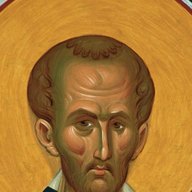
St. John ChrysostomHomily 16 on 1 Corinthians · on 1 Corinthians 6:1
"Dare any one of you, having a matter against his brother, go to law before the unrighteous, and not before the saints?" Here also he again makes his complaint upon acknowledged grounds; for in that other place he says, "It is actually reported that there is fornication among you." And in this place, "Dare any one of…
St. John ChrysostomHomily 11 on 1 Corinthians · on 1 Corinthians 6:2
For with these same discoursing he saith, "And if the world shall be judged by you, are ye unworthy to judge the smallest matters?" For as the Christian ought to be far removed from arrogance, so also from flattery and a mean spirit. Thus, if any one says, "I count money as nothing, but all things here are to me as a…
St. John ChrysostomHomily 16 on 1 Corinthians · on 1 Corinthians 6:2
Then, since it seemed easily open to contempt, I mean our being judged by those who were within, and especially at that time, (for they were not perhaps competent to comprehend a point, nor were they such as the heathen judges, well skilled in laws and rhetoric, inasmuch as the greater part of them were uneducated…
St. John ChrysostomHomily 16 on 1 Corinthians · on 1 Corinthians 6:3
"Know ye not that we shall judge angels? how much more, things which pertain to this life?" Some say that here the priests are hinted at, but away with this. His speech is about demons. For had he been speaking about corrupt priests, he would have meant them above when he said, "the world is judged in you:" (for the…
St. John ChrysostomHomily 16 on 1 Corinthians · on 1 Corinthians 6:4
"If then ye have to judge things pertaining to this life, set them to judge who are of no account in the Church." Wishing to instruct us as forcibly as possible that they ought not to commit themselves to those without, whatsoever the matter may be; having raised what seemed to be an objection, he answers it in the…
St. John ChrysostomHomily 16 on 1 Corinthians · on 1 Corinthians 6:5
"But this I say to move you to shame." These are the words of one exposing their objection as being an idle pretext: and therefore he adds, "Is it so that there is not a wise man among you, no not even one?" Is the scarcity, says he, so great? so great the want of sensible persons among you? And what he subjoins…
St. John ChrysostomHomily 16 on 1 Corinthians · on 1 Corinthians 6:6
"But brother goeth to law with brother, and that before unbelievers." Do you observe with what effect he disparaged the judges at first by calling them unrighteous; whereas here, to move shame, he calls them Unbelievers? For surely it is extremely disgraceful if the priest could not be the author of reconciliation…
Now therefore there is utterly a fault among you, because ye go to law one with another. Why do ye not rather take wrong? why do ye not rather suffer yourselves to be defrauded?
St. John ChrysostomHomily 16 on 1 Corinthians · on 1 Corinthians 6:7
"Nay, already it is altogether a defect in you that ye have lawsuits one with another." Do you see for what place he reserved this point? And how he has cleared the discussion of it in good time? For "I talk not yet," saith he, "which injures, or which is injured." Thus far, the act itself of going to law brings each…
St. John ChrysostomHomily 16 on 1 Corinthians · on 1 Corinthians 6:8
"Nay, ye yourselves do wrong, and defraud, and that your brethren." Again, it is a twofold crime, perhaps even threefold or fourfold. One, not to know how to bear being wronged. Another, actually to do wrong. A third, to commit the settlement of these matters even unto the unjust. And yet a fourth, that it should be…
Know ye not that the unrighteous shall not inherit the kingdom of God? Be not deceived: neither fornicators, nor idolaters, nor adulterers, nor effeminate, nor abusers of themselves with mankind,
St. John ChrysostomHomily 9 on 1 Corinthians · on 1 Corinthians 6:9
This is no small subject of enquiry which we propose, but rather about things which are of the first necessity and which all men enquire about; namely, whether hell fire have any end. For that it hath no end Christ indeed declared when he said, "Their fire shall not be quenched, and their worm shall not die." ...As I…
St. John ChrysostomHomily 16 on 1 Corinthians · on 1 Corinthians 6:9
Having thus, you see, abashed them from arguments on general principles, and before that, from the rewards proposed; he shuts up the exhortation with a threat, making his speech more peremptory, and saying thus, "Know ye not that the unrighteous shall not inherit the kingdom of God? Be not deceived: neither…
St. John ChrysostomHomily 16 on 1 Corinthians · on 1 Corinthians 6:11
"And such were some of you: but ye were washed, but ye were sanctified." In a way to abash them exceedingly, he adds this: as if he said, "Consider from what evils God delivered us; how great an experiment and demonstration of loving-kindness He afforded us! He did not limit His redemption to mere deliverance, but…
All things are lawful unto me, but all things are not expedient: all things are lawful for me, but I will not be brought under the power of any.
Πάντα μοι ἔξεστιν, ἀλλ᾽ οὐ πάντα συμφέρει· πάντα μοι ἔξεστιν, ἀλλ᾽ οὐκ ἐγὼ ἐξουσιασθήσομαι ὑπό τινος.
St. John ChrysostomHomily 17 on 1 Corinthians · on 1 Corinthians 6:12
Here he glances at the gluttons. For since he intends to assail the fornicator again, and fornication arises from luxuriousness and want of moderation, he strongly chastises this passion. It cannot be that he speaks thus with regard to things forbidden, such not being "lawful:" but of things which seem to be…
Meats for the belly, and the belly for meats: but God shall destroy both it and them. Now the body is not for fornication, but for the Lord; and the Lord for the body.
St. John ChrysostomHomily 17 on 1 Corinthians · on 1 Corinthians 6:13
"Meats for the belly." By "the belly" here he means not the stomach, but the stomach's voraciousness. As when he says, "Whose God is their belly:" not speaking about that part of the body, but about greediness. To prove that so it is, hear what follows: "And the belly for meats; but the body is not for fornication,…
St. John ChrysostomHomily 17 on 1 Corinthians · on 1 Corinthians 6:14
Having now sufficiently condemned the glutton, he uses also the hope of things to come to divert us from this wickedness: saying, "And God both raised up the Lord, and will raise up us also through His power." Do you perceive again his Apostolical wisdom? For he is always establishing the credibility of the…
Know ye not that your bodies are the members of Christ? shall I then take the members of Christ, and make them the members of an harlot? God forbid.
οὐκ οἴδατε ὅτι τὰ σώματα ὑμῶν μέλη Χριστοῦ ἐστιν; ἄρας οὖν τὰ μέλη τοῦ Χριστοῦ ποιήσω πόρνης μέλη; μὴ γένοιτο.
St. John ChrysostomHomily 18 on 1 Corinthians · on 1 Corinthians 6:15
Having passed on from the fornicator to the covetous person, he comes back to the former from the latter, no longer henceforth discoursing with him but with the others who had not committed fornication. And in the act of securing them lest they fall into the same sins, he assails him again. For he that has committed…
St. John ChrysostomHomily 18 on 1 Corinthians · on 1 Corinthians 6:16
Then he makes out how the fornicator becomes this, saying thus, "Know ye not that he that is joined unto a harlot is one body?" How is this evident? "For the twain, saith He, shall become one." For the conjunction suffers the two no longer to be two, but makes them both one.
But he that is joined unto the Lord is one spirit.
ὁ δὲ κολλώμενος τῷ Κυρίῳ ἓν πνεῦμά ἐστι.
St. John ChrysostomHomily 18 on 1 Corinthians · on 1 Corinthians 6:17
"But he that is joined unto the Lord is one spirit." For the conjunction suffers the two no longer to be two, but makes them both one. Now mark again, how he proceeds by means of the bare terms, conducting his accusation in the names of the harlot and of Christ. Wherefore he saith, "He that is joined to a harlot is…
St. John ChrysostomHomily 18 on 1 Corinthians · on 1 Corinthians 6:18
"Flee fornication." He said not, "abstain from fornication," but "Flee:" that is, with all zeal make to yourselves deliverance from that evil. "Every sin that a man doeth is without the body; but he that committeth fornication sinneth against his own body." This is less than what went before; but since he had to speak…
St. John ChrysostomHomily 18 on 1 Corinthians · on 1 Corinthians 6:19
"Know ye not that your body is a temple of the Holy Ghost which is in you?" He did not merely say, "of the Spirit," but, "which is in you;" which was the part of one who also was soothing. And again, explaining himself still further, he added, "which ye have from God." He mentioned Him that gave also, both exalting…
St. John ChrysostomHomily 18 on 1 Corinthians · on 1 Corinthians 6:20
Mark, accordingly, how he secures his ground. For having said, "Ye are not your own," he adds not, "But are under compulsion;" but, "Ye were bought with a price." Why sayest thou this? Surely on another ground, one might say perhaps, you should have persuaded men, pointing out that we have a Master. But this is common…
Every note is a real passage, quoted word for word from a published English translation, with its source. Nothing here is summarised or written by us. Some verses have many notes and some have none, because the Fathers wrote more on some passages than others.
St. John Chrysostom, Homilies on 1 Corinthians, Nicene and Post-Nicene Fathers, series 1, vol. 12 (1888–1889).
Scripture: the King James Version (1611); the Greek (tap Ελ) is the 1904 Patriarchal text of the Ecumenical Patriarchate.
All of these translations are in the public domain. The passages were matched to their verses by the Historical Christian Commentaries project, which also hosts the full texts we link to. The Fathers are a treasury of the Church's mind, and they are best read alongside the life of the Church: if a passage raises a question, bring it to your priest.