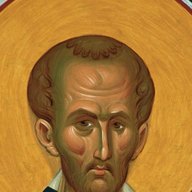
St. John ChrysostomHomily 19 on 1 Corinthians · on 1 Corinthians 7:1–2
For they had written to him, "Whether it was right to abstain from one's wife, or not:" and writing back in answer to this and giving rules about marriage, he introduces also the discourse concerning virginity: "It is good for a man not to touch a woman." "For if," says he, "thou enquire what is the excellent and…
St. John ChrysostomHomily 19 on 1 Corinthians · on 1 Corinthians 7:3–4
Now what is the meaning of "the due honor? The wife hath not power over her own body;" but is both the slave and the mistress of the husband. And if you decline the service which is due, you have offended God. But if thou wish to withdraw thyself, it must be with the husband's permission, though it be but a for short…
Defraud ye not one the other, except it be with consent for a time, that ye may give yourselves to fasting and prayer; and come together again, that Satan tempt you not for your incontinency.
St. John ChrysostomHomily 19 on 1 Corinthians · on 1 Corinthians 7:5
What then can this mean? "Let not the wife," says he, "exercise continence, if the husband be unwilling; nor yet the husband without the wife's consent." Why so? Because great evils spring from this sort of continence. For adulteries and fornications and the ruin of families have often arisen from hence. For if when…
But I speak this by permission, and not of commandment.
τοῦτο δὲ λέγω κατὰ συγγνώμην, οὐ κατ᾽ ἐπιταγήν.
St. John ChrysostomHomily 19 on 1 Corinthians · on 1 Corinthians 7:6–7
"But this I say by way of permission, not of commandment. For I would that all men were even as I myself; in a state of continence." This he doth in many places when he is advising about difficult matters; he brings forward himself, and says, "Be ye imitators of me." "Howbeit each man hath his own gift from God, one…
St. John ChrysostomHomily 19 on 1 Corinthians · on 1 Corinthians 7:9
Do you see the strong sense of Paul how he both signifies that continence is better, and yet puts no force on the person who cannot attain to it; fearing lest some offence arise? "For it is better to marry than to burn." He indicates how great is the tyranny of concupiscence. What he means is something like this: "If…
St. John ChrysostomHomily 19 on 1 Corinthians · on 1 Corinthians 7:10–11
Because it is a law expressly appointed by Christ which he is about to read to them about the "not putting away a wife without fornication;" therefore he says, "Not I." True it is what was before spoken though it were not expressly stated, yet it also is His decree. But this, you see, He had delivered in express…
St. John ChrysostomHomily 19 on 1 Corinthians · on 1 Corinthians 7:12–13
For as when discoursing about separating from fornicators, he made the matter easy by the correction which he applied to his words, saying, "Howbeit, not altogether with the fornicators of this world;" so also in this case he provideth for the abundant easiness of the duty, saying, "If any wife have a husband, or…
For the unbelieving husband is sanctified by the wife, and the unbelieving wife is sanctified by the husband: else were your children unclean; but now are they holy.
St. John ChrysostomHomily 19 on 1 Corinthians · on 1 Corinthians 7:14
Then lest the woman might fear, as though she became unclean because of intercourse with her husband, he says, "For the unbelieving husband is sanctified in the wife, and the unbelieving wife is sanctified in the husband." And yet, if "he that is joined to an harlot is one body," it is quite clear that the woman also…
St. John ChrysostomHomily 19 on 1 Corinthians · on 1 Corinthians 7:15
"Yet if the unbelieving departeth, let him depart," for in this case the matter is no longer fornication. But what is the meaning of, "if the unbelieving departeth?" For instance, if he bid thee sacrifice and take part in his ungodliness on account of thy marriage, or else part company; it were better the marriage…
St. John ChrysostomHomily 19 on 1 Corinthians · on 1 Corinthians 7:16
"For how knowest thou, O wife, whether thou shalt save thine husband?" This again refers to that expression, "let her not leave him." That is, "if he makes no disturbance, remain," saith he, "for there is even profit in this; remain and advise and give counsel and persuade." For no teacher will have such power to…
St. John ChrysostomHomily 19 on 1 Corinthians · on 1 Corinthians 7:17–20
"Only as God hath distributed to each man, as the Lord hath called each, so let him walk. Was any one called being circumcised? let him not become uncircumcised. Was any called in uncircumcision? let him not be circumcised. Circumcision is nothing, and uncircumcision is nothing; but the keeping of the commandments of…
St. John ChrysostomHomily 19 on 1 Corinthians · on 1 Corinthians 7:21
Astonishing! where has he put slavery? As circumcision profits not: and uncircumcision does no harm; so neither doth slavery, nor yet liberty. And that he might point out this with surpassing clearness, he says, "But even if thou canst become free, use it rather:" that is, rather continue a slave. Now upon what…
St. John ChrysostomHomily 19 on 1 Corinthians · on 1 Corinthians 7:22
Next he adds also the cause; "For he that was called in the Lord being a bondservant, is the Lord's free man: likewise he that was called, being free, is Christ's bondservant." "For," saith he, "in the things that relate to Christ, both are equal: and like as thou art the slave of Christ, so also is thy master. How…
Ye are bought with a price; be not ye the servants of men.
τιμῆς ἠγοράσθητε· μὴ γίνεσθε δοῦλοι ἀνθρώπων.
St. John ChrysostomHomily 19 on 1 Corinthians · on 1 Corinthians 7:23
"Ye were bought with a price: become not bondservants of men." This saying is addressed not to slaves only but also to free men. For it is possible for one who is a slave not to be a slave; and for one who is a freeman to be a slave. "And how can one be a slave and not a slave?" When he doeth all for God: when he…
St. John ChrysostomHomily 19 on 1 Corinthians · on 1 Corinthians 7:25
"Now concerning virgins. I have no commandment of the Lord; but I give my judgment, as one that hath obtained mercy of the Lord to be faithful." Advancing on his way in regular order, he proceeds next to speak concerning virginity. For after that he had exercised and trained them, in his words concerning continence,…
St. John ChrysostomHomily 19 on 1 Corinthians · on 1 Corinthians 7:27
"Art thou bound unto a wife? Seek not to be loosed. Art thou loosed from a wife? Seek not a wife." These words carry no contradiction to what had been said before but rather the most entire agreement with them. For he says in that place also, "Except it be by consent:" as here he says, "Art thou bound unto a wife?…
But and if thou marry, thou hast not sinned; and if a virgin marry, she hath not sinned. Nevertheless such shall have trouble in the flesh: but I spare you.
St. John ChrysostomHomily 19 on 1 Corinthians · on 1 Corinthians 7:28
Then, lest this should seem to be laying down a law, he subjoins, "but if thou marry, thou hast not sinned." He next alleges the existing state of things, "the present distress, the shortness of the time," and "the affliction." For marriage draws along with it many things, which indeed he hath glanced at, as well here…
There is difference also between a wife and a virgin. The unmarried woman careth for the things of the Lord, that she may be holy both in body and in spirit: but she that is married careth for the things of the world, how she may please her husband.
And this I speak for your own profit; not that I may cast a snare upon you, but for that which is comely, and that ye may attend upon the Lord without distraction.
St. John ChrysostomHomily 19 on 1 Corinthians · on 1 Corinthians 7:35
"And this I say for your own profit, not that I may cast a snare upon you, but for that which is seemly, and that ye may attend upon the Lord without distraction." Let the virgins hear that not by that one point is virginity defined; for she that is careful about the things of the world cannot be a virgin, nor seemly.…
But if any man think that he behaveth himself uncomely toward his virgin, if she pass the flower of her age, and need so require, let him do what he will, he sinneth not: let them marry.
St. John ChrysostomHomily 19 on 1 Corinthians · on 1 Corinthians 7:36
"But if any man think that he behaveth himself unseemly toward his virgin." Here he seems to be talking about marriage; but all that he says relates to virginity; for he allows even a second marriage, saying, "only in the Lord." Now what means, "in the Lord?" With chastity, with honor: for this is needed everywhere,…
Nevertheless he that standeth stedfast in his heart, having no necessity, but hath power over his own will, and hath so decreed in his heart that he will keep his virgin, doeth well.
The wife is bound by the law as long as her husband liveth; but if her husband be dead, she is at liberty to be married to whom she will; only in the Lord.
Every note is a real passage, quoted word for word from a published English translation, with its source. Nothing here is summarised or written by us. Some verses have many notes and some have none, because the Fathers wrote more on some passages than others.
St. John Chrysostom, Homilies on 1 Corinthians, Nicene and Post-Nicene Fathers, series 1, vol. 12 (1888–1889).
Scripture: the King James Version (1611); the Greek (tap Ελ) is the 1904 Patriarchal text of the Ecumenical Patriarchate.
All of these translations are in the public domain. The passages were matched to their verses by the Historical Christian Commentaries project, which also hosts the full texts we link to. The Fathers are a treasury of the Church's mind, and they are best read alongside the life of the Church: if a passage raises a question, bring it to your priest.