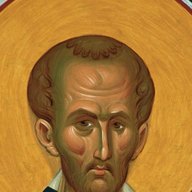
St. John ChrysostomHomily 39 on Acts · on Acts 18:1
What can be the reason that, having persuaded some so far as to say that they would hear him again, and there being no dangers, Paul is so in haste to leave Athens? Probably he knew that he should do them no great good; moreover he was led by the Spirit to Corinth. For the Athenians, although fond of hearing strange…
And found a certain Jew named Aquila, born in Pontus, lately come from Italy, with his wife Priscilla; (because that Claudius had commanded all Jews to depart from Rome:) and came unto them.
St. John ChrysostomHomily 39 on Acts · on Acts 18:2
"And having found a certain Jew named Aquila, of Pontus by birth, lately come from Italy"--for the greater part of his life had been passed there--"and Priscilla his wife, because that Claudius had commanded all the Jews to depart from Rome." For though it was in the reign of Nero that the war against the Jews was…
St. John ChrysostomHomily 39 on Acts · on Acts 18:3
Lo, what a justification he found for dwelling in the same house with them! For because here, of all places, it was necessary that he should not receive, as he himself says, "That wherein they glory, they may be found, even as we," it is providentially ordered that he there abides. Observe how, not in Jerusalem, nor…
St. John ChrysostomHomily 39 on Acts · on Acts 18:4–5
"And he reasoned in the synagogue every sabbath, and persuaded the Jews and the Greeks. And when Silas and Timotheus were come from Macedonia, Paul was straitened in the word, testifying to the Jews that Jesus is the Christ." "And when the Jews opposed and blasphemed," i.e. they tried to bear him down, they set upon…
And when they opposed themselves, and blasphemed, he shook his raiment, and said unto them, Your blood be upon your own heads; I am clean: from henceforth I will go unto the Gentiles.
St. John ChrysostomHomily 39 on Acts · on Acts 18:6
What then does Paul? He separates from them, and in a very awful manner: and though he does not now say, "It was need that the word should be spoken unto you," yet he darkly intimates it to them: "and when they opposed themselves, and blasphemed, he shook his raiment, and said unto them, Your blood be upon your own…
St. John ChrysostomHomily 39 on Acts · on Acts 18:7
"And he departed thence, and entered into a certain man's house, named Justus, one that worshipped God, whose house joined hard to the synagogue." See how having again said, "Henceforth"--for all that, he does not neglect them; so that it was to rouse them that he said this, and thereupon came to Justus, whose house…
And Crispus, the chief ruler of the synagogue, believed on the Lord with all his house; and many of the Corinthians hearing believed, and were baptized.
St. John ChrysostomHomily 39 on Acts · on Acts 18:8
"And Crispus, the chief ruler of the synagogue, believed on the Lord with all his house." This also was, of all things, enough to bring them over. "And many of the Corinthians hearing believed, and were baptized." "Crispus the ruler of the synagogue believed in the Lord, with his whole house: and many of the…
St. John ChrysostomHomily 39 on Acts · on Acts 18:9–10
"Then spake the Lord to Paul in the night by a vision, Be not afraid, but speak, and hold not thy peace: for I am with thee, and no man shall set on thee to hurt thee: for I have much people in this city." See by how many reasons He persuades him, and how He puts last the reason which of all others most prevailed with…
St. John ChrysostomHomily 39 on Acts · on Acts 18:11–12
"And he continued there a year and six months, teaching the word of God among them. And when Gallio was proconsul of Achaia, the Jews made insurrection with one accord against Paul, and brought him to the judgment-seat." Do you mark why those men were ever contriving to give a public turn to the misdemeanors they…
St. John ChrysostomHomily 39 on Acts · on Acts 18:13–16
"Saying, This fellow seduceth men contrary to the law to worship God. And when Paul was about to open his mouth, Gallio said: If indeed it were any wrong-doing or wicked lewdness, O ye Jews, reason would that I should bear with you. But if it be a question of words and names, and of your law, look ye to it; for I will…
And when Paul was now about to open his mouth, Gallio said unto the Jews, If it were a matter of wrong or wicked lewdness, O ye Jews, reason would that I should bear with you:
Then all the Greeks took Sosthenes, the chief ruler of the synagogue, and beat him before the judgment seat. And Gallio cared for none of those things.
St. John ChrysostomHomily 39 on Acts · on Acts 18:17
He taught them that such matters do not demand a judicial sentence, but they were doing everything out of order. And he does not say, "It is not my duty," but "I do not choose," so that they may not trouble him again. Thus Pilate said in the case of Christ, "Take him, and judge him according to your law." But they…
St. John ChrysostomHomily 39 on Acts · on Acts 18:17
"And he drave them from the judgment-seat"--he effectually closed the tribunal against them. "Then all having seized Sosthenes the ruler of the synagogue, beat him before the judgment-seat. And Gallio cared for none of these things": but their beating him he did not take as an insult to himself. So petulant were the…
And Paul after this tarried there yet a good while, and then took his leave of the brethren, and sailed thence into Syria, and with him Priscilla and Aquila; having shorn his head in Cenchrea: for he had a vow.
St. John ChrysostomHomily 40 on Acts · on Acts 18:18
See how the Law was breaking up; see how they were bound by conscience. This, namely, was a Jewish custom, to shear their heads agreeably with a vow. But then there ought to be also a sacrifice, which was not the case here. "Having yet tarried:" after the beating of Sosthenes. For it was necessary that he should yet…
St. John ChrysostomHomily 40 on Acts · on Acts 18:19
"And with him Priscilla" - lo, a woman also - "and Aquila." But these he left at Ephesus. With good reason, namely, that they should teach. For having been with him so long time, they were learning many things: and yet he did not at present withdraw them from their custom as Jews. "And he came to Ephesus, and left…
St. John ChrysostomHomily 40 on Acts · on Acts 18:19
"And they came to Ephesus, and there he left them": for he did not wish to take them about with him, but left them at Ephesus. But they subsequently dwelt at Corinth, and he bears high testimony to them, and writing to the Romans, salutes them. ... It was not for nothing that he left them at Ephesus, but for Apollos'…
St. John ChrysostomHomily 40 on Acts · on Acts 18:20–21
"When they desired him to tarry longer time with them, he consented not; but bade them farewell, saying, I must by all means keep this feast that cometh in Jerusalem." Therefore it was that he was hindered from coming into Asia, being impelled to what was of pressing moment. Thus observe him here, entreated (by them)…
But bade them farewell, saying, I must by all means keep this feast that cometh in Jerusalem: but I will return again unto you, if God will. And he sailed from Ephesus.
St. John ChrysostomHomily 40 on Acts · on Acts 18:22–23
"And when he had landed at Caesarea, and gone up, and saluted the Church, he went down to Antioch. And after he had spent some time there, he departed, and went over all the country of Galatia and Phrygia in order, strengthening all the disciples." He came again to those places which he had previously visited. Through…
St. John ChrysostomHomily 40 on Acts · on Acts 18:24
"And a certain Jew named Apollos, born at Alexandria, an eloquent man, and mighty in the Scriptures, came to Ephesus." Lo, even learned men are now urgent, and the disciples henceforth go abroad. Do you mark the spread of the preaching? For he was an awakened man, travelling in foreign parts for this very purpose.…
This man was instructed in the way of the Lord; and being fervent in the spirit, he spake and taught diligently the things of the Lord, knowing only the baptism of John.
St. John ChrysostomHomily 40 on Acts · on Acts 18:25
"This man was instructed in the way of the Lord; and being fervent in the Spirit, he spake and taught diligently the things of the Lord, knowing only the baptism of John." If this man knew only the baptism of John, how is it that he was "fervent in the Spirit," for the Spirit was not given in that way? It seems to me…
And he began to speak boldly in the synagogue: whom when Aquila and Priscilla had heard, they took him unto them, and expounded unto him the way of God more perfectly.
St. John ChrysostomHomily 40 on Acts · on Acts 18:26
"And he began to speak boldly in the synagogue: whom when Aquila and Priscilla had heard, they took him unto them, and expounded unto him the way of God more perfectly." It was not for nothing that Paul left them at Ephesus, but for Apollos' sake, the Spirit so ordered it, that he might come with greater force to the…
And when he was disposed to pass into Achaia, the brethren wrote, exhorting the disciples to receive him: who, when he was come, helped them much which had believed through grace:
St. John ChrysostomHomily 40 on Acts · on Acts 18:27
"And when he was disposed to pass into Achaia, the brethren wrote, exhorting the disciples to receive him." He wished then also to depart into Achaia, and these also encouraged him to do so, having also given him letters. In faith, he did all by faith; "the brethren wrote," etc. Nowhere envy, nowhere an evil eye.…
St. John ChrysostomHomily 40 on Acts · on Acts 18:28
"For he mightily convinced the Jews, and that publicly, showing by the Scriptures that Jesus was Christ." Now by this, that he "publicly" convinced them, his boldness was shown: by the clearness of his arguing, his power was declared: by his convicting them out of the Scriptures, his skill of learning. For neither…
Every note is a real passage, quoted word for word from a published English translation, with its source. Nothing here is summarised or written by us. Some verses have many notes and some have none, because the Fathers wrote more on some passages than others.
St. John Chrysostom, Homilies on Acts, Nicene and Post-Nicene Fathers, series 1, vol. 11 (1888–1889).
Scripture: the King James Version (1611); the Greek (tap Ελ) is the 1904 Patriarchal text of the Ecumenical Patriarchate.
All of these translations are in the public domain. The passages were matched to their verses by the Historical Christian Commentaries project, which also hosts the full texts we link to. The Fathers are a treasury of the Church's mind, and they are best read alongside the life of the Church: if a passage raises a question, bring it to your priest.