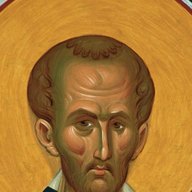
St. John ChrysostomHomily 40 on Acts · on Acts 19:1
"And it came to pass, that, while Apollos was at Corinth, Paul, having passed through the upper coasts" - meaning what we have read as to Caesarea and the other places - "came to Ephesus, and having found certain disciples." But whence had those, being in Ephesus, the baptism of John? Probably they had been on a visit…
He said unto them, Have ye received the Holy Ghost since ye believed? And they said unto him, We have not so much as heard whether there be any Holy Ghost.
St. John ChrysostomHomily 40 on Acts · on Acts 19:2
"Have ye received the Holy Ghost since ye believed? And they said unto him, We have not so much as heard whether there be any Holy Ghost." He does not say to them, Do ye believe in Jesus? but what? "Have ye received the Holy Ghost?" He knew that they had not, but wishes themselves to say it, that having learnt what…
St. John ChrysostomHomily 40 on Acts · on Acts 19:3–4
"And he said unto them, Unto what then were ye baptized? And they said, Unto John's baptism. Then said Paul, John verily baptized with the baptism of repentance, saying unto the people, that they should believe on Him who should come after him, that is, on Christ Jesus." For that they did not even believe in Christ is…
Then said Paul, John verily baptized with the baptism of repentance, saying unto the people, that they should believe on him which should come after him, that is, on Christ Jesus.
St. John ChrysostomHomily 40 on Acts · on Acts 19:5–6
"When they heard this, they were baptized in the name of the Lord Jesus. And when Paul had laid his hands upon them, the Holy Ghost came on them; and they spake with tongues, and prophesied." The gift is twofold: tongues and prophesyings. Hence is shown an important doctrine, that the baptism of John is incomplete.…
St. John ChrysostomHomily 41 on Acts · on Acts 19:8
See him in every place forcing his way into the synagogue, and in this manner departing thence. For in every place, he wished to have the occasion given him by them. He wished to separate the disciples thence, and to have the beginning for ceasing to assemble with them, given by the Jews themselves. He was henceforth…
St. John ChrysostomHomily 41 on Acts · on Acts 19:8–9
"And having entered in to the synagogue," etc. But why did he speak boldly? It means, he was ready to confront dangers, and disputed more openly, not veiling the doctrines. "But when some were hardened, and spake evil of the way, having departed from them, he separated the disciples." He put a stop, it means, to their…
But when divers were hardened, and believed not, but spake evil of that way before the multitude, he departed from them, and separated the disciples, disputing daily in the school of one Tyrannus.
St. John ChrysostomHomily 41 on Acts · on Acts 19:9
"But when divers were hardened, speaking evil of the way." They might well call it "the way"; this was indeed the way, that led into the kingdom of heaven. "He departed from them, and separated the disciples, disputing daily in the school of one Tyrannus." He put a stop to their evil-speaking: he did not wish to…
St. John ChrysostomHomily 41 on Acts · on Acts 19:9–10
"But when divers were hardened, speaking evil of the way." They might well call it "the way"; this was indeed the way, that led into the kingdom of heaven. "He departed from them, and separated the disciples, disputing daily in the school of one Tyrannus. And this was done for the space of two years, so that all that…
St. John ChrysostomHomily 41 on Acts · on Acts 19:10
"And this was done for the space of two years, so that all that were in Asia heard the word of the Lord, both Jews and Greeks." Do you mark how much was effected by his persisting? "Both Jews and Greeks heard: all that dwelt in Asia": it was for this also that the Lord suffered him not to go into Asia on a former…
St. John ChrysostomHomily 41 on Acts · on Acts 19:11–12
"And God wrought special miracles by the hands of Paul: so that from his body were brought unto the sick handkerchiefs or aprons, and the diseases departed from them, and the evil spirits went out of them." Not touched the wearer only and so were healed, but also receiving them, they laid them upon the sick and so…
St. John ChrysostomHomily 41 on Acts · on Acts 19:12
"So that from his body were brought unto the sick handkerchiefs or aprons, and the diseases departed from them, and the evil spirits went out of them." Not touched the wearer only and so were healed, but also receiving them, they laid them upon the sick and so healed them. "He that believeth on Me," saith Christ,…
Then certain of the vagabond Jews, exorcists, took upon them to call over them which had evil spirits the name of the LORD Jesus, saying, We adjure you by Jesus whom Paul preacheth.
St. John ChrysostomHomily 41 on Acts · on Acts 19:13
"Then certain of the vagabond Jews, exorcists, took upon them to call over them which had evil spirits the name of the Lord Jesus, saying, We adjure you by Jesus whom Paul preacheth." So entirely did they do all by way of trade! Observe: vagabond, or, itinerant, Jewish exorcists. And to believe indeed, they had no…
St. John ChrysostomHomily 41 on Acts · on Acts 19:14–16
"And there were seven sons of one Sceva, a Jew, and chief of the priests, which did so. And the evil spirit answered and said, Jesus I know, and Paul I know; but who are ye? And the man in whom the evil spirit was leaped on them, and overcame them, and prevailed against them, so that they fled out of that house naked…
St. John ChrysostomHomily 41 on Acts · on Acts 19:15
"Jesus I know, and Paul I know." For, that there may not seem to be any slight put upon the Name of Jesus, the demon first confesses Him, and then has permission given him. For, to show that it was not any weakness of the Name, but all owing to the imposture of those men, why did not the same take place in the case of…
And the man in whom the evil spirit was leaped on them, and overcame them, and prevailed against them, so that they fled out of that house naked and wounded.
St. John ChrysostomHomily 41 on Acts · on Acts 19:17–18
"And this became known to all, both Jews and Greeks, that dwelt at Ephesus, and fear fell upon them all, and the name of the Lord Jesus was magnified. And many of them that had believed came confessing and making known their practices." For since they had got to possess such power as, by means of the demons, to do…
Many of them also which used curious arts brought their books together, and burned them before all men: and they counted the price of them, and found it fifty thousand pieces of silver.
St. John ChrysostomHomily 41 on Acts · on Acts 19:19–20
"And many of them that practised curious arts, brought their books together, and burnt them in the presence of all men" - having seen that there was no more use of them now that the demons themselves do these things - "and reckoned up the price of them, and found the amount fifty thousand pieces of silver. So mightily…
After these things were ended, Paul purposed in the spirit, when he had passed through Macedonia and Achaia, to go to Jerusalem, saying, After I have been there, I must also see Rome.
St. John ChrysostomHomily 42 on Acts · on Acts 19:21
He sends Timothy and Erastus into Macedonia, but himself remains at Ephesus. Having made a long enough stay in that city, he wishes to remove elsewhere again. But how is it, that having from the first chosen to depart into Syria, he turns back to Macedonia? "He purposed," it says, "in the Spirit," showing that all…
St. John ChrysostomHomily 42 on Acts · on Acts 19:21
He no longer speaks here after the manner of a man, or, He purposed to pass through those regions, without tarrying longer. Wherefore does he send away Timothy and Erastus? Of this I suppose he says, "Wherefore when we could no longer forbear, we thought it good to be left at Athens alone. He sent away," it says, "two…
St. John ChrysostomHomily 42 on Acts · on Acts 19:21–41
Seest thou how God permits trials, and by them stirs up and awakens the disciples, and makes them more energetic? Then let us not sink down under trials: for He Himself will "also make the way of escape, that we may be able to bear them." Nothing so makes friends, and rivets them so firmly, as affliction: nothing so…
St. John ChrysostomHomily 42 on Acts · on Acts 19:21–41
Afflictions cut us off from the sympathy we have for the present world, as appears in this, that we wish for death immediately, and cease to be loving of the body: which very thing is the greatest part of wisdom, to have no hankering, no ties to the present life. The soul which is afflicted does not wish to be…
St. John ChrysostomHomily 42 on Acts · on Acts 19:21–41
A great good is affliction: and we learn this from our own children: for without affliction a boy would learn nothing useful. But we, more than they, need affliction. For if there, when the passions as yet are quiet, chastisement benefits them, how much more us, especially possessed as we are by so many! Nay, we…
St. John ChrysostomHomily 42 on Acts · on Acts 19:22
"But he himself tarried awhile in Asia." Most of all does he pass his time in Asia; and with reason: there, namely, was the tyranny, of the philosophers. Afterwards also he came and discoursed to them again.
St. John ChrysostomHomily 42 on Acts · on Acts 19:23
"There arose no small stir about the Way." Do you see the renown acquired? They contradicted, it says: then came miracles, twofold: then again, danger: such is the way the threads alternate throughout the whole texture of the history.
St. John ChrysostomHomily 42 on Acts · on Acts 19:24
"For a certain man named Demetrius, a silversmith, which made silver temples of Diana, brought no small gain unto the craftsmen." "Which made," it says, "silver temples of Diana." And how is it possible that temples could be made of silver? Perhaps as small boxes. Great was the honor paid to this Diana in Ephesus;…
St. John ChrysostomHomily 42 on Acts · on Acts 19:25
Observe the maliciousness of the man. He was wealthy himself, and to him indeed it was no such great loss; but to them the loss was great, since they were poor, and subsisted on their daily earnings. Nevertheless, these men say nothing, but only he. And observe: "Whom having collected, and the workmen of like…
St. John ChrysostomHomily 42 on Acts · on Acts 19:25
"From this work we have our wealth. Hath persuaded." How did he persuade - he, a man of mean consideration? How prevail over so great a force of habit? by doing what - by saying what? It is not for a Paul to effect this, it is not for a man. Even this is enough, that he said, "They are no gods." Now if the impiety of…
Moreover ye see and hear, that not alone at Ephesus, but almost throughout all Asia, this Paul hath persuaded and turned away much people, saying that they be no gods, which are made with hands:
St. John ChrysostomHomily 42 on Acts · on Acts 19:26
"Moreover ye see and hear, that not alone at Ephesus, but almost throughout all Asia, this Paul hath persuaded and turned away much people, saying that they be no gods, which are made with hands: so that not only this our craft is in danger to be set at naught; but also, that the temple of the great goddess Diana…
St. John ChrysostomHomily 42 on Acts · on Acts 19:26
"Ye both see and hear," so palpable was the result that was taking place - "that not alone at Ephesus, but almost throughout all Asia, this Paul by persuading hath turned away," not by violence: this is the way to persuade a city. Then, what touched them closely, "that they be no gods which are made with hands." He…
So that not only this our craft is in danger to be set at nought; but also that the temple of the great goddess Diana should be despised, and her magnificence should be destroyed, whom all Asia and the world worshippeth.
St. John ChrysostomHomily 42 on Acts · on Acts 19:27
And yet the very things he spoke were enough to bring them to true religion: but being poor senseless creatures, this is the part they act. For if this (Paul being) man is strong enough to turn away all, and the worship of the gods is in jeopardy, one ought to reflect, how great must this man's God be, and that he…
St. John ChrysostomHomily 42 on Acts · on Acts 19:27
For, lest they should consider within themselves (how strange), that a human being should have such power as this, and if a human being has power to effect such things, why then one ought to be persuaded by that man, he adds: "not only is this our craft in danger to be set at naught, but also," as if forsooth alleging…
St. John ChrysostomHomily 42 on Acts · on Acts 19:28
Observe the testimonies borne to the Apostles by their enemies, that they overthrew their worship. There at Lystra they brought "garlands and oxen." Here he says, "This our craft is in danger to be set at naught. - Ye have filled all everywhere with your doctrine." So said the Jews also with regard to Christ: "Ye see…
St. John ChrysostomHomily 42 on Acts · on Acts 19:28
"And when they heard, they were filled with wrath, and shouted, Great is Diana of the Ephesians!" For each city had its proper gods. They thought to make their voice a barrier against the Divine Spirit. Children indeed, these Greeks! And their feeling was as if by their voice they could reinstate the worship of her,…
And the whole city was filled with confusion: and having caught Gaius and Aristarchus, men of Macedonia, Paul’s companions in travel, they rushed with one accord into the theatre.
St. John ChrysostomHomily 42 on Acts · on Acts 19:29
"And cried out, saying, Great is Diana of the Ephesians. And the whole city was filled with confusion: and rushed with one accord into the theatre." Such is the way with vulgar minds, any trivial occasion shall hurry them away and inflame their passions. Therefore it behooves to do things with strict examination. But…
St. John ChrysostomHomily 42 on Acts · on Acts 19:30
"And when Paul," etc. Paul then wished to enter in that he might harangue them: for he took his persecutions as occasions for teaching: "but the disciples suffered him not." Mark, how great forethought we always find them taking for him. At the very first they brought him out that they might not in his person receive…
St. John ChrysostomHomily 42 on Acts · on Acts 19:31
"And certain of the Asiarchs, which were his friends, sent unto him, desiring him that he would not adventure himself into the theatre" to a disorderly populace and tumult. And Paul complies, for he was not vainglorious, nor ambitious.
St. John ChrysostomHomily 42 on Acts · on Acts 19:31
"And certain of the Asiarchs besought him that he would not enter into the theatre." Knowing his eagerness, they "besought him:" so much did all the believers love him.
St. John ChrysostomHomily 42 on Acts · on Acts 19:32
"Some therefore cried one thing, and some another: for the assembly was confused." Such is the nature of the multitude: it recklessly follows, like fire when it has fallen upon fuel; and the more part knew not wherefore they were come together.
And they drew Alexander out of the multitude, the Jews putting him forward. And Alexander beckoned with the hand, and would have made his defence unto the people.
St. John ChrysostomHomily 42 on Acts · on Acts 19:33
"And they drew Alexander out of the multitude, the Jews putting him forward." It was the Jews that thrust him forward; but as providence ordered it, this man did not speak. "And Alexander beckoned with the hand, and would have made his defence unto the people."
St. John ChrysostomHomily 42 on Acts · on Acts 19:33
"And they drew Alexander," etc. This Alexander, why did he wish to plead? Was he accused? No, but it was to find an opportunity, and overturn the whole matter, and inflame the anger of the people.
But when they knew that he was a Jew, all with one voice about the space of two hours cried out, Great is Diana of the Ephesians.
ἐπιγνόντες δὲ ὅτι Ἰουδαῖός ἐστι, φωνὴ ἐγένετο μία ἐκ πάντων, ὡς ἐπὶ ὥρας δύο κραζόντων· μεγάλη ἡ Ἄρτεμις Ἐφεσίων.
St. John ChrysostomHomily 42 on Acts · on Acts 19:34
"But when they knew that he was a Jew, all with one voice about the space of two hours cried out, Great is Diana of the Ephesians." A childish understanding indeed! as if they were afraid, lest their worship should be extinguished, they shouted without intermission. For two years had Paul abode there, and see how many…
St. John ChrysostomHomily 42 on Acts · on Acts 19:34
"But when they knew that he was a Jew, all with one voice about the space of two hours cried out, Great is Diana of the Ephesians." Do you mark the inordinate rage?
And when the townclerk had appeased the people, he said, Ye men of Ephesus, what man is there that knoweth not how that the city of the Ephesians is a worshipper of the great goddess Diana, and of the image which fell down from Jupiter?
St. John ChrysostomHomily 42 on Acts · on Acts 19:35
"And when the town clerk had appeased the people, he said, Ye men of Ephesus, what man is there that knoweth not how that the city of the Ephesians is temple-keeper of the great goddess Diana, and of the image which fell down from Jupiter?" As if the thing were not palpable. With this saying first he extinguished…
St. John ChrysostomHomily 42 on Acts · on Acts 19:35
Well, and with rebuke does the town clerk say, "What man is there that knoweth not how that the city of the Ephesians-" coming to the point which they were frightened about. Is it this, says he, that ye do not worship her? And he does not say, "That knoweth not" Diana, but, "our city," that it always worshipped her.
St. John ChrysostomHomily 42 on Acts · on Acts 19:36
"Seeing then that these things cannot be spoken against, ye ought to be quiet, and to do nothing rashly." Why then do ye make a question about them, as if these things were not plain? Then he quietly chides them, showing that they had come together without reason. "And to do nothing rashly" he says. Showing that they…
St. John ChrysostomHomily 42 on Acts · on Acts 19:37
"For ye have brought hither these men, which are neither robbers of churches, nor yet blasphemers of your goddess." All this however he says to the people; but in order that those (workmen) also might become more reasonable, he says: "Wherefore if Demetrius, and the craftsman which are with him, have a matter against…
St. John ChrysostomHomily 42 on Acts · on Acts 19:37
"For ye have brought hither," etc. They wanted to make religion the pretext for what concerned their own money-making: and it was not right on account of private charges to hold a public assembly. For he put them to a nonplus, and left them not a word to say for themselves.
Wherefore if Demetrius, and the craftsmen which are with him, have a matter against any man, the law is open, and there are deputies: let them implead one another.
St. John ChrysostomHomily 42 on Acts · on Acts 19:38
In order that those (workmen) also might become more reasonable, he says: "Wherefore if Demetrius, and the craftsman which are with him, have a matter against any man, the law is open, and there are deputies: let them implead one another. But if ye enquire anything concerning other matters, it shall be determined in a…
St. John ChrysostomHomily 42 on Acts · on Acts 19:39
"But if ye enquire anything concerning other matters, it shall be determined in a lawful assembly." "A lawful assembly," he says, for there were three assemblies according to law in each month; but this one was contrary to law.
St. John ChrysostomHomily 42 on Acts · on Acts 19:40
"For we are in danger to be called in question for this day's uproar, there being no cause, for which matter we shall not be able to give an account for this concourse." Then he terrified them also by saying, "We are in danger to be called to account" for sedition.
St. John ChrysostomHomily 42 on Acts · on Acts 19:40
"There being no cause," he says, "for this concourse, for which matter we shall not be able to give the account." See how prudently, how cleverly, the unbelievers act. Thus he extinguished their wrath. For as it is easily kindled, so also is it easily extinguished.
And when he had thus spoken, he dismissed the assembly.
St. John ChrysostomHomily 42 on Acts · on Acts 19:41
See how prudently, how cleverly, the unbelievers (act). Thus he extinguished their wrath. For as it is easily kindled, so also is it easily extinguished. "And when he had thus spoken," it says, "he dismissed the assembly."
Every note is a real passage, quoted word for word from a published English translation, with its source. Nothing here is summarised or written by us. Some verses have many notes and some have none, because the Fathers wrote more on some passages than others.
St. John Chrysostom, Homilies on Acts, Nicene and Post-Nicene Fathers, series 1, vol. 11 (1888–1889).
Scripture: the King James Version (1611); the Greek (tap Ελ) is the 1904 Patriarchal text of the Ecumenical Patriarchate.
All of these translations are in the public domain. The passages were matched to their verses by the Historical Christian Commentaries project, which also hosts the full texts we link to. The Fathers are a treasury of the Church's mind, and they are best read alongside the life of the Church: if a passage raises a question, bring it to your priest.