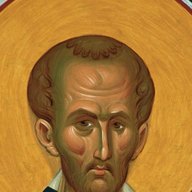
St. John ChrysostomHomily 15 on Acts · on Acts 7:1
"Then," it proceeds, "said the high-priest, Are these things so?" Observe, the question is put with mildness, that he may effect some great mischief. For this reason Stephen too begins his speech in a tone of gentleness.
St. John ChrysostomHomily 15 on Acts · on Acts 7:1
"And he said," etc. He shows here, that the promise was made before the Place, before Circumcision, before Sacrifice, before the Temple, and that it was not of their merit that these received either Circumcision or Law, but that the land was the reward of obedience alone. Moreover, that neither on the giving of…
And he said, Men, brethren, and fathers, hearken; The God of glory appeared unto our father Abraham, when he was in Mesopotamia, before he dwelt in Charran,
St. John ChrysostomHomily 15 on Acts · on Acts 7:2
"Men, brethren, and fathers, hearken; The God of glory appeared unto our father Abraham, when he was in Mesopotamia, before he dwelt in Charran." Immediately at the outset he overthrows their conceit, and makes it appear by what he says, that the temple is nothing, that the customs are nothing either, without their…
St. John ChrysostomHomily 15 on Acts · on Acts 7:3
"And said unto him, Get thee out of thy country, and from thy kindred, and come into a land which I shall show thee." "And from thy kindred." How then saith the Scripture, that Abraham's father was willing to go out? Hence we learn, that it was in consequence of Abraham's vision, that his father was moved to join in…
Then came he out of the land of the Chaldaeans, and dwelt in Charran: and from thence, when his father was dead, he removed him into this land, wherein ye now dwell.
St. John ChrysostomHomily 15 on Acts · on Acts 7:4
"Then came he out of the land of the Chaldaeans, and dwelt in Charran: and from thence, when his father was dead, He removed him into this land, wherein ye now dwell." See how he raises their thoughts away from their possession of the land. For if He said that He will give: clearly all came from Him, and nothing from…
St. John ChrysostomHomily 15 on Acts · on Acts 7:4
"Then came he out," it says, of the land of the Chaldeans: and that if one look closely into the matter, the Jews are of Persian origin: and that, without miracles, one must do as God bids, whatever hardships be the consequence; since the Patriarch left both the grave of his father and all that he had, in obedience to…
And he gave him none inheritance in it, no, not so much as to set his foot on: yet he promised that he would give it to him for a possession, and to his seed after him, when as yet he had no child.
St. John ChrysostomHomily 15 on Acts · on Acts 7:5
"And He gave him none inheritance in it, no, not so much as to set his foot on." And He promised to give it to him." Do you perceive, that he does not merely resume the thread of his discourse? "He gave him not," says he; "and He promised; and to his seed after him, when as yet he had no child." Again, what God can…
St. John ChrysostomHomily 15 on Acts · on Acts 7:5
"And He promised," it says, "to give it to him, and to his seed after him." Herein is shown the greatness both of God's goodness and of Abraham's faith. For the expression, "when as yet he had no child," does show his obedience and faith. "Promised to give it to him and to his seed." And yet the events showed the…
And God spake on this wise, That his seed should sojourn in a strange land; and that they should bring them into bondage, and entreat them evil four hundred years.
St. John ChrysostomHomily 16 on Acts · on Acts 7:6–7
See, what a number of years the Promise has been given, and the manner of the Promise, and nowhere sacrifice, nowhere circumcision! He here shows, how God Himself suffered them to be afflicted, not that He had anything to lay to their charge. "And they shall bring them into bondage," etc. But nevertheless, they did…
St. John ChrysostomHomily 16 on Acts · on Acts 7:6–7
This is suitable to be said here also: that God is rich in ways and means to bring us up from hence. For this above all showed the riches of God's resources, that in its very reverses the nation increased, while enslaved, while evil-entreated, and sought to be exterminated. And this is the greatness of the Promise.…
And he gave him the covenant of circumcision: and so Abraham begat Isaac, and circumcised him the eighth day; and Isaac begat Jacob; and Jacob begat the twelve patriarchs.
St. John ChrysostomHomily 16 on Acts · on Acts 7:8
"And he gave him the covenant of circumcision: and so he begat Isaac." Here he lets himself down to lower matters. "And circumcised him on the eighth day: and Isaac begat Jacob, and Jacob the twelve patriarchs." Here he seems to hint now at the type. And observe, how, while he seems to concede something to…
St. John ChrysostomHomily 16 on Acts · on Acts 7:9
"And the patriarchs moved with envy, sold Joseph into Egypt." Here again, the type of Christ. Though they had no fault to find with him, and though he came on purpose to bring them their food, they thus ill-treated him. Still here again the promise, though it is a long while first, receives its fulfillment. "And the…
St. John ChrysostomHomily 16 on Acts · on Acts 7:9–10
"And God was with him"--this also is for them--"and delivered him out of all his afflictions." He shows that unknowingly they helped to fulfill the prophecy, and that they were themselves the cause, and that the evils recoiled on their own selves. And he shows, that the saints were not exempt from tribulation, but…
And delivered him out of all his afflictions, and gave him favour and wisdom in the sight of Pharaoh king of Egypt; and he made him governor over Egypt and all his house.
St. John ChrysostomHomily 16 on Acts · on Acts 7:10
"And God was with him"-this also is for them-"and delivered him out of all his afflictions." He shows that unknowingly they helped to fulfil the prophecy, and that they were themselves the cause, and that the evils recoiled on their own selves. "And gave him favor and wisdom in the sight of Pharaoh king of Egypt, Gave…
St. John ChrysostomHomily 16 on Acts · on Acts 7:11–16
"Now there came a dearth over all the land of Egypt and Canaan, and great affliction: and our fathers found no sustenance. But when Jacob heard that there was corn in Egypt, he sent out our fathers first. And at the second time Joseph was made known to his brethren." They came down to buy, and had to depend upon him…
St. John ChrysostomHomily 16 on Acts · on Acts 7:17–18
"But when the time of the promise drew nigh, which God had sworn to Abraham the people grew and multiplied in Egypt, till another king arose, which knew not Joseph." Then again, fresh disappointment: first, famine, but they came through that: secondly, the falling into the hands of their enemy: thirdly, the being…
St. John ChrysostomHomily 16 on Acts · on Acts 7:19
"The same dealt subtly with our kindred, and evil-entreated our fathers, that they should cast out their young children, to the end they might not live." "Dealt subtly:" he hints at their not liking to exterminate them openly: "that they should cast out their young children," it says.
St. John ChrysostomHomily 16 on Acts · on Acts 7:20
"In which time," it says, "Moses was born, and was exceeding fair." If the former circumstance was wonderful, that Joseph was sold by his brethren, here again is another circumstance more wonderful still, that the king "nourished" the very person who was to overthrow his dominion, being himself the person that was to…
St. John ChrysostomHomily 16 on Acts · on Acts 7:21
"And when he was cast out, Pharaoh's daughter took him up, and nourished him for her own son." Not a word of Temple, not a word of Sacrifice, while all these Providences are taking place. And he was nourished in a barbarian house.
St. John ChrysostomHomily 16 on Acts · on Acts 7:23
"And when he was full forty years old." Forty years he was there, and was not found out from his being circumcised. Observe, how, being in safety, they overlook their own interests, both he and Joseph, in order that they may save others: "And when he was full forty years old, it came into his heart to visit his…
St. John ChrysostomHomily 16 on Acts · on Acts 7:24–25
"And seeing one of them suffer wrong, he defended him, and avenged him that was oppressed, and smote the Egyptian: for he supposed his brethren would have understood how that God by his hand would deliver them: but they understood not." See how up to this point he is not yet offensive to them; how they listened to him…
And the next day he shewed himself unto them as they strove, and would have set them at one again, saying, Sirs, ye are brethren; why do ye wrong one to another?
St. John ChrysostomHomily 16 on Acts · on Acts 7:26
"And the next day he showed himself unto them as they strove, and would have set them at one again, saying, Sirs, ye are brethren; why do ye wrong one to another?" Do you mark with what mildness he addresses them? He who had shown his wrath in the case of the other, shows his gentleness in his own case.
St. John ChrysostomHomily 16 on Acts · on Acts 7:27
"But he that did his neighbor wrong thrust him away, saying, Who made thee a ruler and a judge over us?" Mark; the very words which they said to Christ: "Who made Thee ruler and judge over us?" So habitual a thing was it for Jews to wrong their benefactors when in the act of receiving benefits!
St. John ChrysostomHomily 16 on Acts · on Acts 7:28
Mark; the very words which they said to Christ: "Who made Thee ruler and judge over us?" So habitual a thing was it for Jews to wrong (their benefactors) when in the act of receiving benefits! And again, mark the atrocious baseness: "As thou didst the Egyptian yesterday! Then fled Moses at this saying, and was a…
St. John ChrysostomHomily 16 on Acts · on Acts 7:29
"Then fled Moses at this saying, and was a stranger in the land of Midian, where he begat two sons." But neither did flight extinguish the plan of Providence, as neither did death (i.e. the death of Christ).
St. John ChrysostomHomily 16 on Acts · on Acts 7:30–31
"And when forty years were expired, there appeared to him in the wilderness of mount Sinai an angel of the Lord in a flame of fire in a bush." Do you mark that it is not hindered by lapse of time? For when he was an exile, when a stranger, when he had now passed much time in a foreign land, so as to have two sons,…
St. John ChrysostomHomily 16 on Acts · on Acts 7:32–33
"I am the God of thy fathers, the God of Abraham, and the God of Isaac, and the God of Jacob." Lo! how He shows that He is none other than "the God of Abraham, and the God of Isaac, and the God of Jacob"--He, "the Angel of the Great Counsel." Here he shows what great loving-kindness God herein exhibits. "Then Moses…
I have seen, I have seen the affliction of my people which is in Egypt, and I have heard their groaning, and am come down to deliver them. And now come, I will send thee into Egypt.
St. John ChrysostomHomily 16 on Acts · on Acts 7:34
"I have seen, I have seen the affliction of My people which is in Egypt, and I have heard their groaning, and am come down to deliver them. And now come, I will send thee into Egypt." See, how he shows, that both by kindnesses, and by chastisements, and by miracles, God was drawing them to Him: but they were still the…
This Moses whom they refused, saying, Who made thee a ruler and a judge? the same did God send to be a ruler and a deliverer by the hand of the angel which appeared to him in the bush.
St. John ChrysostomHomily 17 on Acts · on Acts 7:35
This is very suitable to the matter in hand. "This Moses," he says. "This," the man who had been in danger of losing his life; the man who had been set at naught by them; "this" the man whom they had declined: "this" same, God having raised up, sent unto them. "Whom they refused, saying, Who made thee a ruler?" just…
St. John ChrysostomHomily 17 on Acts · on Acts 7:35
Marvel not, he says, if they on whom Christ confers His benefits refuse His kingdom, seeing in the case of Moses it was just the same. "He brought them out;" and rescued them not in a general way, but also while they were in the wilderness. Do you mark that they themselves (Stephen's hearers) are concerned in those…
St. John ChrysostomHomily 17 on Acts · on Acts 7:36–37
"This" same Moses, he says,-and observe how he points to his renown-"this" same Moses, he says, "brought them out, after that he had showed wonders and signs in the land of Egypt, and in the Red sea, and in the wilderness forty years. This is that Moses, which said unto the children of Israel, A prophet shall the Lord…
St. John ChrysostomHomily 17 on Acts · on Acts 7:36–37
"Wonders and signs," etc. He shows, that the prophecy must by all means be fulfilled, and that Moses is not opposed to Him. "Which said unto the children of Israel, A prophet," etc. He shows, that the prophecy must by all means be fulfilled, and that Moses is not opposed to Him.
This is that Moses, which said unto the children of Israel, A prophet shall the Lord your God raise up unto you of your brethren, like unto me; him shall ye hear.
This is he, that was in the church in the wilderness with the angel which spake to him in the mount Sina, and with our fathers: who received the lively oracles to give unto us:
St. John ChrysostomHomily 17 on Acts · on Acts 7:38
"This is he, that was in the Church in the wilderness with the Angel which spake to him in the mount Sina, and with our fathers: who received the lively oracles to give unto us." Again no mention of temple, none of sacrifice. "With the Angel," it says, "he received the lively oracles to give unto the fathers." It…
St. John ChrysostomHomily 17 on Acts · on Acts 7:38
"This is he that was in the Church in the wilderness, and, that said unto the children of Israel." Do you mark that thence comes the root, and that "salvation is from the Jews?" "With the Angel," it says, "which spake unto him." Lo, again he affirms that it was He (Christ) that gave the Law, seeing Moses was with…
St. John ChrysostomHomily 17 on Acts · on Acts 7:39
But they did not hear him, keeping their disobedience, even after the miracles: "To whom," he says, "our fathers would not obey:" after the wonders done in those forty years. And not only so, but just the contrary: "but thrust him from them, and in their hearts turned back again into Egypt."
St. John ChrysostomHomily 17 on Acts · on Acts 7:39
Then follows the charge, in the first instance, against the patriarchs [after], the "signs and wonders," after the receiving of the "lively oracles: To whom," he says, "our fathers would not obey." But concerning those, Ezekiel says that they are not "living;" as when he says, "And I gave you statutes that are not…
St. John ChrysostomHomily 17 on Acts · on Acts 7:40
"And said unto Aaron, Make us gods which shall go before us." O the folly! "Make," say they; "that they may go before us." Whither? "Into Egypt." See how hard they were to tear away from the customs of Egypt! What sayest thou? What, not wait for him that brought thee out, but flee the benefit, and deny the Benefactor?…
St. John ChrysostomHomily 17 on Acts · on Acts 7:41
"Make us gods"-they did not say, "a God."-And yet one may well wonder at this, that they do not even know.-"And they made a calf in those days, and offered sacrifices unto the idol, and rejoiced in the works of their own hands": for which they ought to have hid their faces. What wonder that ye know not Christ, seeing…
St. John ChrysostomHomily 17 on Acts · on Acts 7:41
Hence these same "customs" date their origin, hence the sacrifices: they were themselves the first that made sacrifices to their idols! For that is why it is marked, "They made a calf in Horeb, and offered sacrifices to the idol:" seeing that, before this the name of sacrifice is nowhere mentioned, but only lively…
Then God turned, and gave them up to worship the host of heaven; as it is written in the book of the prophets, O ye house of Israel, have ye offered to me slain beasts and sacrifices by the space of forty years in the wilderness?
St. John ChrysostomHomily 17 on Acts · on Acts 7:42
"Then God turned, and gave them up to worship the host of heaven; as it is written in the book of the Prophets, O ye house of Israel, have ye offered to me slain beasts and sacrifices by the space of forty years in the wilderness?" The expression, "gave them up," means, He suffered. Even when there was a Tabernacle,…
St. John ChrysostomHomily 17 on Acts · on Acts 7:42
"As it is written in the Book of the Prophets"-and observe, he does not cite the text without a purpose, but shows by it that there is no need of sacrifices; saying: "Did ye offer slain beasts and sacrifice to Me?"-He lays an emphasis on this word (to Me?). "Ye cannot say that it was from sacrificing to Me, that ye…
Yea, ye took up the tabernacle of Moloch, and the star of your god Remphan, figures which ye made to worship them: and I will carry you away beyond Babylon.
St. John ChrysostomHomily 17 on Acts · on Acts 7:43
"Yea, ye took up the tabernacle of Moloch, and the star of your god Remphan: images which ye made to worship them." The cause of sacrifices! "And I will carry you away beyond Babylon." Even the captivity, an impeachment of their wickedness!
Our fathers had the tabernacle of witness in the wilderness, as he had appointed, speaking unto Moses, that he should make it according to the fashion that he had seen.
St. John ChrysostomHomily 17 on Acts · on Acts 7:44
"Our fathers had the tabernacle of witness in the wilderness, as he had appointed, speaking unto Moses, that he should make it according to the fashion he had seen." "But a Tabernacle," say you, "there was (the Tabernacle) 'of Witness.'" (Yes,) this is why it was: that they should have God for Witness: this was all.…
St. John ChrysostomHomily 17 on Acts · on Acts 7:44
Seest thou, how the holy place is there wherever God may be? For to this end also he says, "in the wilderness," to compare place with place. Then the benefit (conferred upon them): And our fathers that came after brought it in with Jesus into the possession of the Gentiles, whom God drave out before the face of our…
Which also our fathers that came after brought in with Jesus into the possession of the Gentiles, whom God drave out before the face of our fathers, unto the days of David;
St. John ChrysostomHomily 17 on Acts · on Acts 7:45
"Which also, our fathers that came after brought in." "As He had appointed, that spake unto Moses, that he should make it according to the fashion that he had seen." Again, it was none other than He (Christ) that gave the fashion itself. "Until the days of David": and there was no temple! And yet the Gentiles also had…
St. John ChrysostomHomily 17 on Acts · on Acts 7:46
"Until the days of David," he says: even David, and no Temple! "And he sought to find favor before God": and built not:-so far was the Temple from being a great matter! David "desired to find favor:" and he builded not, he, the wonderful, the great; but the castaway, Solomon.
St. John ChrysostomHomily 17 on Acts · on Acts 7:47
"But Solomon," it says, "built Him an house." They thought Solomon was great: but that he was not better than his father, nay not even equal to him, is manifest.
St. John ChrysostomHomily 17 on Acts · on Acts 7:48–50
"Howbeit the Most High dwelleth not in (places) made with hands." This was shown indeed already by what had been before said: but it is shown also by the voice of a prophet; "What house will ye build for Me? saith the Lord God. As saith the prophet, Heaven is my throne, and earth is my footstool: what house will ye…
St. John ChrysostomHomily 17 on Acts · on Acts 7:48–50
"Howbeit the Most High dwelleth not in temples made with hands; as saith the prophet, Heaven is My throne, and earth is My footstool." Nay, not even these are worthy of God, forasmuch as they are made, seeing they are creatures, the works of His hand. See how he leads them on by little and little (showing) that not…
St. John ChrysostomHomily 17 on Acts · on Acts 7:51
What is the reason that at this point he speaks in the tone of invective? Great was his boldness of speech, when at the point to die: for in fact I think he knew that this was the case. "Ye stiffnecked," he says, "and uncircumcised in heart and ears." This also is from the prophets: nothing is of himself. "Ye do…
St. John ChrysostomHomily 17 on Acts · on Acts 7:51
Observe, he says not, "Ye resist God," but, "the Spirit:" so far was he from knowing any difference between Them. And, what is greater: "As your fathers did," he says, "so do ye." Thus also did Christ (reproach them), forasmuch as they were always boasting much of their fathers.
Which of the prophets have not your fathers persecuted? and they have slain them which shewed before of the coming of the Just One; of whom ye have been now the betrayers and murderers:
St. John ChrysostomHomily 17 on Acts · on Acts 7:52
"Which of the prophets have not your fathers persecuted? and they have slain them which showed before of the coming of the Just One:" he still says, "the Just One," wishing to check them: "of Whom ye have been now the betrayers and murderers"-two charges he lays against them-"who have received the Law by the…
St. John ChrysostomHomily 17 on Acts · on Acts 7:53
How, "By the disposition of Angels?" Some say (The Law), disposed by Angels; or, put into his hand by the Angel Who appeared to him in the bush; for was He man? No wonder that He who wrought those works, should also have wrought these. "Ye slew them who preached of Him." much more Himself. He shows them disobedient…
St. John ChrysostomHomily 17 on Acts · on Acts 7:53
They, then, stand up for the Law, and say, "He blasphemeth against Moses:" he shows, therefore, that it is they who blaspheme, and that (their blasphemy is not only against Moses, but) against God; shows that "they" from the very beginning have been doing this: that "they" have themselves destroyed their "customs,"…
St. John ChrysostomHomily 18 on Acts · on Acts 7:54
See, once more, the wrong-doers in trouble. Just as the Jews are perplexed, saying, "What are we to do with these men?" so these also are "cut to the heart." And yet it was he that had good right to be incensed, who, having done no wrong, was treated like a criminal, and was spitefully calumniated. But the…
St. John ChrysostomHomily 18 on Acts · on Acts 7:55–56
He mentions the cause of his angelic appearance: "But he, being full of the Holy Ghost, looked up steadfastly into heaven, and saw the glory of God, and Jesus standing on the right hand of God." And in this manner He appeared to him: that, were it but so, the Jews might receive Him: for since the idea of His sitting…
St. John ChrysostomHomily 18 on Acts · on Acts 7:55–56
And when he said, "I see the heavens opened, they stopped their ears, and ran upon him with one accord." And yet in what respect are these things deserving of accusation? "Upon him," the man who has wrought such miracles, the man who has prevailed over all in speech, the man who can hold such discourse! As if they had…
St. John ChrysostomHomily 18 on Acts · on Acts 7:57–58
Just what they did in Christ's case, the same they do here also. For as He said, "Ye shall see the Son of Man sitting on the right hand of God" (Matt. xxvi. 64), and they, calling it blasphemy, "ran upon Him;" just so was it here. There, they "rent their garments;" here, they "stopped their ears." ... And yet, if he…
St. John ChrysostomHomily 18 on Acts · on Acts 7:57–58
And see, how many signs are wrought! "And cast him out of the city, and stoned him." Here again, "without the city," and even in death, Confession and Preaching. "And the witnesses laid down their clothes at a young man's feet, whose name was Saul." Observe how particularly he relates what concerns Paul, to show thee…
St. John ChrysostomHomily 18 on Acts · on Acts 7:59
"And they stoned Stephen, calling upon God, and saying, Lord Jesus, receive my spirit." This is meant to show them that he is not perishing, and to teach them.
St. John ChrysostomHomily 18 on Acts · on Acts 7:60
"And he knelt down, and cried with a loud voice, Lord, lay not this sin to their charge." To clear himself, and show that neither were his former words prompted by passion, he says, "Lord, lay not this sin to their charge": wishing also even in this way to win them over. For to show that he forgave their wrath and…
St. John ChrysostomHomily 18 on Acts · on Acts 7:60
And this blessed man does not simply pray, but does it with earnestness: "having kneeled down." Mark his divine death! So long only the Lord permitted the soul to remain in him. "And having said this, he fell asleep."
Every note is a real passage, quoted word for word from a published English translation, with its source. Nothing here is summarised or written by us. Some verses have many notes and some have none, because the Fathers wrote more on some passages than others.
St. John Chrysostom, Homilies on Acts, Nicene and Post-Nicene Fathers, series 1, vol. 11 (1888–1889).
Scripture: the King James Version (1611); the Greek (tap Ελ) is the 1904 Patriarchal text of the Ecumenical Patriarchate.
All of these translations are in the public domain. The passages were matched to their verses by the Historical Christian Commentaries project, which also hosts the full texts we link to. The Fathers are a treasury of the Church's mind, and they are best read alongside the life of the Church: if a passage raises a question, bring it to your priest.