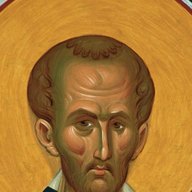
St. John ChrysostomHomily 1 on Ephesians · on Ephesians 1:1–2
Observe, he applies the word "through" to the Father. But what then? Shall we say that He is inferior? Surely not. Observe that he calls saints, men with wives, and children, and domestics. For that these are they whom he calls by this name is plain from the end of the Epistle, as, when he says, "Wives, be in…
St. John ChrysostomHomily 1 on Ephesians · on Ephesians 1:3
Observe; The God of Him that was Incarnate. And though thou wilt not, The Father of God the Word. He is here alluding to the blessings of the Jews; for that was blessing also, but it was not spiritual blessing. For how did it run? "The Lord bless thee, He will bless the fruit of thy body;" and "He will bless thy going…
St. John ChrysostomHomily 1 on Ephesians · on Ephesians 1:4
His meaning is somewhat of this sort. Through whom He hath blessed us, through Him He hath also chosen us. And He, then, it is that shall bestow upon us all those rewards hereafter. He is the very Judge that shall say, "Come, ye blessed of my Father, inherit the kingdom prepared for you from the foundation of the…
St. John ChrysostomHomily 1 on Ephesians · on Ephesians 1:4–5
Having thus spoken of the good works of these, he again recurs to His grace. "In love," saith he, "having predestinated us." Because this comes not of any pains, nor of any good works of ours, but of love; and yet not of love alone, but of our virtue also. For if indeed of love alone, it would follow that all must be…
St. John ChrysostomHomily 1 on Ephesians · on Ephesians 1:5
That is to say, because He earnestly willed it. This is, as one might say, His earnest desire. For the word "good pleasure" every where means the precedent will, for there is also another will. As for example, the first will is that sinners should not perish; the second will is, that, if men become wicked, they shall…
St. John ChrysostomHomily 1 on Ephesians · on Ephesians 1:6
That the glory of His grace may be displayed, he saith, which He freely bestowed on us in the Beloved. Now then if for this He hath shown grace to us, to the praise of the glory of His grace, and that He may display His grace, let us abide therein. "To the praise of His glory." What is this? that who should praise…
St. John ChrysostomHomily 1 on Ephesians · on Ephesians 1:7
Again he descends from high to low: first speaking of adoption, and sanctification, and blamelessness, and then of the Passion, and in this not lowering his discourse and bringing it down from greater things to lesser, no rather, he was heightening it, and raising it from the lesser to the greater. For nothing is so…
St. John ChrysostomHomily 1 on Ephesians · on Ephesians 1:7–8
The abovementioned gifts are riches, yet is this far more so. "Which," saith he, "He made to abound toward us." They are both "riches" and "they have abounded," that is to say, were poured forth in ineffable measure. It is not possible to represent in words what blessings we have in fact experienced. For riches indeed…
St. John ChrysostomHomily 1 on Ephesians · on Ephesians 1:8–9
That is to say, Making us wise and prudent, in that which is true wisdom, and that which is true prudence. Strange! what friendship! For He telleth us His secrets; the mysteries, saith he, of His will, as if one should say, He hath made known to us the things that are in His heart. For here is indeed the mystery which…
That in the dispensation of the fulness of times he might gather together in one all things in Christ, both which are in heaven, and which are on earth; even in him:
St. John ChrysostomHomily 1 on Ephesians · on Ephesians 1:10
Heavenly things, he means to say, had been severed from earthly. They had no longer one Head. So far indeed as the system of the creation went, there was over all One God, but so far as management of one household went, this, amid the wide spread of Gentile error, was not the case, but they had been severed from His…
In whom also we have obtained an inheritance, being predestinated according to the purpose of him who worketh all things after the counsel of his own will:
St. John ChrysostomHomily 2 on Ephesians · on Ephesians 1:11
Paul earnestly endeavors on all occasions to display the unspeakable loving-kindness of God towards us, to the utmost of his power. For that it is impossible to do so adequately, hear his own words. "O! the depth of the riches both of the wisdom and knowledge of God; how unsearchable are His judgments, and His ways…
St. John ChrysostomHomily 2 on Ephesians · on Ephesians 1:12–13
"To the end that we should be unto the praise of His glory, we who had before hoped in Christ. In whom ye also having heard the word of the truth, the Gospel of your salvation." That is to say, through whom. Observe how he on all occasions speaks of Christ, as the Author of all things, and in no case gives Him the…
In whom ye also trusted, after that ye heard the word of truth, the gospel of your salvation: in whom also after that ye believed, ye were sealed with that holy Spirit of promise,
St. John ChrysostomHomily 2 on Ephesians · on Ephesians 1:13–14
"In whom having also believed, ye were sealed with the Holy Spirit of promise, which is an earnest of our inheritance." Here again, the word "sealed," is an indication of especial forecast. He does not speak of our being predestinated only, nor of our being allotted, but further, of our being sealed. For just as…
St. John ChrysostomHomily 2 on Ephesians · on Ephesians 1:14
It is an earnest, however, of what? of "The redemption of God's own possession." For our absolute redemption takes place then. For now we have our life in the world, we are liable to many human accidents, and are living amongst ungodly men. But our absolute redemption will be then, when there shall be no sins, no…
St. John ChrysostomHomily 3 on Ephesians · on Ephesians 1:15–16
Never was anything equal to the yearnings of the Apostle, never anything like the sympathy and the affectionateness of the blessed Paul, who made his every prayer in behalf of whole cities and peoples, and writes the same to all, "I thank my God for you, making mention of you in my prayers." Think how many he had in…
St. John ChrysostomHomily 3 on Ephesians · on Ephesians 1:17
What is thy prayer, and what thy entreaty? It is "That the God of our Lord Jesus Christ, the Father of glory, may give unto you a spirit of wisdom and revelation." Two things he requires them to understand, as it is their duty to understand them; to what blessings they are called, and how they have been released from…
The eyes of your understanding being enlightened; that ye may know what is the hope of his calling, and what the riches of the glory of his inheritance in the saints,
St. John ChrysostomHomily 3 on Ephesians · on Ephesians 1:18
"Having the eyes of your heart enlightened in the knowledge of Him." He that hath learned what God is, will have no misgiving about His promises, and disbelief about what hath been already brought to pass. He prays, then, that there may be given them "a spirit of wisdom and revelation." Yet still he also establishes…
St. John ChrysostomHomily 3 on Ephesians · on Ephesians 1:19
But what is clear? that through His power we have believed that He hath raised Christ. For to persuade souls, is a thing far more miraculous than to raise a dead body. I will endeavor to make this clear. Hearken then. Christ said to the dead, "Lazarus, come forth," and straightway he obeyed. Peter said, "Tabitha,…
St. John ChrysostomHomily 3 on Ephesians · on Ephesians 1:20
Seest thou how great things He hath wrought? He hath raised up Christ. Is this a small thing? But look again. He hath set Him at His right hand. And shall any language then be able to represent this? Him that is of the earth, more mute than the fishes, and made the sport of devils, He hath in a moment raised up on…
Far above all principality, and power, and might, and dominion, and every name that is named, not only in this world, but also in that which is to come:
St. John ChrysostomHomily 3 on Ephesians · on Ephesians 1:21
"Far above all rule," he saith. Need then indeed is there of the Spirit, of an understanding wise in the knowledge of Him. Need then is there indeed of revelation. Reflect, how vast is the distance between the nature of man and of God. Yet from this vile estate hath He exalted Him to that high dignity. Nor does He…
And hath put all things under his feet, and gave him to be the head over all things to the church,
καὶ πάντα ὑπέταξεν ὑπὸ τοὺς πόδας αὐτοῦ, καὶ αὐτὸν ἔδωκε κεφαλὴν ὑπὲρ πάντα τῇ ἐκκλησίᾳ,
St. John ChrysostomHomily 3 on Ephesians · on Ephesians 1:22
"And He put all things in subjection under His feet." Not simply so set Him above them as to be honored above them, nor by way of comparison with them, but so that He should sit over them as His slaves. Amazing! Awful indeed are these things; every created power hath been made the slave of man by reason of God the…
St. John ChrysostomHomily 3 on Ephesians · on Ephesians 1:23
"Which is His body." In order then that when you hear of the Head you may not conceive the notion of supremacy only, but also of consolidation, and that you may behold Him not as supreme Ruler only, but as Head of a body. "The fulness of Him that filleth all in all" he says. As though this were not sufficient to show…
Every note is a real passage, quoted word for word from a published English translation, with its source. Nothing here is summarised or written by us. Some verses have many notes and some have none, because the Fathers wrote more on some passages than others.
St. John Chrysostom, Homilies on Ephesians, Nicene and Post-Nicene Fathers, series 1, vol. 13 (1888–1889).
Scripture: the King James Version (1611); the Greek (tap Ελ) is the 1904 Patriarchal text of the Ecumenical Patriarchate.
All of these translations are in the public domain. The passages were matched to their verses by the Historical Christian Commentaries project, which also hosts the full texts we link to. The Fathers are a treasury of the Church's mind, and they are best read alongside the life of the Church: if a passage raises a question, bring it to your priest.