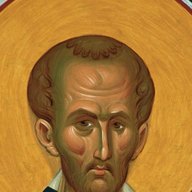
St. John ChrysostomHomily 4 on Ephesians · on Ephesians 2:1
There is, we know, a corporal, and there is also a spiritual, dying. Of the first it is no crime to partake, nor is there any peril in it, inasmuch as there is no blame attached to it, for it is a matter of nature, not of deliberate choice. It had its origin in the transgression of the first-created man, and…
St. John ChrysostomHomily 4 on Ephesians · on Ephesians 2:1–2
You observe the gentleness of Paul, and how on all occasions he encourages the hearer, not bearing too hard upon him. For whereas he had said, Ye have arrived at the very last degree of wickedness, (for such is the meaning of becoming dead,) that he may not excessively distress them, (because men are put to shame when…
Wherein in time past ye walked according to the course of this world, according to the prince of the power of the air, the spirit that now worketh in the children of disobedience:
St. John ChrysostomHomily 4 on Ephesians · on Ephesians 2:2
Why does he call the Devil "the prince" of the world? Because nearly the whole human race has surrendered itself to him and all are willingly and of deliberate choice his slaves. And to Christ, though He promises unnumbered blessings, not any one so much as gives any heed; whilst to the Devil, though promising nothing…
St. John ChrysostomHomily 4 on Ephesians · on Ephesians 2:2
"According to the power," saith he, "of the air, of the spirit." Here again he means, that Satan occupies the space under Heaven, and that the incorporeal powers are spirits of the air, under his operation. For that his kingdom is of this age, i. e., will cease with the present age, hear what he says at the end of the…
St. John ChrysostomHomily 4 on Ephesians · on Ephesians 2:2
"That now worketh," he says, "in the sons of disobedience." You observe that it is not by force, nor by compulsion, but by persuasion, he wins us over; "disobedience" or "untractableness" is his word, as though one were to say, by guile and persuasion he draws all his votaries to himself.
Among whom also we all had our conversation in times past in the lusts of our flesh, fulfilling the desires of the flesh and of the mind; and were by nature the children of wrath, even as others.
St. John ChrysostomHomily 4 on Ephesians · on Ephesians 2:3
"In the lusts of our flesh, doing the desires of the flesh, and of the mind, and were by nature children of wrath, even as the rest." That is, having no spiritual affections. Yet, lest he should slander the flesh, or lest it should be supposed that the transgression was not great, observe how he guards the matter,…
St. John ChrysostomHomily 4 on Ephesians · on Ephesians 2:4
"But God, being rich in mercy." Not merely merciful, but rich in mercy; as it is said also in another place; "In the multitude of thy mercies." And again, "Have mercy upon me, according to the multitude of thy tender mercies."
St. John ChrysostomHomily 4 on Ephesians · on Ephesians 2:4
"For His great love, wherewith He loved us." Why did He love us? For these things are not deserving of love, but of the sorest wrath, and punishment. And thus it was of great mercy.
St. John ChrysostomHomily 4 on Ephesians · on Ephesians 2:5
"Even when we were dead through our trespasses He quickened us together with Christ." Again is Christ introduced, and it is a matter well worthy of our belief, because if the Firstfruits live, so do we also. He hath quickened both Him, and us. Seest thou that all this is said of Christ incarnate? Beholdest thou "the…
St. John ChrysostomHomily 4 on Ephesians · on Ephesians 2:6
"He raised us up with Him and made us sit with Him." Beholdest thou the glory of His inheritance? That "He hath raised us up together," is plain. But that He "hath made us sit with Him in the heavenly places in Christ Jesus," how does this hold? It holds as truly, as that He hath raised us together. For as yet no one…
St. John ChrysostomHomily 4 on Ephesians · on Ephesians 2:7
"That in the ages to come, He might show the exceeding riches of His grace, in kindness towards us, in Christ Jesus." Whereas he had been speaking of the things which concerned Christ, and these might be nothing to us, (for what, it might be said, is it to us, that He rose) therefore he shows that they do moreover…
St. John ChrysostomHomily 4 on Ephesians · on Ephesians 2:8
"For by grace," saith he "have ye been saved." In order then that the greatness of the benefits bestowed may not raise thee too high, observe how he brings thee down: "by grace ye have been saved," saith he, "Through faith;" Then, that, on the other hand, our free-will be not impaired, he adds also our part in the…
St. John ChrysostomHomily 4 on Ephesians · on Ephesians 2:9
"That no man should glory." That he may excite in us proper feeling touching this gift of grace. "What then?" saith a man, "Hath He Himself hindered our being justified by works?" By no means. But no one, he saith, is justified by works, in order that the grace and loving-kindness of God may be shown. He did not…
St. John ChrysostomHomily 4 on Ephesians · on Ephesians 2:10
"For we are His workmanship, created in Christ Jesus for good works, which God afore prepared that we should walk in them." Observe the words he uses. He here alludes to the regeneration, which is in reality a second creation. We have been brought from non-existence into being. As to what we were before, that is, the…
St. John ChrysostomHomily 4 on Ephesians · on Ephesians 2:10
"For good works, which God afore prepared that we should walk in them." Not merely that we should begin, but that we should walk in them, for we need a virtue which shall last throughout, and be extended on to our dying day. If we had to travel a road leading to a royal city, and then when we had passed over the…
Wherefore remember, that ye being in time past Gentiles in the flesh, who are called Uncircumcision by that which is called the Circumcision in the flesh made by hands;
St. John ChrysostomHomily 5 on Ephesians · on Ephesians 2:11
"Who are called Uncircumcision." The honor then of the Jews is in names, their prerogative is in the flesh. For uncircumcision is nothing, and circumcision is nothing.
St. John ChrysostomHomily 5 on Ephesians · on Ephesians 2:11–12
There are many things to show the loving-kindness of God. First, the fact, that by Himself He hath saved us, and by Himself through such a method as this. Secondly, that He hath saved us, as being what we were. Thirdly, that He hath exalted us to the place where we are. For all these things both contain in themselves…
St. John ChrysostomHomily 5 on Ephesians · on Ephesians 2:11–12
Ye, saith he, who were thus called by the Jews. But why when he is about to show that the benefit bestowed upon them consisted in this, in having fellowship with Israel, does he disparage the Israelitish prerogative? He does not disparage it. In essential points he enhances it, but only in these points, in which they…
That at that time ye were without Christ, being aliens from the commonwealth of Israel, and strangers from the covenants of promise, having no hope, and without God in the world:
St. John ChrysostomHomily 5 on Ephesians · on Ephesians 2:12
Never think, saith he, that because ye happen not to be circumcised, and are now in uncircumcision, that there is any difference in this. No, the real trouble was this, the being "without Christ," the being "aliens from the commonwealth of Israel." Whereas this circumcision is not "the commonwealth." Again, the being…
St. John ChrysostomHomily 5 on Ephesians · on Ephesians 2:13
Is this then the great privilege, it may be said, that we are admitted into the commonwealth of the Jews? What art thou saying? "He hath summed up all things that are in heaven, and that are in earth," and now dost thou tell us about Israelites? Yes, he would say. Those higher privileges we must apprehend by faith;…
St. John ChrysostomHomily 5 on Ephesians · on Ephesians 2:14
"For He is our peace, Who made both one." What is this, "both one?" He does not mean this, that He hath raised us to that high descent of theirs, but that he hath raised both us and them to a yet higher. Only that the blessing to us is greater, because to these it had been promised, and they were nearer than we; to us…
St. John ChrysostomHomily 5 on Ephesians · on Ephesians 2:14–15
"And brake down," he proceeds, "the middle wall of partition." What the middle wall of partition is, he interprets by saying, "the enmity having abolished in His flesh, even the law of commandments contained in ordinances." Some indeed affirm that he means the wall of the Jews against the Greeks, because it did not…
Having abolished in his flesh the enmity, even the law of commandments contained in ordinances; for to make in himself of twain one new man, so making peace;
St. John ChrysostomHomily 5 on Ephesians · on Ephesians 2:15
What is meant by "Having abolished by ordinances?" For he makes a wide distinction between "commandments" and "ordinances." He either then means "faith," calling that an "ordinance," (for by faith alone He saved us,) or he means "precept," such as Christ gave, when He said, "But I say unto you, that ye are not to be…
St. John ChrysostomHomily 5 on Ephesians · on Ephesians 2:16
"And might reconcile them both in one body unto God through the Cross." He saith, not merely "might reconcile," but "might reconcile thoroughly" indicating that heretofore human nature had been easily reconciled, as, e.g., in the case of the saints and before the time of the Law. "In one body," saith he, and that His…
St. John ChrysostomHomily 6 on Ephesians · on Ephesians 2:17
He sent not, saith the Apostle, by the hand of another, nor did He announce these tidings to us by means of any other, but Himself did it in His own person. He sent not Angel nor Archangel on the mission, because to repair so many and vast mischiefs and to declare what had been wrought was in the power of none other,…
St. John ChrysostomHomily 6 on Ephesians · on Ephesians 2:18
"Peace," saith he, that "peace" which is towards God. He hath reconciled us. For the Lord Himself also saith, "Peace I leave with you; my peace I give unto you." And again, "Be of good cheer, I have overcome the world." And again, "Whatsoever ye shall ask in my name that will I do." And again, "For the Father loveth…
St. John ChrysostomHomily 6 on Ephesians · on Ephesians 2:19
Perceive ye that it is not with the Jews simply, no, but with those saintly and great men, such as Abraham, and Moses, and Elias? It is for the self-same city with these we are enrolled, for that we declare ourselves. "For they that say such things," saith he, "make it manifest that they are seeking after a country of…
St. John ChrysostomHomily 6 on Ephesians · on Ephesians 2:20
Observe how he blends all together, the Gentiles, the Jews, the Apostles, the Prophets, and Christ, and illustrates the union sometimes from the body, and sometimes from the building: "built," saith he, "upon the foundation of the Apostles and Prophets;" that is, the Apostles and Prophets are a foundation, and he…
St. John ChrysostomHomily 6 on Ephesians · on Ephesians 2:21
Mark, how he knits it all together, and represents Him at one time, as holding down the whole body from above, and welding it together; at another time, as supporting the building from below, and being, as it were, a root, or base. And whereas he had used the expression, "He created in Himself of the twain one new…
St. John ChrysostomHomily 6 on Ephesians · on Ephesians 2:22
"It groweth," saith he, "into a holy temple in the Lord, in whom ye also," he adds, "are builded together." He is speaking continuously: "Into a holy temple, for a habitation of God in the Spirit." What then is the object of this building? It is that God may dwell in this temple. For each of you severally is a temple,…
Every note is a real passage, quoted word for word from a published English translation, with its source. Nothing here is summarised or written by us. Some verses have many notes and some have none, because the Fathers wrote more on some passages than others.
St. John Chrysostom, Homilies on Ephesians, Nicene and Post-Nicene Fathers, series 1, vol. 13 (1888–1889).
Scripture: the King James Version (1611); the Greek (tap Ελ) is the 1904 Patriarchal text of the Ecumenical Patriarchate.
All of these translations are in the public domain. The passages were matched to their verses by the Historical Christian Commentaries project, which also hosts the full texts we link to. The Fathers are a treasury of the Church's mind, and they are best read alongside the life of the Church: if a passage raises a question, bring it to your priest.