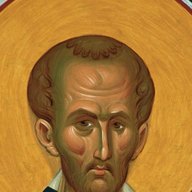
St. John ChrysostomHomily 6 on Ephesians · on Ephesians 3:1
He has mentioned Christ's great and affectionate care; he now passes on to his own, insignificant indeed as it is, and a very nothing in comparison with that, and yet this is enough to engage them to himself. For this cause, saith he, am I also bound. For if my Lord was crucified for your sakes, much more am I bound.…
St. John ChrysostomHomily 6 on Ephesians · on Ephesians 3:2
He alludes to the prediction addressed to Ananias concerning him at Damascus, when the Lord said, "Go thy way, for he is a chosen vessel unto Me, to bear My name before the Gentiles and Kings." By "dispensation of grace," he means the revelation made to him. As much as to say, "I learned it not from man." He…
St. John ChrysostomHomily 6 on Ephesians · on Ephesians 3:3
Perhaps he had informed them of it by some persons, or had not long before been writing to them. Here he is pointing out that the whole is of God, that we have contributed nothing. For what? I ask, was not Paul himself, the wonderful, he that was so versed in the law, he that was brought up at the feet of Gamaliel…
St. John ChrysostomHomily 6 on Ephesians · on Ephesians 3:4
Amazing! So then he wrote not the whole, nor so much as he should have written. But here the nature of the subject prevented it. Elsewhere, as in the case of the Hebrews and the Corinthians, the incapacity of the hearers. "Whereby, when ye read, ye can perceive," saith he, "my understanding in the mystery of Christ,"…
St. John ChrysostomHomily 6 on Ephesians · on Ephesians 3:5
What then, tell me, did not the Prophets know it? How then doth Christ say, that Moses and the Prophets wrote "these things concerning Me?" And again, "If ye believed Moses, ye would believe Me." And again, "Ye search the Scriptures, because ye think that in them ye have eternal life, and these are they which bear…
St. John ChrysostomHomily 6 on Ephesians · on Ephesians 3:6
What is this; "fellow-heirs, and fellow-partakers of the promise, and fellow-members of the body?" This last is the great thing, that they should be one body; this exceeding closeness of relation to Him. For that they were to be called indeed, that they knew, but that it was so great, as yet they knew not. This…
St. John ChrysostomHomily 6 on Ephesians · on Ephesians 3:7
He had said, "I am a prisoner;" but now again he says, that all is of God, as he says, "according to the gift of His grace;" for according to the power of the gift is the dignity of this privilege. But the gift would not have been enough, had it not also implanted in him power. For a work indeed it was of power, of…
St. John ChrysostomHomily 7 on Ephesians · on Ephesians 3:8
They who go to the physician's have not merely to go there and nothing further; they have to learn how to treat themselves, and to apply remedies. And so with us then who come here, we must not do this and nothing else, we must learn our lesson, the surpassing lowliness of Paul. What? when he was about to speak of the…
St. John ChrysostomHomily 7 on Ephesians · on Ephesians 3:8–9
"To preach unto the Gentiles the unsearchable riches of Christ." If His "riches are unsearchable," and that too after his appearing, much more is His essence. If it is still a mystery, much more was it before it was made known; for a mystery he calls it on this account, because neither did the Angels know it, nor was…
And to make all men see what is the fellowship of the mystery, which from the beginning of the world hath been hid in God, who created all things by Jesus Christ:
St. John ChrysostomHomily 7 on Ephesians · on Ephesians 3:9
"And to make all men see," saith he, "what is the dispensation of the mystery which from all ages hath been hid in God, who created all things." Angels knew only this, that "The Lord's portion was His people." And again it is said, "The Prince of Persia withstood me." So that it is nothing to be wondered at that they…
St. John ChrysostomHomily 7 on Ephesians · on Ephesians 3:10
True, to man it was not revealed; and art thou enlightening Angels and Archangels and Principalities and Powers? I am, saith he. For it was "hid in God," even "in God who created all things." And dost thou venture to utter this? I do, saith he. But whence hath this been made manifest to the Angels? By the Church.…
St. John ChrysostomHomily 7 on Ephesians · on Ephesians 3:11
"According to the eternal purpose." It hath been now, he means, brought to pass, but not now decreed, it had been planned beforehand from the very first. "According to the eternal purpose which He purposed in Christ Jesus our Lord." That is, according to the eternal foreknowledge; foreknowing the things to come, i.e.,…
St. John ChrysostomHomily 7 on Ephesians · on Ephesians 3:12
"In whom we have," saith he, "boldness, and access in confidence through our faith in him." "Have access," not as prisoners, he says, nor yet, as persons candidates for pardon, nor as sinners; for, saith he, we have even "boldness with confidence," that is, accompanied with cheerful trust; arising from what source?…
St. John ChrysostomHomily 7 on Ephesians · on Ephesians 3:13
How is it "for them?" How is it "their glory?" It is because God so loved them, as to give even the Son for them, and to afflict His servants for them: for it was in order that they might attain so many blessings, that Paul was in prison. Surely this was from God's exceeding love towards them: it is what God also…
St. John ChrysostomHomily 7 on Ephesians · on Ephesians 3:14–15
He here shows the spirit of his prayer for them. He does not say simply, "I pray," but manifests the supplication to be heartfelt, by the "bowing of the knees." "From whom every family." That is, no longer, he means, reckoned, according to the number of Angels, but according to Him who hath created the tribes both in…
St. John ChrysostomHomily 7 on Ephesians · on Ephesians 3:16–17
"That He would grant you according to the riches of His glory that ye may be strengthened with power through His Spirit in the inward man; that Christ may dwell in your hearts through faith." Mark with what insatiable earnestness he invokes these blessings upon them, that they may not be tossed about. But how shall…
St. John ChrysostomHomily 7 on Ephesians · on Ephesians 3:18–19
"To the end that ye being rooted and grounded in love, may be strong to apprehend with all the saints, what is the breadth, and length, and height, and depth," Thus is his prayer now again, the very same as when he began. For what were his words in the beginning? "That the God of our Lord Jesus Christ, the Father of…
St. John ChrysostomHomily 7 on Ephesians · on Ephesians 3:19
"That ye may be filled unto all the fulness of God." What he means is this. Although the love of Christ lies above the reach of all human knowledge, yet shall ye know it, if ye shall have Christ dwelling in you, yea, not only shall know from Him this, but shall even "be filled unto all the fulness of God;" meaning by…
St. John ChrysostomHomily 7 on Ephesians · on Ephesians 3:20
"Now unto Him that is able to do exceeding abundantly above all that we ask or think, according to the power that worketh in us." That God hath done "abundantly above all that we ask or think," is evident from what the Apostle himself hath written. For I indeed, saith he, pray, but He of Himself, even without any…
St. John ChrysostomHomily 7 on Ephesians · on Ephesians 3:21
"Unto Him be the glory," he concludes, "in the Church and in Christ Jesus, unto all generations forever and ever. Amen." Well does he close the discourse with prayer and doxology; for right were it that He, who hath bestowed upon us such vast gifts, should be glorified and blessed, so that this is even a proper part…
Every note is a real passage, quoted word for word from a published English translation, with its source. Nothing here is summarised or written by us. Some verses have many notes and some have none, because the Fathers wrote more on some passages than others.
St. John Chrysostom, Homilies on Ephesians, Nicene and Post-Nicene Fathers, series 1, vol. 13 (1888–1889).
Scripture: the King James Version (1611); the Greek (tap Ελ) is the 1904 Patriarchal text of the Ecumenical Patriarchate.
All of these translations are in the public domain. The passages were matched to their verses by the Historical Christian Commentaries project, which also hosts the full texts we link to. The Fathers are a treasury of the Church's mind, and they are best read alongside the life of the Church: if a passage raises a question, bring it to your priest.