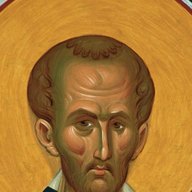
St. John ChrysostomHomily 3 on Matthew · on Matthew 1:1
Why Joseph's genealogy is traced, who had no part in the birth. And one cause we have mentioned already; but it is necessary to mention likewise the other, that which is more mystical and secret than the first. What then is this? He would not that it should be manifest to the Jews, at the time of the birth, that…
St. John ChrysostomHomily 2 on Matthew · on Matthew 1:1
"The book of the generation of Jesus Christ, Son of David, Son of Abraham." "What sayest thou? Didst thou not promise to discourse of the Only-begotten Son of God, and dost thou make mention of David, a man born after a thousand generations, and say that he is both father and ancestor?" Stay, seek not to learn all at…
St. John ChrysostomHomily 2 on Matthew · on Matthew 1:1
Wherefore he call it a "book of the generation of Jesus Christ," while yet this book hath not the birth only, but the whole dispensation? Because this is the sum of the whole dispensation, and is made an origin and root of all our blessings. As then Moses calleth it the book of heaven and earth, although he hath not…
St. John ChrysostomHomily 2 on Matthew · on Matthew 1:1
Wherefore did he not say, "the Son of Abraham," and then "the Son of David?" It is not, as some suppose, that he means to proceed upward from the lower point, since then he would have done the same as Luke, but now he doth the contrary. Why then hath he made mention of David? The man was in the mouths of all, both…
St. John ChrysostomHomily 2 on Matthew · on Matthew 1:1
"But whence is it manifest that He is of David?" one may say. For if He was not sprung of a man, but from a woman only, and the Virgin hath not her genealogy traced, how shall we know that He was of David's race? Thus, there are two things inquired; both why His mother's genealogy is not recited, and wherefore it can…
St. John ChrysostomHomily 2 on Matthew · on Matthew 1:1
For this reason he hath also straightway called Him by this title, naming Him Jesus. For this name, Jesus, is not Greek, but in the Hebrew language it is thus called Jesus; which is, when interpreted into the Greek tongue, "A Saviour." And He is called a Saviour, from His saving His people. Seest thou how he hath…
St. John ChrysostomHomily 3 on Matthew · on Matthew 1:2
But why is it, that having mentioned Abraham, and having said that "he begat Isaac, and Isaac, Jacob;" and not having made any mention of his brother; when he is come to Jacob, he remembers both "Judah, and his brethren"? Now there are some that say, it was because of the perverseness of Esau, and of the rest that…
St. John ChrysostomHomily 3 on Matthew · on Matthew 1:2
For this cause he made mention also of the twelve patriarchs, by this again bringing down their pride at the noble birth of their fathers. Because many of these also were born of women that were slaves; but nevertheless the difference of the parents did not make a difference in the children. For all were equally both…
St. John ChrysostomHomily 3 on Matthew · on Matthew 1:3
But besides what we have said, there is another cause also, wherefore he hath mentioned even this history; for to be sure, Zara's name was not cast at random on that of Phares. (For indeed it was irrelevant, and superfluous, when he had mentioned Phares, from whom he was to trace Christ's genealogy, to mention Zara…
St. John ChrysostomHomily 3 on Matthew · on Matthew 1:3
"And Judas begat Phares and Zara of Thamar." What doest thou, O man, putting us in remembrance of a history that contains an unlawful intercourse? But why is this said? Since, if we were recounting the race of a mere man, one might naturally have been silent touching these things; but if of God Incarnate, so far from…
St. John ChrysostomHomily 3 on Matthew · on Matthew 1:5–6
Seest thou that it was not for few nor small causes that he brought to our remembrance the whole history concerning Judah? For this end he hath mentioned Ruth also and Rahab, the one an alien, the other an harlot, that thou mayest learn that He came to do away with all our ills. For He hath come as a Physician, not as…
St. John ChrysostomHomily 4 on Matthew · on Matthew 1:16
Having then mentioned all His forefathers, and ending with Joseph, he did not stop at this, but added, "Joseph the husband of Mary;" intimating that it was for her sake he traced his genealogy also. Then, lest when thou hast heard of the "husband of Mary," thou shouldest suppose that Christ was born after the common…
So all the generations from Abraham to David are fourteen generations; and from David until the carrying away into Babylon are fourteen generations; and from the carrying away into Babylon unto Christ are fourteen generations.
St. John ChrysostomHomily 4 on Matthew · on Matthew 1:17
He hath divided all the generations into three portions, to indicate that not even when their form of government was changed did they become better, but alike under an aristocracy, and under a king, and under an oligarchy, they were in the same evil ways, and whether popular leaders, or priests, or kings controlled…
Now the birth of Jesus Christ was on this wise: When as his mother Mary was espoused to Joseph, before they came together, she was found with child of the Holy Ghost.
St. John ChrysostomHomily 4 on Matthew · on Matthew 1:18
"The birth of Jesus Christ was on this wise." "Of what kind of birth art thou telling me, I pray thee, since thou hast already mentioned His ancestors?" "I still wish to tell thee the manner also of His birth." Seest thou, how he wakens up the hearer? For as though he were about to speak of something unusual, he…
St. John ChrysostomHomily 4 on Matthew · on Matthew 1:19
"And Joseph her husband, being," saith he "a just man, and not willing to make her a public example, was minded to put her away privily." Having said that it was of the Holy Ghost, and without cohabitation, he establishes his statement in another way again. Lest any one should say, "Whence doth this appear? Who hath…
But while he thought on these things, behold, the angel of the LORD appeared unto him in a dream, saying, Joseph, thou son of David, fear not to take unto thee Mary thy wife: for that which is conceived in her is of the Holy Ghost.
St. John ChrysostomHomily 4 on Matthew · on Matthew 1:20
The matter then being in this state, and all at their wits' end, the angel comes to solve all their difficulties. But it is worth inquiring, why the angel did not speak sooner, before the husband had such thoughts: but, "when he thought on it," not until then, he came; for it is said, "While he thought on these…
St. John ChrysostomHomily 4 on Matthew · on Matthew 1:21
Or rather, not by things past only, but likewise by things to come, he wins him over. "And she shall bring forth," saith he, "a Son, and thou shall call His name Jesus." "For do not thou, because He is of the Holy Ghost, imagine that thou art an alien to the ministry of this dispensation. Since although in the birth…
St. John ChrysostomHomily 5 on Matthew · on Matthew 1:22–23
"Now all this was done, that it might be fulfilled which was spoken of the Lord by the prophet, saying." In a tone worthy of the wonder, with all his might he hath uttered his voice, saying, "Now all this was done." For when he saw the sea and the abyss of the love of God towards man, and that actually come to pass…
St. John ChrysostomHomily 5 on Matthew · on Matthew 1:23
What then saith this oracle? "Behold, a virgin shall be with child, and shall bring forth a son, and they shall call His name Emmanuel." How was it then, one may say, that His name was not called Emmanuel, but Jesus Christ? Because he said not, "thou shalt call," but "they shall call," that is, the multitude, and the…
St. John ChrysostomHomily 5 on Matthew · on Matthew 1:23
But if, when their mouths are stopped on this point, they should seek another, namely, what is said touching Mary's virginity, and should object to us other translators, saying, that they used not the term "virgin," but "young woman;" in the first place we will say this, that the Seventy were justly entitled to…
St. John ChrysostomHomily 5 on Matthew · on Matthew 1:24
"Then Joseph, being raised from sleep, did as the angel of the Lord had bidden him." Seest thou obedience, and a submissive mind? Seest thou a soul truly wakened, and in all things incorruptible? For neither when he suspected something painful or amiss could he endure to keep the Virgin with him; nor yet, after he was…
St. John ChrysostomHomily 5 on Matthew · on Matthew 1:25
"And took unto him Mary his wife." Seest thou how continually the evangelist uses this word, not willing that that mystery should be disclosed as yet, and annihilating that evil suspicion? And when he had taken her, "he knew her not, till she had brought forth her first-born Son." He hath here used the word "till,"…
Every note is a real passage, quoted word for word from a published English translation, with its source. Nothing here is summarised or written by us. Some verses have many notes and some have none, because the Fathers wrote more on some passages than others.
St. John Chrysostom, Homilies on the Gospel of Matthew, Nicene and Post-Nicene Fathers, series 1, vol. 10 (1888–1889).
Scripture: the King James Version (1611); the Greek (tap Ελ) is the 1904 Patriarchal text of the Ecumenical Patriarchate.
All of these translations are in the public domain. The passages were matched to their verses by the Historical Christian Commentaries project, which also hosts the full texts we link to. The Fathers are a treasury of the Church's mind, and they are best read alongside the life of the Church: if a passage raises a question, bring it to your priest.