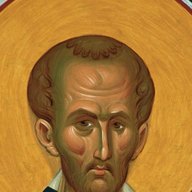
St. John ChrysostomHomily 29 on Matthew · on Matthew 9:1
By His own city here he means Capernaum. For that which gave Him birth was Bethlehem; that which brought Him up, Nazareth; that which had Him continually inhabiting it, Capernaum.
The Eastern Cross/Bible/Matthew/Chapter 9
The Gospel according to St. Matthew
Tap Fathers under a verse to read what the saints said about it.
And he entered into a ship, and passed over, and came into his own city.
Καὶ ἐμβὰς εἰς πλοῖον διεπέρασε καὶ ἦλθεν εἰς τὴν ἰδίαν πόλιν.
By His own city here he means Capernaum. For that which gave Him birth was Bethlehem; that which brought Him up, Nazareth; that which had Him continually inhabiting it, Capernaum.
And, behold, they brought to him a man sick of the palsy, lying on a bed: and Jesus seeing their faith said unto the sick of the palsy; Son, be of good cheer; thy sins be forgiven thee.
Καὶ ἰδοὺ προσέφερον αὐτῷ παραλυτικὸν ἐπὶ κλίνης βεβλημένον· καὶ ἰδὼν ὁ Ἰησοῦς τὴν πίστιν αὐτῶν εἶπε τῷ παραλυτικῷ· θάρσει, τέκνον· ἀφέωνταί σοι αἱ ἁμαρτίαι σου.
This paralytic, however, was different from that one who is set forth in John. For he lay at the pool, but this at Capernaum; and that man had his infirmity thirty and eight years, but concerning this, no such thing is mentioned; and the other was in a state destitute of protectors, but this had some to take care of…
And, behold, certain of the scribes said within themselves, This man blasphemeth.
καὶ ἰδού τινες τῶν γραμματέων εἶπον ἐν ἑαυτοῖς· οὗτος βλασφημεῖ.
Upon their murmuring, then, and saying, "This man blasphemeth; who can forgive sins but God only?" let us see what He saith. Did He indeed take away the suspicion? And yet if He were not equal, He should have said, "Why fix upon me a notion which is not convenient? I am far from this power." But now hath He said none…
And Jesus knowing their thoughts said, Wherefore think ye evil in your hearts?
καὶ ἰδὼν ὁ Ἰησοῦς τὰς ἐνθυμήσεις αὐτῶν εἶπεν· ἵνα τί ὑμεῖς ἐνθυμεῖσθε πονηρὰ ἐν ταῖς καρδίαις ὑμῶν;
For whether is easier, to say, Thy sins be forgiven thee; or to say, Arise, and walk?
τί γάρ ἐστιν εὐκοπώτερον, εἰπεῖν, ἀφέωνταί σου αἱ ἁμαρτίαι, ἢ εἰπεῖν, ἔγειρε καὶ περιπάτει;
And whereas, when He spake unto the sick of the palsy, He spake without clearly manifesting His own authority: for He said not, "I forgive thee thy sins," but, "thy sins be forgiven thee:" upon their constraining, He discloses His authority more clearly, saying, "But that ye may know that the Son of Man hath power on…
But that ye may know that the Son of man hath power on earth to forgive sins, (then saith he to the sick of the palsy,) Arise, take up thy bed, and go unto thine house.
ἵνα δὲ εἰδῆτε ὅτι ἐξουσίαν ἔχει ὁ υἱὸς τοῦ ἀνθρώπου ἐπὶ τῆς γῆς ἀφιέναι ἁμαρτίας — τότε λέγει τῷ παραλυτικῷ· ἐγερθεὶς ἆρόν σου τὴν κλίνην καὶ ὕπαγε εἰς τὸν οἶκόν σου.
But when the multitudes saw it, they marvelled, and glorified God, which had given such power unto men.
ἰδόντες δὲ οἱ ὄχλοι ἐθαύμασαν καὶ ἐδόξασαν τὸν Θεὸν τὸν δόντα ἐξουσίαν τοιαύτην τοῖς ἀνθρώποις.
"For when the multitudes saw it, they marvelled, and glorified God, which had given such power unto men:" for the flesh was an offense unto them. But He did not rebuke them, but proceeds by His works to arouse them, and exalt their thoughts. Since for the time it was no small thing for Him to be thought greater than…
And as Jesus passed forth from thence, he saw a man, named Matthew, sitting at the receipt of custom: and he saith unto him, Follow me. And he arose, and followed him.
Καὶ παράγων ὁ Ἰησοῦς ἐκεῖθεν εἶδεν ἄνθρωπον καθήμενον ἐπὶ τὸ τελώνιον, Ματθαῖον λεγόμενον, καὶ λέγει αὐτῷ· ἀκολούθει μοι. καὶ ἀναστὰς ἠκολούθησεν αὐτῷ.
For when He had performed the miracle, He did not remain, lest, being in sight, He should kindle their jealousy the more; but He indulges them by retiring, and soothing their passion. This then let us also do, not encountering them that are plotting against us; let us rather soothe their wound, giving way and relaxing…
And it came to pass, as Jesus sat at meat in the house, behold, many publicans and sinners came and sat down with him and his disciples.
Καὶ ἐγένετο αὐτοῦ ἀνακειμένου ἐν τῇ οἰκίᾳ, καὶ ἰδοὺ πολλοὶ τελῶναι καὶ ἁμαρτωλοὶ ἐλθόντες συνανέκειντο τῷ Ἰησοῦ καὶ τοῖς μαθηταῖς αὐτοῦ.
Having therefore called him, He also honored him with a very great honor by partaking straightway of his table; for in this way He would both give him good hope for the future, and lead him on to a greater confidence. For not in a long time, but at once, He healed his vice. And not with him only doth He sit down to…
And when the Pharisees saw it, they said unto his disciples, Why eateth your Master with publicans and sinners?
καὶ ἰδόντες οἱ Φαρισαῖοι εἶπον τοῖς μαθηταῖς αὐτοῦ· διατί μετὰ τῶν τελωνῶν καὶ ἁμαρτωλῶν ἐσθίει ὁ διδάσκαλος ὑμῶν;
But how is it, one may say, that Paul commands, "If any man that is called a brother be a fornicator or covetous, with such an one no, not to eat?" In the first place, it is not as yet manifest, whether to teachers also he gives this charge, and not rather to brethren only. Next, these were not yet of the number of…
But when Jesus heard that, he said unto them, They that be whole need not a physician, but they that are sick.
ὁ δὲ Ἰησοῦς ἀκούσας εἶπεν αὐτοῖς· οὐ χρείαν ἔχουσιν οἱ ἰσχύοντες ἰατροῦ, ἀλλ᾽ οἱ κακῶς ἔχοντες.
What then saith Infinite Wisdom? "They that be whole need not a physician," saith He, "but they that are sick." See how He turned their reasoning to the opposite conclusion. That is, while they made it a charge against Him that He was in company with these men: He on the contrary saith, that His not being with them…
But go ye and learn what that meaneth, I will have mercy, and not sacrifice: for I am not come to call the righteous, but sinners to repentance.
πορευθέντες δὲ μάθετε τί ἐστιν ἔλεον θέλω καὶ οὐ θυσίαν. οὐ γὰρ ἦλθον καλέσαι δικαίους, ἀλλὰ ἁμαρτωλοὺς εἰς μετάνοιαν.
"Go ye and learn what that meaneth, I will have mercy, and not sacrifice." Now this He said, to upbraid them with their ignorance of the Scriptures. Wherefore also He orders His discourse more sharply, not Himself in anger, far from it; but so as that the publicans might not be in utter perplexity. And yet of course…
Then came to him the disciples of John, saying, Why do we and the Pharisees fast oft, but thy disciples fast not?
Τότε προσέρχονται αὐτῷ οἱ μαθηταὶ Ἰωάννου λέγοντες· διατί ἡμεῖς καὶ οἱ Φαρισαῖοι νηστεύομεν πολλά, οἱ δὲ μαθηταί σου οὐ νηστεύουσι;
He then having stopped their mouths every way, as well from the Scriptures as from the natural consequence of things; and they having nothing to say, proved as they were obnoxious to the charges which they had brought against Him, and adversaries of the law and the Old Testament; they leave Him, and again transfer…
And Jesus said unto them, Can the children of the bridechamber mourn, as long as the bridegroom is with them? but the days will come, when the bridegroom shall be taken from them, and then shall they fast.
καὶ εἶπεν αὐτοῖς ὁ Ἰησοῦς· μὴ δύνανται οἱ υἱοὶ τοῦ νυμφῶνος πενθεῖν ἐφ᾽ ὅσον [χρόνον] μετ᾽ αὐτῶν ἐστιν ὁ νυμφίος; ἐλεύσονται δὲ ἡμέραι ὅταν ἀπαρθῇ ἀπ᾽ αὐτῶν ὁ νυμφίος, καὶ τότε νηστεύσουσιν.
"The children of the bride-chamber cannot fast, as long as the bridegroom is with them." Thus, when others were to be spoken for, the publicans I mean, to soothe their wounded soul, He was more severe in His reproof of their revilers; but when they were deriding Himself and His disciples, He makes His reply with all…
No man putteth a piece of new cloth unto an old garment, for that which is put in to fill it up taketh from the garment, and the rent is made worse.
οὐδεὶς δὲ ἐπιβάλλει ἐπίβλημα ῥάκους ἀγνάφου ἐπὶ ἱματίῳ παλαιῷ· αἴρει γὰρ τὸ πλήρωμα αὐτοῦ ἀπὸ τοῦ ἱματίου, καὶ χεῖρον σχίσμα γίνεται.
Then what He had done before, this He doth here again. I mean, that as He, when they were attempting to prove Him blameable for eating with sinners, proved to them on the contrary, that His proceeding was not only no blame, but an absolute praise to Him: so here too, when they wanted to show of Him, that He knows not…
Neither do men put new wine into old bottles: else the bottles break, and the wine runneth out, and the bottles perish: but they put new wine into new bottles, and both are preserved.
οὐδὲ βάλλουσιν οἶνον νέον εἰς ἀσκοὺς παλαιούς· εἰ δὲ μήγε, ῥήγνυνται οἱ ἀσκοί, καὶ ὁ οἶνος ἐκχεῖται καὶ οἱ ἀσκοὶ ἀπολοῦνται· ἀλλὰ οἶνον νέον εἰς ἀσκοὺς βάλλουσιν καινούς, καὶ ἀμφότεροι συντηροῦνται.
"Neither do men put new wine into old bottles." Seest thou His illustrations, how like the Old Testament? the garment? the wine skins? For Jeremiah too calls the people "a girdle," and makes mention again of "bottles" and of "wine." Thus, the discourse being about gluttony and a table, He takes His illustrations from…
While he spake these things unto them, behold, there came a certain ruler, and worshipped him, saying, My daughter is even now dead: but come and lay thy hand upon her, and she shall live.
Ταῦτα αὐτοῦ λαλοῦντος αὐτοῖς ἰδοὺ ἄρχων [εἷς] προσελθὼν προσεκύνει αὐτῷ λέγων ὅτι ἡ θυγάτηρ μου ἄρτι ἐτελεύτησεν· ἀλλὰ ἐλθὼν ἐπίθες τὴν χεῖρά σου ἐπ᾽ αὐτὴν καὶ ζήσεται.
The deed overtook the words; so that the mouths of the Pharisees were the more stopped. For both he that came was a ruler of the synagogue, and his affliction terrible. For the young damsel was both his only child, and twelve years old, the very flower of her age; on which account especially He raised her up again,…
And Jesus arose, and followed him, and so did his disciples.
καὶ ἐγερθεὶς ὁ Ἰησοῦς ἠκολούθησεν αὐτῷ καὶ οἱ μαθηταὶ αὐτοῦ.
And whereas Mark saith, He took the three disciples, and so doth Luke; our evangelist merely saith, "the disciples." Wherefore then did He not take with Him Matthew, though he had but just come unto Him? To bring him to a more earnest longing, and because he was yet rather in an imperfect state. For to this intent…
And, behold, a woman, which was diseased with an issue of blood twelve years, came behind him, and touched the hem of his garment:
Καὶ ἰδοὺ γυνή, αἱμορροοῦσα δώδεκα ἔτη, προσελθοῦσα ὄπισθεν ἥψατο τοῦ κρασπέδου τοῦ ἱματίου αὐτοῦ.
Wherefore did she not approach Him boldly? She was ashamed on account of her affliction, accounting herself to be unclean. For if the menstruous woman was judged not to be clean, much more would she have the same thought, who was afflicted with such a disease; since in fact that complaint was under the law accounted a…
For she said within herself, If I may but touch his garment, I shall be whole.
ἔλεγε γὰρ ἐν ἑαυτῇ, ἐὰν μόνον ἅψωμαι τοῦ ἱματίου αὐτοῦ, σωθήσομαι.
But Jesus turned him about, and when he saw her, he said, Daughter, be of good comfort; thy faith hath made thee whole. And the woman was made whole from that hour.
ὁ δὲ Ἰησοῦς ἐπιστραφεὶς καὶ ἰδὼν αὐτὴν εἶπε· θάρσει, θύγατερ· ἡ πίστις σου σέσωκέ σε. καὶ ἐσώθη ἡ γυνὴ ἀπὸ τῆς ὥρας ἐκείνης.
What then doth Christ? He suffers her not to be hid, but brings her into the midst, and makes her manifest for many purposes. It is true indeed that some of the senseless ones say, "He does this for love of glory. For why," say they, "did He not suffer her to be hid?" What sayest thou, unholy, yea, all unholy one? He…
And when Jesus came into the ruler’s house, and saw the minstrels and the people making a noise,
Καὶ ἐλθὼν ὁ Ἰησοῦς εἰς τὴν οἰκίαν τοῦ ἄρχοντος καὶ ἰδὼν τοὺς αὐλητὰς καὶ τὸν ὄχλον θορυβούμενον, λέγει αὐτοῖς·
Noble tokens, surely, these, of the rulers of synagogues; in the moment of her death pipes and cymbals raising a dirge! What then doth Christ? All the rest He cast out, but the parents He brought in; to leave no room for saying that He healed her in any other way.
He said unto them, Give place: for the maid is not dead, but sleepeth. And they laughed him to scorn.
ἀναχωρεῖτε· οὐ γὰρ ἀπέθανε τὸ κοράσιον, ἀλλὰ καθεύδει. καὶ κατεγέλων αὐτοῦ.
And before her resurrection too, He raises her in His word; saying, "The maid is not dead, but sleepeth." And in many instances besides He doeth this. As then on the sea He expels tumult from the mind of the by-standers, at the same time both signifying that it is easy for Him to raise the dead (which same thing He…
But when the people were put forth, he went in, and took her by the hand, and the maid arose.
ὅτε δὲ ἐξεβλήθη ὁ ὄχλος, εἰσελθὼν ἐκράτησε τῆς χειρὸς αὐτῆς, καὶ ἠγέρθη τὸ κοράσιον.
Seeing then the cymbals and the multitude, He put them all out, and in the presence of the parents works the miracle; not introducing another soul, but recalling the same that had gone out, and awakening her as it were out of a sleep. And He holds her by the hand, assuring the beholders; so as by that sight to make a…
And the fame hereof went abroad into all that land.
καὶ ἐξῆλθεν ἡ φήμη αὕτη εἰς ὅλην τὴν γῆν ἐκείνην.
And when Jesus departed thence, two blind men followed him, crying, and saying, Thou son of David, have mercy on us.
Καὶ παράγοντι ἐκεῖθεν τῷ Ἰησοῦ ἠκολούθησαν αὐτῷ δύο τυφλοὶ κράζοντες καὶ λέγοντες· ἐλέησον ἡμᾶς, υἱὲ Δαυΐδ.
Wherefore can it be that He puts them off, and they crying out? Here again teaching us utterly to repel the glory that cometh from the multitude. For because the house was near, He leads them thither to heal them in private. And this is evident from the fact, that He charged them moreover to tell no man. But this is…
And when he was come into the house, the blind men came to him: and Jesus saith unto them, Believe ye that I am able to do this? They said unto him, Yea, Lord.
ἐλθόντι δὲ εἰς τὴν οἰκίαν προσῆλθον αὐτῷ οἱ τυφλοί, καὶ λέγει αὐτοῖς ὁ Ἰησοῦς· πιστεύετε ὅτι δύναμαι τοῦτο ποιῆσαι; λέγουσιν αὐτῷ· ναί, Κύριε.
And having brought them into the house, He puts to them a further question. For in many cases He made a point of healing on entreaty, lest any should suppose Him to be rushing upon these miracles through vainglory: and not on this account alone, but to indicate also that they deserve healing, and that no one should…
Then touched he their eyes, saying, According to your faith be it unto you.
τότε ἥψατο τῶν ὀφθαλμῶν αὐτῶν λέγων· κατὰ τὴν πίστιν ὑμῶν γενηθήτω ὑμῖν.
And then at last He for His part lays His hand upon them, saying, "According to your faith be it unto you." And this He doth to confirm their faith, and to show that they are participators in the good work, and to witness that their words were not words of flattery. For neither did He say, "Let your eyes be opened,"…
And their eyes were opened; and Jesus straitly charged them, saying, See that no man know it.
καὶ ἀνεῴχθησαν αὐτῶν οἱ ὀφθαλμοί· καὶ ἐνεβριμήσατο αὐτοῖς ὁ Ἰησοῦς λέγων· ὁρᾶτε μηδεὶς γινωσκέτω.
Then after their cure He commands them to tell no man; neither doth He merely command them, but with much strictness. "For Jesus," it is said, "straitly charged them, saying, See that no man know it. But they, when they were departed, spread abroad His fame in all that country." They however did not endure this, but…
But they, when they were departed, spread abroad his fame in all that country.
οἱ δὲ ἐξελθόντες διεφήμισαν αὐτὸν ἐν ὅλῃ τῇ γῇ ἐκείνῃ.
As they went out, behold, they brought to him a dumb man possessed with a devil.
Αὐτῶν δὲ ἐξερχομένων ἰδοὺ προσήνεγκαν αὐτῷ ἄνθρωπον κωφὸν δαιμονιζόμενον·
"And as they went out," it is said, "behold, they brought unto Him a dumb man possessed with a devil." For the affliction was not natural, but the device of the evil Spirit; wherefore also he needs others to bring him. For he could neither make entreaty himself, being speechless, nor supplicate others, when the evil…
And when the devil was cast out, the dumb spake: and the multitudes marvelled, saying, It was never so seen in Israel.
καὶ ἐκβληθέντος τοῦ δαιμονίου ἐλάλησεν ὁ κωφός, καὶ ἐθαύμασαν οἱ ὄχλοι λέγοντες ὅτι οὐδέποτε ἐφάνη οὕτως ἐν τῷ Ἰσραήλ.
"For when the devil was cast out," it saith, "the dumb spake: and the multitudes marvelled, saying, It was never so seen in Israel." Now this especially vexed the Pharisees, that they preferred Him to all, not only that then were, but that had ever been. And they preferred Him, not for His healing, but for His doing…
But the Pharisees said, He casteth out devils through the prince of the devils.
οἱ δὲ Φαρισαῖοι ἔλεγον· ἐν τῷ ἄρχοντι τῶν δαιμονίων ἐκβάλλει τὰ δαιμόνια.
"He casteth out devils through the prince of the devils." What can be more foolish than this? For in the first place, as He also saith further on, it is impossible that a devil should cast out a devil for that being is wont to repair what belongs to himself, not to pull it down. But He did not cast out devils only,…
And Jesus went about all the cities and villages, teaching in their synagogues, and preaching the gospel of the kingdom, and healing every sickness and every disease among the people.
Καὶ περιῆγεν ὁ Ἰησοῦς τὰς πόλεις πάσας καὶ τὰς κώμας διδάσκων ἐν ταῖς συναγωγαῖς αὐτῶν καὶ κηρύσσων τὸ εὐαγγέλιον τῆς βασιλείας καὶ θεραπεύων πᾶσαν νόσον καὶ πᾶσαν μαλακίαν ἐν τῷ λαῷ.
"He went about," it is said, "all the cities and villages, teaching in their synagogues, and preaching the gospel of the kingdom, and healing every sickness and every disease." And so far from punishing them for their insensibility, He did not even simply rebuke them; at once both evincing His meekness, and so…
But when he saw the multitudes, he was moved with compassion on them, because they fainted, and were scattered abroad, as sheep having no shepherd.
Ἰδὼν δὲ τοὺς ὄχλους ἐσπλαγχνίσθη περὶ αὐτῶν, ὅτι ἦσαν ἐκλελυμένοι καὶ ἐρριμμένοι ὡς πρόβατα μὴ ἔχοντα ποιμένα.
For this cause Christ, to teach us that of mere goodness He had entered on this, so far from waiting for the sick to come to Him, of Himself hastened unto them, bearing them two of the greatest blessings; one, the gospel of the kingdom; another, the perfect cure of all their diseases. And not a city did He overlook,…
Then saith he unto his disciples, The harvest truly is plenteous, but the labourers are few;
τότε λέγει τοῖς μαθηταῖς αὐτοῦ· ὁ μὲν θερισμὸς πολύς, οἱ δὲ ἐργάται ὀλίγοι.
And not even at this doth He stop, but He exhibits also another instance of His forethought. That is, "When He saw," it is said, "the multitudes, He was moved with compassion on them, because they were troubled, and scattered abroad, as sheep having no shepherd. Then saith He unto His disciples, The harvest truly is…
Pray ye therefore the Lord of the harvest, that he will send forth labourers into his harvest.
δεήθητε οὖν τοῦ κυρίου τοῦ θερισμοῦ ὅπως ἐκβάλῃ ἐργάτας εἰς τὸν θερισμὸν αὐτοῦ.
Then to signify how great the gift is, He saith, "Pray ye the Lord of the harvest;" and indirectly declares it to be His own prerogative. For after having said, "Pray ye the Lord of the harvest;" when they had not made any entreaty nor prayer, He Himself at once ordains them, reminding them also of the sayings of…
Every note is a real passage, quoted word for word from a published English translation, with its source. Nothing here is summarised or written by us. Some verses have many notes and some have none, because the Fathers wrote more on some passages than others.
All of these translations are in the public domain. The passages were matched to their verses by the Historical Christian Commentaries project, which also hosts the full texts we link to. The Fathers are a treasury of the Church's mind, and they are best read alongside the life of the Church: if a passage raises a question, bring it to your priest.