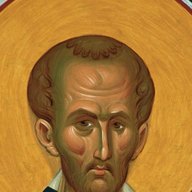
St. John ChrysostomHomily 1 on Romans · on Romans 1:1
Moses having written five books, has nowhere put his own name to them, neither have they who after him put together the history of events after him, no nor yet has Matthew, nor John, nor Mark, nor Luke; but the blessed Paul everywhere in his Epistles sets his own name. Now why was this? Because they were writing to…
St. John ChrysostomHomily 1 on Romans · on Romans 1:1
"Paul, a servant of Jesus Christ." Why did God change his name, and call him Paul who was Saul? It was, that he might not even in this respect come short of the Apostles, but that that preëminence which the chief of the Disciples had, he might also acquire; and have whereon to ground a closer union with them. And he…
St. John ChrysostomHomily 1 on Romans · on Romans 1:1
"Called an Apostle." He styles himself "called" in all his Epistles, so showing his own candor, and that it was not of his own seeking that he found, but that when called he came near and obeyed. And the faithful, he styles, "called to be saints," but while they had been called so far as to be believers, he had…
St. John ChrysostomHomily 1 on Romans · on Romans 1:2
"Which He promised afore by His Prophets in the Holy Scriptures." For the Lord, saith he, "shall give the word to them that proclaim glad tidings with great power"; and again, "How beautiful are the feet of them that preach the Gospel of peace." See here both the name of the Gospel expressly and the temper of it, laid…
St. John ChrysostomHomily 1 on Romans · on Romans 1:3
"Concerning His Son which was made of the seed of David, according to the flesh." What dost thou, O Paul, that after lifting up our souls so, and elevating them, and causing great and unutterable things to pass show before them, and speaking of the Gospel, and that too the Gospel of God, and bringing in the chorus of…
St. John ChrysostomHomily 1 on Romans · on Romans 1:4
"And declared to be the Son of God with power, according to the Spirit of Holiness, by the resurrection from the dead, even Jesus Christ." What is said has been made obscure by the close-folding of the words, and so it is necessary to divide it. What then is it, which he says? We preach, says he, Him Who was made of…
St. John ChrysostomHomily 1 on Romans · on Romans 1:5
"By Whom we have received grace and Apostleship for obedience to the faith." See the candor of the servant. He wishes nothing to be his own, but all his Master's. And indeed it was the Spirit that gave this. Wherefore He saith, "I have many things to say unto you, but ye cannot bear them now. Howbeit when He, the…
Among whom are ye also the called of Jesus Christ:
ἐν οἷς ἐστε καὶ ὑμεῖς κλητοὶ Ἰησοῦ Χριστοῦ,
St. John ChrysostomHomily 1 on Romans · on Romans 1:6
"Among whom are ye also the called of Jesus Christ." That is, along with whom ye also are: and he does not say, that he called the others with you, but you with the others. For if in Christ Jesus there is neither bond nor free, much less is there king and private man. For even ye were called and did not come over of…
St. John ChrysostomHomily 1 on Romans · on Romans 1:7
"To all that be in Rome, beloved of God, called to be saints: grace to you and peace from God our Father, and the Lord Jesus Christ." See how continually he puts the word "called," saying, "called to be an Apostle; among whom ye also are called; to all that be in Rome, called:" and this he does not out of superfluity…
St. John ChrysostomHomily 2 on Romans · on Romans 1:8
An exordium worthy of this blessed spirit, and able to teach all men to offer unto God the firstlings of their good deeds and words, and to render thanks not only for their own, but also for others' well-doings: which also maketh the soul pure from envy and grudging, and draweth God in a greater measure towards the…
St. John ChrysostomHomily 2 on Romans · on Romans 1:9
Words these of an Apostle's bowels of affection, the showing forth this of fatherly concernment! And what is it which he says, and why does he call God to witness? He had to declare his feeling toward them. Since then he had not as yet ever seen them, he therefore called no man to witness, but Him Who entereth in the…
St. John ChrysostomHomily 2 on Romans · on Romans 1:10–11
You see him painfully desiring to see them, and yet not enduring to see them contrary to what seemed good unto God, but having his longing mingled with the fear of God. For he loved them, and was eager to come to them. Yet he did not, because he loved them, desire to see them, contrary to what seemed good unto God.…
St. John ChrysostomHomily 2 on Romans · on Romans 1:11
For it was not merely as many now go travelling in a needless and profitless way that he also went, but for necessary and very urgent ends. And he does not tell them his meaning openly, but by way of hints, for he does not say that I may teach you, that I may instruct you, that I may fill up that which is wanting;…
St. John ChrysostomHomily 2 on Romans · on Romans 1:12
As if he said, Do not suspect that I spoke to accuse you. It was not with this feeling that I said what I did. But what may it be that I wished to say? Ye are undergoing many tribulations, being drenched on every side (by those who persecute you). I desired then to see you, that I might comfort you, or rather, not…
Now I would not have you ignorant, brethren, that oftentimes I purposed to come unto you, (but was let hitherto,) that I might have some fruit among you also, even as among other Gentiles.
St. John ChrysostomHomily 2 on Romans · on Romans 1:13
Here is a compliance great as that of slaves, and a plain exhibition of his excellent temper! For, that he was let, he says, but why, he does not go on to say. For he does not pry into the command of his Master, but only obeys. And yet one might expect a person to start questions, as to why God hindered a city so…
St. John ChrysostomHomily 2 on Romans · on Romans 1:14
Which also he said when writing to the Corinthians. And he says it, to ascribe the whole to God. (1 Cor. ix. 16.) And see him here also unassuming, for he does not say, that I may teach and instruct, but what? "that I might have some fruit." And not fruit, simply, but "some fruit." Again, depreciating his own share…
St. John ChrysostomHomily 2 on Romans · on Romans 1:15
Oh, noble soul! having taken on him a task laden of so great dangers, a voyage across the sea, temptations, plottings, risings-for it was likely, that one who was going to address so great a city which was under the tyrannic sway of impiety, should undergo temptations thick as snowflakes; and it was in this way that…
For I am not ashamed of the gospel of Christ: for it is the power of God unto salvation to every one that believeth; to the Jew first, and also to the Greek.
St. John ChrysostomHomily 2 on Romans · on Romans 1:16
"What sayest thou, O, Paul? When it were fitting to say, that I boast, and am proud, and luxuriate in it; thou sayest not this, but what is less than this, that thou art "not ashamed," which is not what we usually say of things very glorious. What then is this which he says, and why does he thus speak? while yet he…
St. John ChrysostomHomily 2 on Romans · on Romans 1:17
But he who hath become just shall live, not for the present life only, but for that which is to come. And he hints not only this, but also another thing along with this, namely, the brightness and gloriousness of such a life. For since it is possible to be saved, yet not without shame (as many are saved of those, who…
St. John ChrysostomHomily 3 on Romans · on Romans 1:18
Observe the discretion of Paul, how after encouraging by the gentler things, he turns his discourse to the more fearful. For after saying that the Gospel is the cause of salvation and of life, that it is the power of God, that it gendereth salvation and righteousness, he mentions what might well make them fear that…
St. John ChrysostomHomily 3 on Romans · on Romans 1:19
But this glory they invested stocks and stones with. As then he which is entrusted with the goods of the king, and is ordered to spend them upon the king's glory, if he waste these upon robbers, and harlots, and witches, and make these splendid out of the king's stores, he is punished as having done the kingdom the…
For the invisible things of him from the creation of the world are clearly seen, being understood by the things that are made, even his eternal power and Godhead; so that they are without excuse:
St. John ChrysostomHomily 3 on Romans · on Romans 1:20
Which also the prophet said, "The heavens declare the glory of God." (Ps. xix. 1.) For what will the Greeks (i.e. Heathen) say in that day? That "we were ignorant of Thee?" Did ye then not hear the heaven sending forth a voice by the sight, while the well-ordered harmony of all things spake out more clearly than a…
Because that, when they knew God, they glorified him not as God, neither were thankful; but became vain in their imaginations, and their foolish heart was darkened.
St. John ChrysostomHomily 3 on Romans · on Romans 1:21
This is the one greatest charge; and the second after it is their also worshipping idols, as Jeremy too in accusing them said, "This people hath committed two evils: they have forsaken me the fountain of living water, and have dug for themselves broken cisterns." (Jer. ii. 13.) And then as a sign of their having known…
Professing themselves to be wise, they became fools,
φάσκοντες εἶναι σοφοὶ ἐμωράνθησαν,
St. John ChrysostomHomily 3 on Romans · on Romans 1:22
For having some great conceit of themselves, and not enduring to go the way which God had commanded them, they were plunged into the reasonings of senselessness. And then to show and give in outline, what a rueful surge it was, and how destitute of excuse...
St. John ChrysostomHomily 3 on Romans · on Romans 1:23
The first charge is, that they did not find God; the second was, that it was while they had great and clear (wise) means to do it; the third, that withal they said they were wise; the fourth, that they not only did not find that Reverend Being, but even lowered Him to devils and to stones and stocks. Now he takes down…
St. John ChrysostomHomily 3 on Romans · on Romans 1:24
Hence he shows, that even of the perversion of the laws it was ungodliness which was the cause, but He "gave them up," here is, let them alone. For as he that hath the command in an army, if upon the battle lying heavy upon him he retreat and go away, gives up his soldiers to the enemies not by thrusting them himself,…
St. John ChrysostomHomily 3 on Romans · on Romans 1:25
Things which were matter for utter scorn, he puts down specially, but what seemed of a graver cast than the rest, in general terms; and by all he shows, that serving the creature is Grecian. And see how strong he makes his assertion, for he does not say, barely. "they served the creature," but "more than the Creator:"…
St. John ChrysostomHomily 4 on Romans · on Romans 1:26–27
All these affections then were vile, but chiefly the mad lust after males; for the soul is more the sufferer in sins, and more dishonored, than the body in diseases. But behold how here too, as in the case of the doctrines, he deprives them of excuse, by saying of the women, that "they changed the natural use." For no…
And likewise also the men, leaving the natural use of the woman, burned in their lust one toward another; men with men working that which is unseemly, and receiving in themselves that recompence of their error which was meet.
St. John ChrysostomHomily 4 on Romans · on Romans 1:27
"And receiving in themselves that recompense of their error which was meet." See how he goes again to the fountain head of the evil, namely, the impiety that comes of their doctrines, and this he says is a reward of that lawlessness. For since in speaking of hell and punishment, it seemed he would not at present be…
St. John ChrysostomHomily 5 on Romans · on Romans 1:28
Lest he should seem to be hinting at them by delaying in his discourse so long over the unnatural sin, he next passes on to other kinds of sins also, and for this cause he carries on the whole of his discourse as of other persons. And as he always does when discoursing with believers about sins, and wishing to show…
Being filled with all unrighteousness, fornication, wickedness, covetousness, maliciousness; full of envy, murder, debate, deceit, malignity; whisperers,
St. John ChrysostomHomily 5 on Romans · on Romans 1:29
See how everything here is intensitive. For he says, "being filled," and "with all," and having named maliciousness in general, he also further pursues the particulars, and these too in excess, saying, "Full of envy, murder," for the latter of these comes from the former, as was shown in Abel's case and Joseph's...
St. John ChrysostomHomily 5 on Romans · on Romans 1:30
"Whisperers, backbiters, haters of God, despiteful," and classing things which to many seem indifferent among his charges, he further strengthens his accusation, going up to the stronghold of their wickednesses, and styles them "boasters." For even worse than sinning is it, even though sinning to be haughty-minded.…
St. John ChrysostomHomily 5 on Romans · on Romans 1:31
"Without natural affection, implacable." For this Christ Himself also pronounces to be the cause of wickedness, saying, "When iniquity shall abound, the love of many shall wax cold." (Matt. xxiv. 12). This too St. Paul here says, calling them "covenant-breakers, without natural affection, implacable, unmerciful," and…
St. John ChrysostomHomily 5 on Romans · on Romans 1:32
"Who knowing the judgment of God, that they which commit such things are worthy of death. not only do the same, but have pleasure in them that do them." Having assumed here two objections, he in the first place removes them. For what reason have you to say, he means, that you know not the things which ought to be…
Every note is a real passage, quoted word for word from a published English translation, with its source. Nothing here is summarised or written by us. Some verses have many notes and some have none, because the Fathers wrote more on some passages than others.
St. John Chrysostom, Homilies on Romans, Nicene and Post-Nicene Fathers, series 1, vol. 11 (1888–1889).
Scripture: the King James Version (1611); the Greek (tap Ελ) is the 1904 Patriarchal text of the Ecumenical Patriarchate.
All of these translations are in the public domain. The passages were matched to their verses by the Historical Christian Commentaries project, which also hosts the full texts we link to. The Fathers are a treasury of the Church's mind, and they are best read alongside the life of the Church: if a passage raises a question, bring it to your priest.