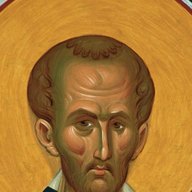
St. John ChrysostomHomily 12 on Romans · on Romans 7:1
Since then he had said, we are "dead to sin," he here shows that not sin only, but also the Law, hath no dominion over them. But if the Law hath none, much less hath sin: and to render his language palatable, he uses a human example to make this plain by. And he seems to be stating one point, but he sets down at once…
For the woman which hath an husband is bound by the law to her husband so long as he liveth; but if the husband be dead, she is loosed from the law of her husband.
St. John ChrysostomHomily 12 on Romans · on Romans 7:2–3
Next, after hinting this at the commencement, he carries on what he has to say by way of proof, in the woman's case, in the following way. "For the woman which hath an husband is bound by the Law to her husband, so long as he liveth: but if the husband be dead, she is loosed from the Law of her husband. So then, if…
So then if, while her husband liveth, she be married to another man, she shall be called an adulteress: but if her husband be dead, she is free from that law; so that she is no adulteress, though she be married to another man.
Wherefore, my brethren, ye also are become dead to the law by the body of Christ; that ye should be married to another, even to him who is raised from the dead, that we should bring forth fruit unto God.
St. John ChrysostomHomily 12 on Romans · on Romans 7:4
Now it is not on this only he grounds his exhortation, but also on the superiority of this second husband. And so he proceeds: "that ye should be married to another, even to Him Who is raised from the dead." Then to prevent their saying, If we do not choose to live with another husband, what then? For the Law does not…
St. John ChrysostomHomily 12 on Romans · on Romans 7:5
You see then the gain to be got from the former husband! And he does not say when we were in the Law, so in every passage shrinking from giving a handle to heretics; but "when we were in the flesh," that is, in evil deeds, in a carnal life. What he says then is, not that they were in the flesh before, but now they…
But now we are delivered from the law, that being dead wherein we were held; that we should serve in newness of spirit, and not in the oldness of the letter.
St. John ChrysostomHomily 12 on Romans · on Romans 7:6
See how he again in this place spares the flesh and the Law. For he does not say that the Law was made of no effect, or that the flesh was made of no effect, but that we were made of no effect (i.e., were delivered). And how were we delivered? Why by the old man, who was held down by sin, being dead and buried. For…
What shall we say then? Is the law sin? God forbid. Nay, I had not known sin, but by the law: for I had not known lust, except the law had said, Thou shalt not covet.
St. John ChrysostomHomily 12 on Romans · on Romans 7:7
Even before this he had been saying, that "the motions of sins, which were by the Law did work in our members": and, "sin shall have no dominion over you, for ye are not under the Law." And that "where no law is, there is no transgression." And, "but the Law came in, that the offence might abound"; and, "the Law…
St. John ChrysostomHomily 12 on Romans · on Romans 7:8
Do you see how he has cleared it of all blame? For "sin," he says, "taking occasion by the commandment," it was, and not the Law, that increased the concupiscence, and the reverse of the Law's intent was brought about. This came of weakness, and not of any badness. For when we desire a thing, and then are hindered of…
St. John ChrysostomHomily 12 on Romans · on Romans 7:9
When, pray, was that? Before Moses. See how he sets himself to show that it, both by the things it did, and the things it did not do, weighed down human nature. For when "I was alive without the Law," he means, I was not so much condemned. "But when the commandment came, sin revived, and I died." This seems indeed to…
St. John ChrysostomHomily 12 on Romans · on Romans 7:10
For what took place was not the natural thing,-their being injured by things profitable. And this is why he says "And the commandment, which was ordained to life, I found to be unto death." He does not say, "it was made," or "it brought forth" death, but "was found," so explaining the novel and unusual kind of…
St. John ChrysostomHomily 12 on Romans · on Romans 7:12
But, if ye be so minded, we will bring before you the language of those who wrest these declarations. For this will make our own statements clearer. For there are some that say, that he is not here saying what he does of the Law of Moses, but some take it of the law of nature; some, of the commandment given in…
Was then that which is good made death unto me? God forbid. But sin, that it might appear sin, working death in me by that which is good; that sin by the commandment might become exceeding sinful.
St. John ChrysostomHomily 12 on Romans · on Romans 7:13
That is, that it might be shown what great evil sin is, namely, a listless will, an inclinableness to the worse side, the actual doing, and the perverted judgment. For this is the cause of all the evils; but he amplifies it by pointing out the exceeding grace of Christ, and teaching them what an evil He freed the…
St. John ChrysostomHomily 13 on Romans · on Romans 7:14
After having said that great evils had taken place, and that sin, taking occasion by the commandment, had grown stronger, and the opposite of what the Law mainly aimed at had been the result, and after having thrown the hearer into a great deal of perplexity, he goes on next to give the rationale of these events,…
St. John ChrysostomHomily 13 on Romans · on Romans 7:15
What does the "I know not" mean?-I am ignorant. And when could this ever happen? For nobody ever sinned in ignorance. Seest thou, that if we do not receive his words with the proper caution, and keep looking to the object of the Apostle, countless incongruities will follow? For if they sinned through ignorance, then…
St. John ChrysostomHomily 13 on Romans · on Romans 7:16
You see here, that the understanding is not yet perverted, but keeps up its own noble character even during the action. For even if it does pursue vice, still it hates it the while, which would be great commendation, whether of the natural or the written Law. For that the Law is good, is (he says) plain, from the fact…
St. John ChrysostomHomily 13 on Romans · on Romans 7:17–18
On this text, those who find fault with the flesh, and contend it was no part of God's creation, attack us. What are we to say then? Just what we did before, when discussing the Law: that as there he makes sin answerable for everything so here also. For he does not say, that the flesh worketh it, but just the…
For I know that in me (that is, in my flesh,) dwelleth no good thing: for to will is present with me; but how to perform that which is good I find not.
St. John ChrysostomHomily 13 on Romans · on Romans 7:19–20
Do you see, how he acquits the essence of the soul, as well as the essence of the flesh, from accusation, and removes it entirely to sinful actions? For if the soul willeth not the evil, it is cleared: and if he does not work it himself, the body too is set free, and the whole may be charged upon the evil moral…
St. John ChrysostomHomily 13 on Romans · on Romans 7:21
What he says is not very clear. What then is it that is said? I praise the law, he says, in my conscience, and I find it pleads on my side so far as I am desirous of doing what is right, and that it invigorates this wish. For as I feel a pleasure in it, so does it yield praise to my decision. Do you see how he shows,…
St. John ChrysostomHomily 13 on Romans · on Romans 7:23
Here again he calls sin a law warring against the other, not in respect of good order, but from the strict obedience yielded to it by those who comply with it. As then it gives the name of master to Mammon, and of god to the belly, not because of their intrinsically deserving it, but because of the extreme…
St. John ChrysostomHomily 13 on Romans · on Romans 7:24
Do you notice what a great thraldom that of vice is, in that it overcomes even a mind that delighted in the Law? For no one can rejoin, he means, that I hate the Law and abhor it, and so sin overcomes me. For "I delight in it, and consent to it," and flee for refuge to it, yet still it had not the power of saving one…
St. John ChrysostomHomily 13 on Romans · on Romans 7:25
Observe how he shows the necessity of having grace present with us, and that the well-doings herein belong alike to the Father and the Son. For if it is the Father Whom he thanketh, still the Son is the cause of this thanksgiving. But when you hear him say, "Who shall deliver me from the body of this death?" do not…
Every note is a real passage, quoted word for word from a published English translation, with its source. Nothing here is summarised or written by us. Some verses have many notes and some have none, because the Fathers wrote more on some passages than others.
St. John Chrysostom, Homilies on Romans, Nicene and Post-Nicene Fathers, series 1, vol. 11 (1888–1889).
Scripture: the King James Version (1611); the Greek (tap Ελ) is the 1904 Patriarchal text of the Ecumenical Patriarchate.
All of these translations are in the public domain. The passages were matched to their verses by the Historical Christian Commentaries project, which also hosts the full texts we link to. The Fathers are a treasury of the Church's mind, and they are best read alongside the life of the Church: if a passage raises a question, bring it to your priest.