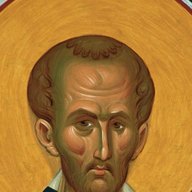
St. John ChrysostomHomily 13 on Romans · on Romans 8:1
Then as the fact that many fall into sin even after baptism presented a difficulty, he consequently hastened to meet it, and says not merely "to them that are in Christ Jesus," but adds, "who walk not after the flesh;" so showing that all afterward comes of our listlessness. For now we have the power of walking not…
St. John ChrysostomHomily 13 on Romans · on Romans 8:2
It is the Spirit he is here calling the law of the Spirit. For as he calls sin the law of sin, so he here calls the Spirit the law of the Spirit. And yet he named that of Moses as such, where he says, "For we know that the Law is spiritual." What then is the difference? A great and unbounded one. For that was…
For what the law could not do, in that it was weak through the flesh, God sending his own Son in the likeness of sinful flesh, and for sin, condemned sin in the flesh:
St. John ChrysostomHomily 13 on Romans · on Romans 8:3
Again, he seems indeed to be disparaging the Law. But if any one attends strictly, he even highly praises it, by showing that it harmonizes with Christ, and gives preference to the same things. For he does not speak of the badness of the Law, but of "what it could not do;" and so again, "in that it was weak," not, "in…
St. John ChrysostomHomily 13 on Romans · on Romans 8:4
What meaneth this word, righteousness? Why, the end, the scope, the well-doing. For what was its design, and what did it enjoin? To be without sin. This then is made good to us now through Christ. And the making a stand against it, and the getting the better of it, came from Him. But it is for us to enjoy the victory.…
St. John ChrysostomHomily 13 on Romans · on Romans 8:5
Yet even this is no disparaging of the flesh. For so long as it keeps its own place, nothing amiss cometh to pass. But when we let it have its own will in everything, and it passes over its proper bounds, and rises up against the soul, then it destroys and corrupts everything, yet not owing to its own nature, but to…
St. John ChrysostomHomily 13 on Romans · on Romans 8:6
He does not speak of the nature of the flesh, or the essence of the body, but of being carnally "minded," which may be set right again, and abolished. And in saying thus, he does not ascribe to the flesh any reasoning power of its own. Far from it. But to set forth the grosser motion of the mind, and giving this a…
St. John ChrysostomHomily 13 on Romans · on Romans 8:7
"Because the carnal mind is enmity against God:" and this is worse than death. Then to show how it is at once death and enmity; "for it is not subject to the Law of God," he says, "neither indeed can be." But be not troubled at hearing the "neither indeed can be." For this difficulty admits of an easy solution. For…
So then they that are in the flesh cannot please God.
οἱ δὲ ἐν σαρκὶ ὄντες Θεῷ ἀρέσαι οὐ δύνανται.
St. John ChrysostomHomily 13 on Romans · on Romans 8:8
What then? Are we, it will be said, to cut our bodies in pieces to please God, and to make our escape from the flesh? and would you have us be homicides, and so lead us to virtue? You see what inconsistencies are gendered by taking the words literally. For by "the flesh" in this passage, he does not mean the body, or…
But ye are not in the flesh, but in the Spirit, if so be that the Spirit of God dwell in you. Now if any man have not the Spirit of Christ, he is none of his.
St. John ChrysostomHomily 13 on Romans · on Romans 8:9
Here again, he does not mean flesh absolutely, but such sort of flesh, that which was in a whirl and thraldom of passions. Why then, it may be said, does he not say so, nor state any difference? It is to rouse the hearer, and to show that he that liveth aright is not even in the body. For inasmuch as it was in a…
St. John ChrysostomHomily 13 on Romans · on Romans 8:10
Again, what is good he applies to them, and the distressing part was short and parenthetic. And that which is an object of desire, is on either side of it, and put at length too, so as to throw the other into shade. Now this he says, not as affirming that the Spirit is Christ, far from it, but to show that he who hath…
But if the Spirit of him that raised up Jesus from the dead dwell in you, he that raised up Christ from the dead shall also quicken your mortal bodies by his Spirit that dwelleth in you.
St. John ChrysostomHomily 13 on Romans · on Romans 8:11
Again, he touches the point of the Resurrection, since this was the most encouraging hope to the hearer, and gave him a security from what had happened unto Christ. Now be not thou afraid because thou art compassed about with a dead body. Let it have the Spirit, and it shall assuredly rise again. What then, shall the…
St. John ChrysostomHomily 14 on Romans · on Romans 8:12–13
After showing how great the reward of a spiritual life is, and that it maketh Christ to dwell in us, and that it quickeneth our mortal bodies, and wingeth them to heaven, and rendereth the way of virtue easier, he next fitly introduces an exhortation to this purpose. "Therefore" we ought "not to live after the flesh."…
St. John ChrysostomHomily 14 on Romans · on Romans 8:14
"For as many as are led by the Spirit of God, they are the sons of God." Now this is again a much greater honor than the first. And this is why he does not say merely, As many as live by the Spirit of God, but, "as many as are led by the Spirit of God," to show that he would have Him use such power over our life as a…
St. John ChrysostomHomily 14 on Romans · on Romans 8:15
"For ye have not received the spirit of bondage again to fear." Then not staying to mention that which stands in contradistinction to bondage, that is, the spirit of freedom, he has named what is far greater, that of adoption, through which he at the same time brings in the other, saying, "But ye have received the…
St. John ChrysostomHomily 14 on Romans · on Romans 8:16
"The Spirit Itself beareth witness with our spirit, that we are the children of God." For it is not from the language merely, he says, that I make my assertion, but from the cause out of which the language has its birth; since it is from the Spirit suggesting it that we so speak. And this in another passage he has put…
St. John ChrysostomHomily 14 on Romans · on Romans 8:17
"And if children, then heirs." Observe how he enhances the Gift by little and little. For since it is a possible case to be children, and yet not become heirs (for it is not by any means all children that are heirs), he adds this besides-that we are heirs. But the Jews, besides their not having the same adoption as…
St. John ChrysostomHomily 14 on Romans · on Romans 8:18
In what went before, he requires of the spiritual man the correcting of his habits, where he says, "Ye are not debtors to live after the flesh," that such an one, for instance, should be above lust, anger, money, vainglory, grudging. But here having reminded them of the whole gift, both as given and as to come, and…
St. John ChrysostomHomily 14 on Romans · on Romans 8:19–20
"For the earnest expectation of the creation waiteth," he says, "for the revelation of the sons of God. For the creation was made subject to vanity, not willingly, but by reason of him who hath subjected the same in hope." And the meaning is something of this kind. The creation itself is in the midst of its pangs,…
St. John ChrysostomHomily 14 on Romans · on Romans 8:21
"That the creature itself also shall be delivered from the bondage of corruption." Now what is this creation? Not thyself alone, but that also which is thy inferior, and partaketh not of reason or sense, this too shall be a sharer in thy blessings. For "it shall be freed," he says, "from the bondage of corruption,"…
St. John ChrysostomHomily 14 on Romans · on Romans 8:22
"For we know that the whole creation groaneth and travaileth in pain together until now." Observe, how he shames the hearer, saying almost, Be not thou worse than the creation, neither find a pleasure in resting in things present. Not only ought we not to cling to them, but even to groan over the delay of our…
And not only they, but ourselves also, which have the firstfruits of the Spirit, even we ourselves groan within ourselves, waiting for the adoption, to wit, the redemption of our body.
St. John ChrysostomHomily 14 on Romans · on Romans 8:23
"And not only they, but ourselves also, which have the first-fruits of the Spirit, even we ourselves groan within ourselves." That is, having had a taste of the things to come. For even if any should be quite stone hard, he means what has been given already is enough to raise him up, and draw him off from things…
St. John ChrysostomHomily 14 on Romans · on Romans 8:24
"For we are saved by hope," he says. Now since he had dwelt upon the promise of the things to come, and this seemed to pain the weaker hearer, if the blessings are all matter of hope; after proving before that they are surer than things present and visible, and discoursing at large on the gifts already given, and…
St. John ChrysostomHomily 14 on Romans · on Romans 8:25
"But if we hope for that we see not, then do we with patience wait for it." That is, if thou art to be looking for everything in this world, what need is there for hope? What is hope then? It is feeling confidence in things to come. What great demand then doth God make upon thee, since He Himself giveth thee blessings…
Likewise the Spirit also helpeth our infirmities: for we know not what we should pray for as we ought: but the Spirit itself maketh intercession for us with groanings which cannot be uttered.
St. John ChrysostomHomily 14 on Romans · on Romans 8:26
"Likewise the Spirit also helpeth our infirmities." For the one point is thy own, that of patience, but the other comes of the Spirit's furnishings, Who also cherisheth thee unto this hope, and through it again lighteneth thy labors. Then that thou mightest know that it is not in thy labors only and dangers that this…
St. John ChrysostomHomily 14 on Romans · on Romans 8:27
"But He that searcheth the hearts." You see that it is not about the Comforter that he is speaking, but about the spiritual heart. Since if this were not so, he ought to have said, "He that searcheth" the Spirit. But that thou mayest learn that the language is meant of a spiritual man, who has the gift of prayer, he…
St. John ChrysostomHomily 15 on Romans · on Romans 8:28
Here he seems to me to have mooted this whole topic with a view to those who were in danger; or, rather, not this only, but also what was said a little before this. For the words, "the sufferings of this present time are not worthy to be compared with the glory which shall be revealed in us;" and those, that "the…
St. John ChrysostomHomily 15 on Romans · on Romans 8:29
"For whom He did foreknow, He also did predestinate to be conformed to the Image of His Son." See what superb honor! for what the Only-begotten was by Nature, this they also have become by grace. And still he was not satisfied with this calling of them conformed thereto, but even adds another point, "that He might be…
St. John ChrysostomHomily 15 on Romans · on Romans 8:30
"Moreover whom He did pre-destinate, them He also called; and whom He called, them He also justified." Now He justified them by the regeneration of the layer. "And whom He justified, them He also glorified" by the gift, by the adoption.
St. John ChrysostomHomily 15 on Romans · on Romans 8:31
"What shall we then say to these things?" As if he should say, Let me then hear no more about the dangers and the malicious devices from every quarter. For even if some disbelieve the things to come, still they have not a word to say against the good things that have already taken place; as, for instance, the…
St. John ChrysostomHomily 15 on Romans · on Romans 8:32
"He that spared not His own Son, but delivered Him up for us all, how shall He not with Him also freely give us all things?" And here the words he uses are high-wrought and exceedingly warm, to show his love. How then is He to neglect us, in whose behalf "He spared not His own Son, but delivered Him up for us all? For…
Who shall lay any thing to the charge of God’s elect? It is God that justifieth.
τίς ἐγκαλέσει κατὰ ἐκλεκτῶν Θεοῦ; Θεὸς ὁ δικαιῶν·
St. John ChrysostomHomily 15 on Romans · on Romans 8:33
"Who shall lay anything to the charge of God's elect?" Here he is against those who say, that faith is no profit, and will not believe the complete change. And see how swiftly he stops their mouths, by the worthiness of Him that elected. He does not say, "Who shall lay anything to the charge of God's" servants? or of…
Who is he that condemneth? It is Christ that died, yea rather, that is risen again, who is even at the right hand of God, who also maketh intercession for us.
St. John ChrysostomHomily 15 on Romans · on Romans 8:34
"Who is He that condemneth?" He does not say, it is God that forgave our sins, but what is much greater, "It is God that justifieth." For when the Judge's sentence declares us just, and a Judge such as that too, what signifieth the accuser? Hence neither is it right to fear temptations, for God is for us, and hath…
St. John ChrysostomHomily 15 on Romans · on Romans 8:35
"Who shall separate us from the love of Christ?" And he does not say of God, so indifferent is it to him whether he mentions the Name of Christ or of God. "Shall tribulation, or distress, or persecution, or famine, or nakedness, or peril, or sword?" Observe the blessed Paul's judgment. For he does not mention the…
St. John ChrysostomHomily 15 on Romans · on Romans 8:36
"For Thy sake we are killed all the day long, we are accounted as sheep for the slaughter." That is, we are exposed to all to be evil entreated of them. But yet against so many and so great dangers and these recent horrors, the object of our conflicts is given as a sufficient consolation, or rather not sufficient…
St. John ChrysostomHomily 15 on Romans · on Romans 8:37
"Nay, in all these things we are more than conquerors through Him that loved us." For what is indeed wonderful is this, not that we are conquerors only, but that we are so by the very things meant as plots against us. And we are not merely conquerors, but we are "more than conquerors," that is, are so with ease,…
St. John ChrysostomHomily 15 on Romans · on Romans 8:38–39
"For I am persuaded, that neither death nor life, nor angels, nor principalities, nor powers, nor things present, nor things to come, nor height, nor depth, nor any other creature, shall be able to separate us from the love of God, which is in Christ Jesus our Lord." And here the words he uses are high-wrought and…
Every note is a real passage, quoted word for word from a published English translation, with its source. Nothing here is summarised or written by us. Some verses have many notes and some have none, because the Fathers wrote more on some passages than others.
St. John Chrysostom, Homilies on Romans, Nicene and Post-Nicene Fathers, series 1, vol. 11 (1888–1889).
Scripture: the King James Version (1611); the Greek (tap Ελ) is the 1904 Patriarchal text of the Ecumenical Patriarchate.
All of these translations are in the public domain. The passages were matched to their verses by the Historical Christian Commentaries project, which also hosts the full texts we link to. The Fathers are a treasury of the Church's mind, and they are best read alongside the life of the Church: if a passage raises a question, bring it to your priest.